
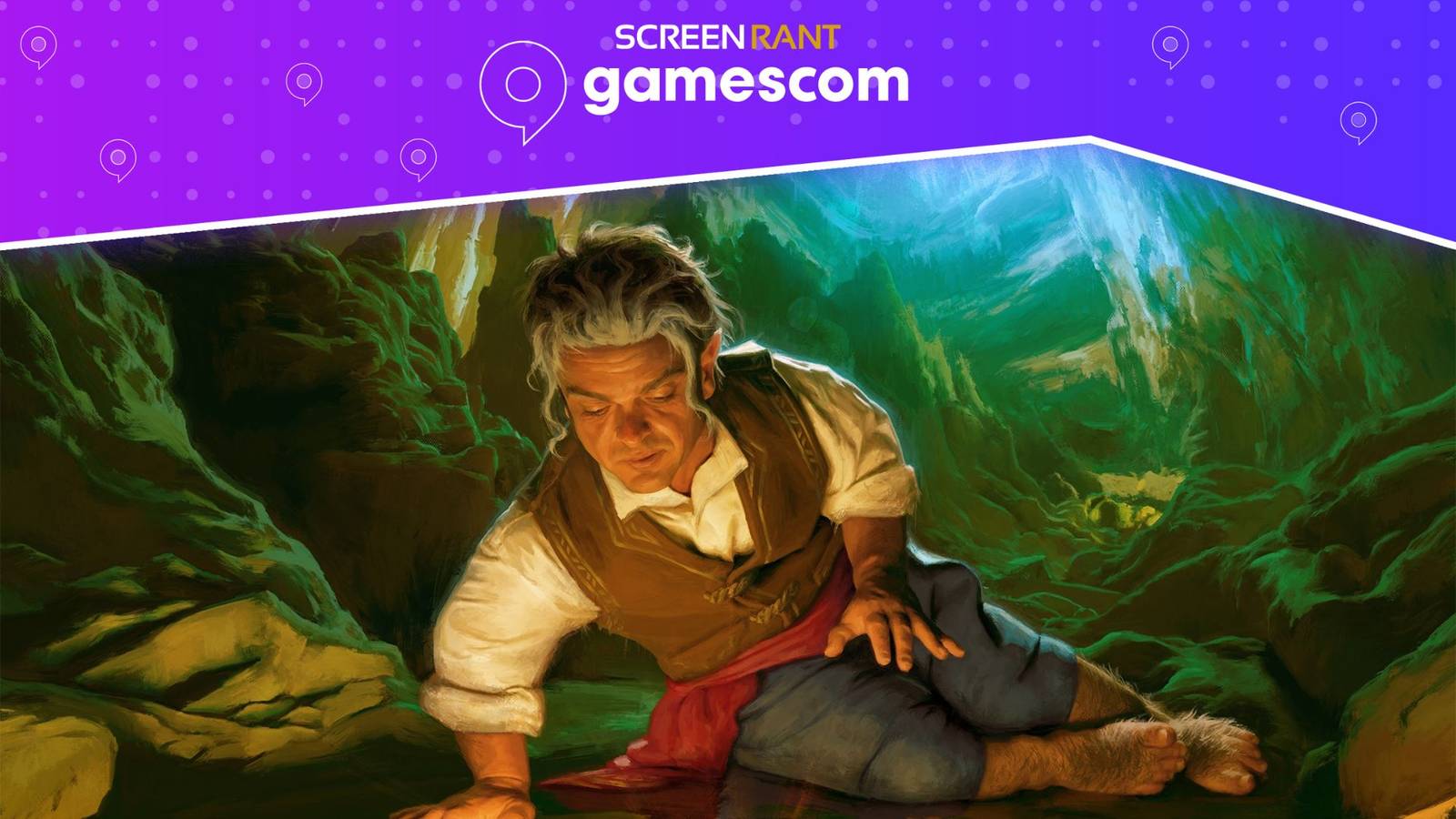
Published Sep 6, 2026, 12:31 PM EDT James is a gaming writer from London who has spent thousands of hours exploring titles from every genre. Though he has a particular affinity for multiplayer titles like World of Warcraft, Destiny 2 and League of Legends, he has also put thousands of hours into single-player experiences, from deep RPGs to epic PC strategies. When he's not playing or writing, he can usually be found supporting his beloved Brentford FC. Magic: The Gathering's forays into Middle-earth have been some of the more exciting sets in recent years. As well as the fact that the immensely rich world that Tolkien managed to construct gives the boffins over at Wizards of the Coast all the ammo they need to create some truly solid cards, the unique style of the illustrations in the books (and films) gives them a great palette to work with for collectors. With the set out in the wild and now it's had a little time to settle down, we sat down with Principal Game Designer Gavin Verhey to discuss everything that went into The Hobbit release, as well as getting the lowdown on exactly what players can expect from those special signature cards in the upcoming Star Trek drop. A World Richer Than Any Other Anybody who follows Tolkien adaptations closely will know that the movie adaptations of The Hobbit were considerably more divisive than The Lord of the Rings (though even that had its controversies at the time). As such, it was probably a relief to many when the MTG adaptation chose to put the original book front and center, along with the artwork that defined its various editions over the years. "We worked with Middle-earth Enterprises on the set and we could have gone in a lot of directions," Verhey explains. "We had the license to do the books and, honestly, to me, The Hobbit book is The Hobbit. That is The Hobbit that we know and love and think about. We really did take the book page by page and went through it trying to figure out what to put in, but it also meant that with our cards and characters we got to reimagine them a little bit too. It's not just an actor's likeness from the screen, it is our version of Gollum, our version of Bilbo, and I think that's a lot of fun too." Not only that, but the reduced scope of The Hobbit, which was first published long before the big trilogy, actually gave the designers more freedom, not less. "With The Lord of the Rings you're taking three iconic fantasy books that are large and condensing them into a single Magic set, so we did have to leave some things on the cutting room floor. We got a lot in, but I had to leave things on the cutting room floor, whereas with The Hobbit we could really let that breathe," Verhey said. "Going page by page and see what left into the story and that's great because you don’t only get the characters you love like Bilbo, Gandalf and so on, but you also get some cute little bits of the world. You get some bears that are just hanging out, you get a bee something. I love that line from Beorn's garden, so we put that in there. I think that really built up the world in a satisfying way." The Hobbit Is A Great Set For New Players It's no secret that there are plenty of Magic: The Gathering sets that really wouldn't serve as great introductions to the game for new players. Though many of the more complex releases come from outside the scope of Universes Beyond, The Hobbit really is a very well-suited set for those who recently got into the game for the first time. As Verhey explains, this was absolutely a deliberate part of the set's design. "There's still some rares and Mythics that are wacky and do bananas stuff, but a lot of mechanics are very approachable. If you compare it to The Lord of the Rings set from a few years ago, the mechanics in that set, like The Ring Tempts You, are a lot more complex than what's going on here," Verhey explains. "I'm not saying it's simple to play. The games are still dynamic and there's a lot going on, but Amass Goblins, Recruit, even Storied (mechanics featured in the set) are all things that are pretty easy to approach and pick up. In game design, we like to think of things on a one-through-five complexity scale, and some sets should be more complex. "I'll give you a great example. We're about to go to Reality Fractured, which is our next Magic in-world set and that is the capstone of this huge story that Jace has been building toward. And as a result, we expect a lot of the enfranchised players to love this set and dive into it. So we're going to give it a little more on complexity points, right? We're going to really dial that in for the experienced fans. That's more of a four out of five on the complexity scale. The Hobbit, on the flip side, we're going to tone that down a little bit. It's more like a two out of five on the complexity scale. It's not totally simple. It's not a brand-new beginner's product, but it is a little on the other side of the spectrum." Mechanics That Are Here To Stay The release of The Hobbit set also brings in several new and relatively new mechanics, some of which were mentioned in the answer above. Happily, these largely aren't going to be a flash in the pan, and players can expect to see most, if not all, of them in future sets, though some will admittedly be a lot more niche than others. "Storied and Recruit are both new. Amassed Goblins is technically kind of new, although Amassed is a returning mechanic. And then Hone appears here for the first time, although I'm happy to tell you that Hone will be appearing in the future as well. Amass we've used several times now. It is a fantastic mechanic for showing off armies growing. I don't know if Amass Goblins specifically [will reappear], but I can almost guarantee you'll see more Amass in the future. That'll happen," Verhey explains. "Recruit is something new here. This is a brand-new mechanic. It's a riff on Connive, another mechanic that involves drawing a card and discarding a card to get a bonus. I think it plays pretty well. I think people seem to like it. The name is pretty generic. I can totally imagine us using it in a future set. I don't have a slam dunk place for it, but it's a nice mechanic you can certainly bring back. "Storied is a lot more specific to what's going on here. While it doesn't have a name that is necessarily tied into The Hobbit, caring about artifacts, Legendary Creatures, sagas, is very much something that is specific and requires a certain set to use. Not saying it couldn't appear somewhere else, but it's a lot more of a niche mechanic. I would not expect to see a ton of in the future. "Finally, Hone. Hone is something that came out of a hackathon. Inside game design, we have these hackathons where we spend about a week and a half, ripping on new ideas. We had a mechanics-focused one, and one of the ideas was what can Red do that builds up? So that was born in a hackathon several years ago, and we finally had a place to put it in The Hobbit. You'll see it used more in the future as well." Up Next, Star Trek Wizards of the Coast The next big step for MTG's Universes Beyond is the release of the Star Trek scope, and as well as being considerably grander in scope than The Hobbit, there are also some genuinely unique features that could make it a set like no other. At the top of that list are the signature cards, hand-signed by actors from various iterations of the show. As Verhey explains, they really have gone all out for what will be guaranteed collector's items. "Star Trek is celebrating its 60th anniversary this year and there are 60 years of content we've tried to get right there. There are more Star Trek episodes than Magic cards and all the products combined, so that's something to consider, We literally cannot put every single episode onto a card even if we wanted to. There's a lot of material to go through and it made sense to do something expansive. Star Trek is also such a foundational piece of geek culture, right? It makes sense to tap into all of that. "We captured everything from all 60 years. I mean, sorry, not literally everything. We captured every show from all 60 years, all the stuff players love. We want to make sure to remember all of that in the set. The really important thing I want to stress about the Signature cards is that it's something we've never done before on anything. We literally got the cards to the actors and had them physically sign each and every one of those cards. "In our booster packs, for example, on the art cards, there’s sometimes a printed signature sometimes, or in THBV and Ninja Turtles, we have a printed signature on some of those headliner cards, but these are literally hand signed. William Shatner and Kate Mulgrew for Janeway and Patrick Stewart and so on literally hand-signed these cards, which is pretty amazing." Magic: The Gathering really does feel like it's in as good a place as it has been in years, and part of that has been how well balanced the sets have been. With Star Trek set to be a lot broader than most we have seen recently, it'll be interesting to see if the complaints about saturation crop up again. Video Game(s) Magic: The Gathering, Magic the Gathering Commander, Magic: The Gathering - Battlegrounds, Magic the Gathering: Duels of the Planeswalkers 2012, Magic: The Gathering - Duels of the Planeswalkers, Magic: The Gathering – Duels of the Planeswalkers 2012, Magic: The Gathering – Duels of the Planeswalkers 2013, Magic: The Gathering – Duels of the Planeswalkers 2014, Magic: The Gathering Arena Created by Richard Garfield Main Genre Fantasy Release Date August 5, 1993 Character(s) Jace Beleren, Chandra Nalaar, Liliana Vess, Garruk Wildspeaker, Nissa Revane, Ajani Goldmane, Nicol Bolas, Teferi, Gideon Jura, Sorin Markov, Ral Zarek
Magic: The Gathering Game Director Gavin Verhey On The Hobbit Release And Those Very Special Star Trek Signature Cards
Full Article
Original Source
Read the full article at Screenrant →KhanList aggregates and links to publicly available news content. We do not host full articles from third-party sources. Always verify important information with original sources.