
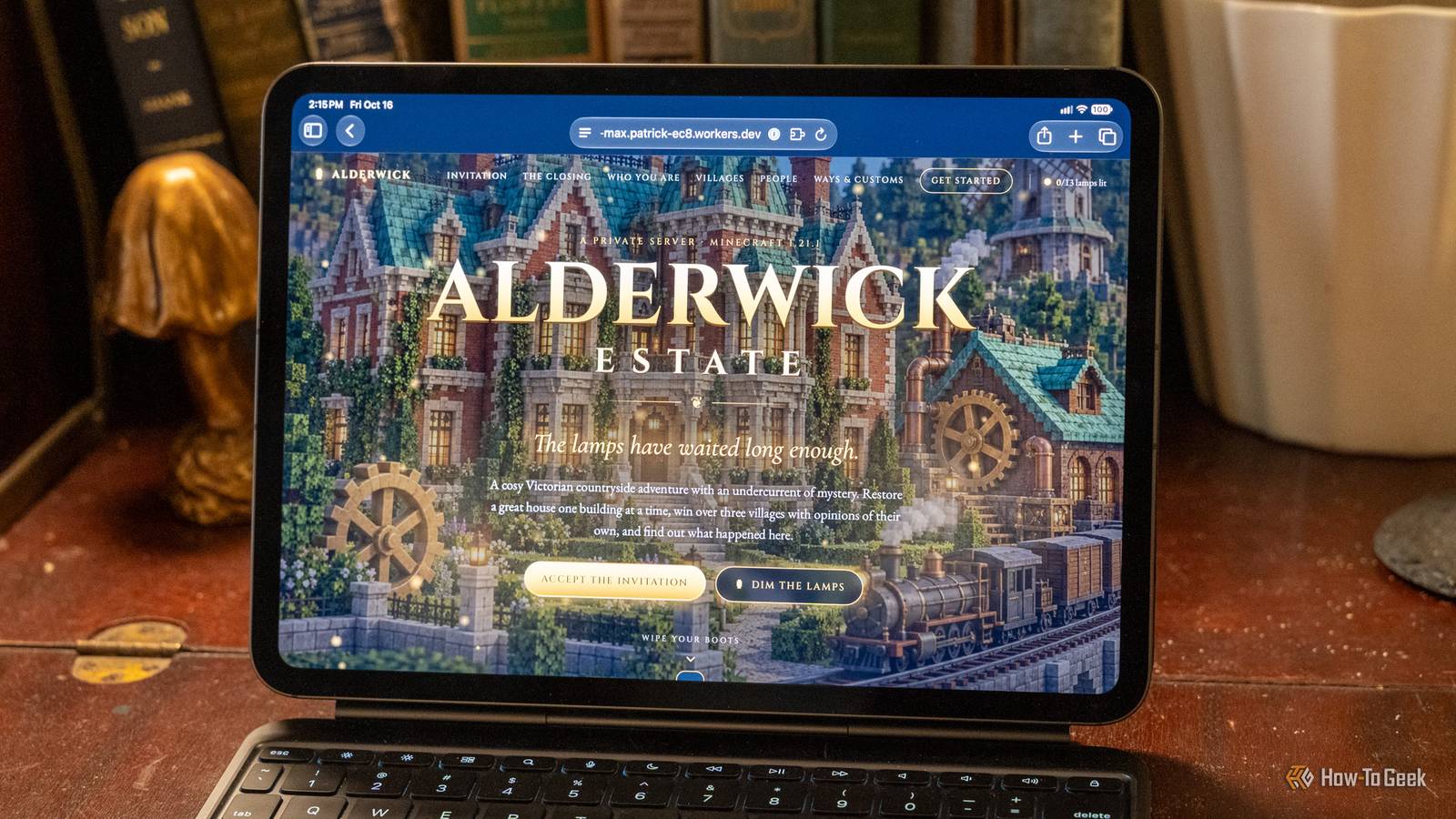
Published Oct 19, 2026, 10:30 AM EDT Patrick Campanale has been in the tech space for well over a decade, specializing in PC/gaming news and reviews, as well as maker-focused products to build small businesses. With a start in technology back in 2010 surrounding the Palm/webOS ecosystem, Patrick spent his formative years developing mobile applications as well as blogging for various publications, eventually leading to starting his own website in 2014. After running a technology blog for a few years, he stepped out of that role and into the world of high-end custom PC manufacturing and building, with a focus on YouTube video production and overclocking. Then, in 2017, Patrick joined the 9to5Toys team as an editor/writer/reviewer with over 14,000 articles being published during his time there, ranging from deals and roundups to in-depth reviews on the latest technology, video games, 3D printers, and more. In his free time, Patrick loves to create projects from wood using various robots and methods, including leveraging the technologies of CNCs and lasers. If Patrick isn't working on a computer or playing video games, he's likely in his 2-car garage workshop creating something unique. In addition to all this, Patrick is also the media director at his local church where he feels God has called him to serve, and he loves every minute of it. Sign in to your How-To Geek account I've long wondered what the different reasoning efforts of an AI model actually change when doing things like making websites, so I decided to try the same website prompt on every Opus 5.5 reasoning level. The results genuinely surprised me. Every site got the same prompt No CLAUDE.md files, no prior instructions, just a fresh session I wanted to be fair with this test, so I had Claude write the prompt that it would use. I explained what type of site I wanted, and it gave me the prompt (included at the end of this post). The task was simple: ask Claude Code to create a website for me with every reasoning level of Opus 5.5, which I would then have Claude Code upload each website to Cloudflare Workers once 90created. Each prompt was run in a fresh session outside of all of my normal development folders so there would be no CLAUDE.md, AGENTS.md, or any other session files that would interfere with the experiment. The website would be one for a Minecraft modpack I'm designing—Alderwick Estate. I gave every session free creative rein to make the site pretty, fed it the facts and graphical assets for the modpack, and let it go. I was very surprised by the results. Low reasoning is fast, and you can (somewhat) tell Ninety seconds gets you started, not finished Opus 5.5 low Let's start off with the fastest website and lowest reasoning level—low. It's no surprise that the lowest reasoning level was also the fastest (and cheapest). It completed in just 1 minute 32 seconds and used around 10,600 output tokens, by far the lowest amount of tokens in the test. I showed all five sites to both colleagues here at How-To Geek and my wife. Nobody who looked at the sites picked the low reasoning effort as their favorite, but most said that it would be a passable site. I completely agree. This site took around a fifth of the tokens that every other level took to create, which makes it a fifth the cost to generate. It also is only about a quarter of the code, making it the lightest site of the bunch. Also, interestingly enough, low reasoning is the only effort level that didn't open the website to check it before calling it done. All the other reasoning efforts did that step without being asked. Overall though, if this was my one-prompt site and it was done in 90 seconds, I can't say that I'd be mad. I would want to do some tweaking to it, but the overall bones are honestly a really great starting point. Medium through max land closer together than you'd expect The jump from low to medium is the big one Let's get the technical side of things out of the way first. At medium reasoning, the site was generated in 6 minutes 35 seconds and used about 43,000 output tokens. High took 8 minutes 12 seconds and around 50,900 output tokens. Xhigh took 7 minutes 28 seconds and around 47,600 output tokens, and max reasoning took 9 minutes 25 seconds and 56,700 output tokens. Opus 5.5 max With that out of the way, how did the sites actually come out? I'd say very similar to each other, but max is a clear winner (to both my wife and me). Opus 5.5 xhigh Here's the thing though: I would be very happy with basically any of these for a one-shot website. Zero extra prompting was done after the sites were generated to tidy them up, and I really don't think they need any extra work. Opus 5.5 high Medium, if I had to pick, would probably be one of my least favorites. It definitely was my wife's least favorite. Of all the people who I showed the five sites to though, not a single person picked the low effort one as their favorite. Opus 5.5 medium The one thing that I've learned from generating these five sites is that each one has something I really like on it. I enjoy the wording of the low-effort, the font choice for the header of the medium, the lamp at the bottom of the high, the scallops of extra high, and basically everything about max. Every reasoning level built a site I'd be happy with At the end of the day, there's not a single one of these sites that I would be unhappy with. I think that's what surprised me the most—just how good every one of the sites was that Claude was able to generate. I did start out with having Claude write the prompt, so there might have been something to that side of things. But, you can also work with Claude to come up with the right prompt for your website before trying it. So, if you've been thinking that you need max reasoning to make a good website, think again. Go ahead, try it yourself. Let's build a website for Alderwick Estate, my Minecraft modpack. You have 10000% free creative reign and control here, make it pretty. It's a one-page site for friends I'm inviting to a private server, so they know what they're getting into. Keep it spoiler-free. Static files only (HTML, CSS, JS, no build step), all in the current directory, served by a plain static server. Don't deploy anything; just build it and stop when you're done. ## Art you can use The pack's existing key art is in `assets/`: - `assets/estate-art.webp` (1254×1254): the full painted pack thumbnail of the estate. - `assets/estate-art-720.webp`: the same art at 720px wide. - `assets/estate-scene.webp` (1254×900): the lower part of the same painting, cropped without the title. - `assets/og.jpg` (1200×630): a social share image. ## What the pack is A cosy Victorian countryside adventure for Minecraft 1.21.1 with an undercurrent of mystery: lamp-lit rooms, village gossip, old machines waking after a long sleep. Built on NeoForge, Create, MCA Reborn and FTB Quests, with 94 pinned mods. You restore a great estate one building at a time, get to know three villages that each have opinions about you, and find out what happened here. Danger exists in the wilds, some of it clearly signposted; retreating is always sensible. Tagline: "The lamps have waited long enough." **Why the estate is dark:** Three generations. Augustin built the house on a rise with a tall belvedere tower so he could see his orchards from his desk. Edmund, an engineer, filled the grounds with machinery and ran a railway to the town of Ironmere. Lenora ran the estate for decades: exacting, practical, never without a notebook. About twelve years ago, in a single season, she shut it all down. She stopped every machine by hand in a particular order, let the staff go with wages and references, closed the house room by room, and left. She never gave a public reason. Last winter Lenora died. Her will put the estate into a trust with two custodians' chairs. The machinery was put to sleep, not broken: the coach-house press, the mineral works, the windmill, the boiler house, the electric wires, the railway to Ironmere. In game, `/estate ledger` lists what each restoration needs. The staff's one remembered instruction: "Light first, then hands, then water." **Who you are:** The first player to join is always the Heir: Lenora's great-niece or great-nephew, raised far from the valley. Later players draw one identity from the will, kept for good, which changes greetings, which villages warm to them first, and the letters they receive: (I) Lenora's former ward, (II) a grandchild of the Harrow family, (III) a child of Ironmere's old foundry, (IV) the chief mechanic's last apprentice. Every identity has a story of its own. Don't look it up. **Three villages:** - *Alderwick*, the market village at the gates. Families worked at the house for three generations and still talk about "before the closing" and "after." Split down the middle about Lenora. Festivals: Charter Day (the founding charter read aloud; bring a chair) and Lamplighting Night (first frost). First impression: divided. - *Bramblemead*, an orchard village with a long memory. Tends the estate orchards on very old leases. Remembers the Drowning Week, when the mine flooded and the estate's pumps saved three trapped miners. Festivals: the Four-Day Bell and the Blossom Walk (dawn, in spring). First impression: warm. Calls Ironmere folk "clinkers." - *Ironmere*, a stern railway and metalworking town. Grew up around a foundry that burned down and a terminal that went quiet. Older folk call any hard year "a Long Cold year." Festival: Whistle Night, celebrated by beating anvils now that there are no engines. First impression: cold. Calls Bramblemead folk "pippins." All three meet each autumn at the Harvest Fair, where the Golden Apple goes to the best produce. **People:** Elias Ward (estate steward; formal, dryly funny, still says "Miss Lenora"; start with him). Mara Voss (Alderwick mechanic; blunt, brilliant; her mother was the estate's chief mechanic). Juniper Bell (Alderwick grocer and matchmaker; in a freight-rate war with Ironmere's stationmaster). Constable Hale (Alderwick law; slow, fair, procedural). Tomas Reed (Bramblemead miller; talks weather first; keeps a copy of something Lenora told him). Nell Finch (Bramblemead innkeeper; food before opinions). Orin Pike (Ironmere stationmaster; precise to the minute). Dr. Ada Wren (Ironmere electrical engineer; lectures in numbered points). Warden Crowe (Ironmere law; severe, consistent, strict about tools). **Talking to villagers:** Right-click with an empty hand to talk; anything typed in nearby chat gets an answer. Topic buttons unlock as the estate is restored and trust grows. Sneak + right-click opens the normal MCA screen and shop. Gossip isn't always accurate, and you can tell a chatty villager to hush. Without AI, villagers still answer with written lines, shops, requests and the law. Elias Ward's greeting: "Ah. You'll be the new custodian. Do wipe your boots; the foyer has had twelve quiet years and would like a thirteenth." **Skills:** Eleven skills, levelled by doing. Press K for skills, levels 1–50, each with a perk tree; skill XP is never lost, even on death. Quests never stall: if a step needs a level, you're raised to it after finishing the prior step. Machines use their owner's skills; unowned machines work at level one and can be claimed with a wrench. Training sites (ore rocks, regrowing trees, fishing spots, combat camps) sit around the estate. **The law and salvage:** Village chests, barrels and crops belong to someone. Theft is remembered, and so is help. Constables may ask for restitution or a short stay in the lock-up; running makes it worse; Ironmere fines industrial theft hardest. Ruins with a white placard are fair game: Old Rook Mill (rotten floors), Harrow Foundry (a fallen chimney), the Flooded Pumpworks (bring a boat), the Blackglass Works (high danger; leave if it turns). **Playing together:** A narrated fly-over plays on arrival (sneak to skip; `/estate intro` replays it). Villages notice whether custodians squabble or share. People say different things to each custodian. The library has books for the first night. The house is safe and lit from the first night. **Getting started:** 1) In CurseForge, Create Custom Profile → Import the Alderwick client ZIP; allocate 6 GB of memory (8 GB comfortable). 2) Multiplayer → Direct Connection with the address from your invitation; keep pinned mod versions and dismiss update prompts. 3) On first login MCA asks "Who are you?": keep your name, choose gender, pick Vanilla, Accept. 4) Open the Quest Book in slot one, read the introduction letter, find the steward. Useful keys and commands: K (skills and perks), `/estate ledger`, `/estate help`, `/estate intro`. **Credit line:** "Alderwick Estate is an original Minecraft modpack by Patrick Campanale. Not an official Minecraft product; not approved by or associated with Mojang or Microsoft."
Low effort Claude built a usable website in 90 seconds, and max only made it a little better
Full Article
Original Source
Read the full article at Howtogeek →KhanList aggregates and links to publicly available news content. We do not host full articles from third-party sources. Always verify important information with original sources.