
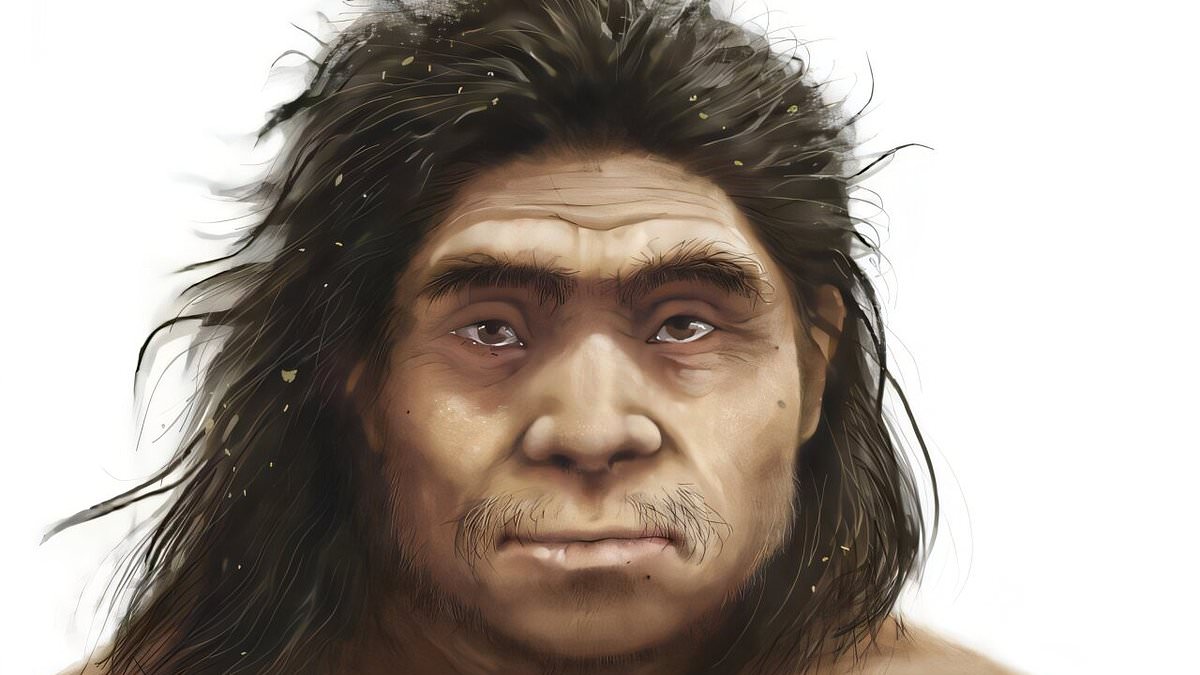
A study of rare fossils has revealed what our ancient human ancestors, the Denisovans, might have looked like.The Denisovans are a mysterious human species that lived across Asia between 300,000 and 40,000 years ago.However, little is known about these ancient humans because so few of their fossils have been discovered or identified.Now, researchers have managed to piece together skull and jaw fragments found in China to reveal the face of one of our distant relatives.Their reconstruction suggests that Denisovans shared some similarities with Neanderthals, but had strikingly distinct facial features.Denisovan skulls were relatively low and broad, with sides that ran almost straight back rather than curving inwards.They also had very large, jutting brow ridges above their eyes, as well as fairly broad cheekbones.Unlike some other ancient human relatives, the Denisovans also had somewhat flattened features, with a jaw and face that only jutted out a little. A study of rare fossils has revealed what our ancient human ancestors, the Denisovans, might have looked like (artist's impression)While Neanderthal remains are relatively abundant, including some almost complete skeletons, Denisovan fossils continue to be elusive.The species was first identified from a few tiny finger bones and scattered teeth found in 2008 by Russian archaeologists in the Denisova Cave in the Altai Mountains of Siberia.However, since fossil remains are so rare, anthropologists are almost entirely reliant on DNA analysis to identify which bones belonged to this cryptic species.In the following years, scientists have identified scattered fossils unearthed around Asia as Denisovan, including jawbones, ribs and skulls.This has helped scientists get a better picture of what the Denisovans were like and where they lived, but many questions still remain.In their new paper, published in the journal Nature, the researchers examined bones from two individuals found at the Xujiayao archaeological site in northern China between 1976 and 1979.Although it was suspected that the remains could be Denisovan, the researchers still needed to prove it.The team drilled tiny holes into the bones to gather powdered fossil samples and extracted the proteins still preserved inside. Researchers have managed to piece together skull and jaw fragments found in China to reveal the face of our distant relatives. This comes after scientists identified mysterious leg bones as belonging to Denisovans, an ancient human group that split from the Neanderthal lineage about 550,000 years agoIn total, they were able to identify 18 ancient proteins, analysing them alongside data from other ancient hominins and regular humans.Slight differences in these protein sequences act like tiny molecular markers, revealing where the fossils fit within the human family tree.The key discovery was a specific variation of the collagen protein, named COL1A2-996K, which has been found in Denisovan fossils but not in Neanderthals or modern humans.The researchers say that this discovery 'strongly supported their affiliation with the Denisovan lineage'.Having established that the fossils really are Denisovan, the researchers could now start piecing together what they would have looked like.The bones were measured and used to create 3D computer models of the reconstructed skull and jaw.Those digital models were then compared with the fossil remains of Neanderthals, modern humans, and other ancient human species.This comparison revealed that Denisovans had a mix of features from even more ancient hominins and characteristics shared by Neanderthals and later humans. The remains were found at the Xujiayao archaeological site (red star) between 1976 and 1979, but have only now been conclusively identified as belonging to Denisovans The fossils share key traits with unidentified remains found at sites across East Asia (illustrated), suggesting that they may belong to the same Denisovan lineage.For example, Denisovans shared similar skull and inner ear structures with Neanderthals, including a small hollow near the back of the skull.This comes after scientists identified two mysterious leg bones found on the seafloor as Denisovan remains.The fossils, which include part of a thigh bone and a shin bone, were recovered from the Penghu Channel between Taiwan and mainland China.Scientists estimated that the individual represented by the thigh bone stood around five feet 11in tall and weighed 183lb (83kg).The individual represented by the shin bone may have reached approximately six feet three inches and weighed 201lb (91kg).That means these Denisovans would have towered over their contemporary ancient humans, and even many modern people today.This new discovery also supports the idea that Denisovans were more widespread across Asia than previously thought.By confirming that these Northern Chinese remains were Denisovan, the researchers proved that the species ranged well beyond the cold Siberian caves or Tibetan mountains they are commonly associated with.Likewise, the fossils share key traits with unidentified remains found at sites across East Asia, suggesting that they may belong to the same Denisovan lineage.The researchers write: 'The inclusion of additional members of East Asian late Middle Pleistocene archaic Homo, alongside Xujiayao, expands the morphological variability of East Asian Denisovans.'THE DENISOVANS EXPLAINEDWho were they?The Denisovans are an extinct species of human that appear to have lived in Siberia and even down as far as southeast Asia.The individuals belonged to a genetically distinct group of humans that were distantly related to Neanderthals but even more distantly related to us. Although remains of these mysterious early humans have mostly been discovered at the Denisova Cave in the Altai Mountains in Siberia, DNA analysis has shown the ancient people were widespread across Asia. Scientists were able to analyse DNA from a tooth and from a finger bone excavated in the Denisova cave in southern Siberia.The discovery was described as 'nothing short of sensational.' In 2020, scientists reported Denisovan DNA in the Baishiya Karst Cave in Tibet.This discovery marked the first time Denisovan DNA had been recovered from a location that is outside Denisova Cave. How widespread were they?Researchers are now beginning to find out just how big a part they played in our history. DNA from these early humans has been found in the genomes of modern humans over a wide area of Asia, suggesting they once covered a vast range.They are thought to have been a sister species of the Neanderthals, who lived in western Asia and Europe at around the same time.The two species appear to have separated from a common ancestor around 200,000 years ago, while they split from the modern human Homo sapien lineage around 600,000 years ago.Last year researchers even claimed they could have been the first to reach Australia.Aboriginal people in Australia contain both Neanderthal DNA, as do most humans, and Denisovan DNA.This latter genetic trace is present in Aboriginal people at the present day in much greater quantities than any other people around the world. How advanced were they?Bone and ivory beads found in the Denisova Cave were discovered in the same sediment layers as the Denisovan fossils, leading to suggestions they had sophisticated tools and jewellery.Professor Chris Stringer, an anthropologist at the Natural History Museum in London, said: 'Layer 11 in the cave contained a Denisovan girl's fingerbone near the bottom but worked bone and ivory artefacts higher up, suggesting that the Denisovans could have made the kind of tools normally associated with modern humans.'However, direct dating work by the Oxford Radiocarbon Unit reported at the ESHE meeting suggests the Denisovan fossil is more than 50,000 years old, while the oldest 'advanced' artefacts are about 45,000 years old, a date which matches the appearance of modern humans elsewhere in Siberia.'Did they breed with other species?Yes. Today, around 5 per cent of the DNA of some Australasians – particularly people from Papua New Guinea – is Denisovans.Now, researchers have found two distinct modern human genomes - one from Oceania and another from East Asia - both have distinct Denisovan ancestry.The genomes are also completely different, suggesting there were at least two separate waves of prehistoric intermingling between 200,000 and 50,000 years ago.Researchers already knew people living today on islands in the South Pacific have Denisovan ancestry.But what they did not expect to find was individuals from East Asia carry a uniquely different type.
Look familiar? Rare fossils reveal what our ancient human relatives, the Denisovans, might have looked like
Full Article
Original Source
Read the full article at Dailymail →KhanList aggregates and links to publicly available news content. We do not host full articles from third-party sources. Always verify important information with original sources.