
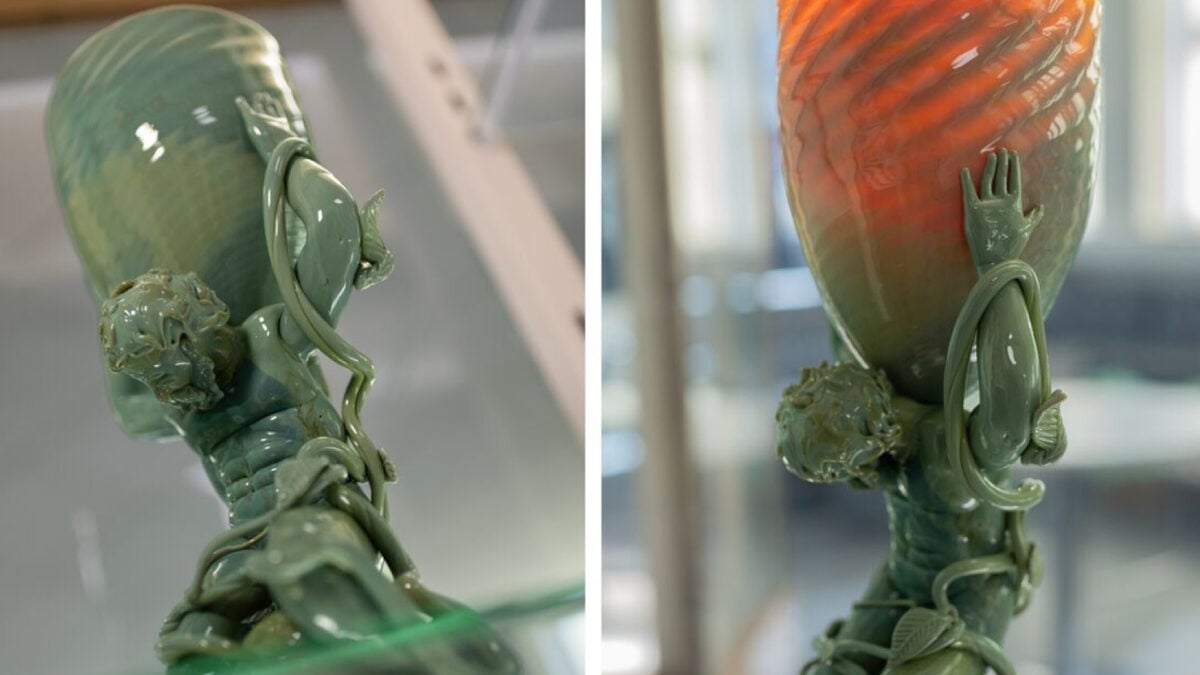
For years, the Lycurgus Cup has captivated art historians, glassmakers, and scientists. Crafted in the 4th century, the Roman cage cup’s glass body transforms from jade green to ruby red under a backlight—an effect modern scholars struggled to properly reproduce until now. In a recent announcement, the University of Sheffield in the U.K. reported that its experts had successfully emulated the optical effect observed in the Lycurgus Cup. For context, the cup is made of dichroic glass, a material that shifts color depending on the angle of view. Research conducted in the mid-20th century indicated that tiny nanoparticles of gold and silver—smaller than wavelengths of light—contributed to the unique color change. However, the team led by Lisa Hollands, a technical specialist in glass at ceramics at Sheffield, is the first to actually demonstrate a working, repeatable recipe in modern times. “I accepted the challenge knowing that it might not work, as I knew it wasn’t as simple as embedding nanoparticles off the shelf into a glass,” Hollands told Gizmodo. The project began as a request from the university’s photonics team for public outreach but grew into a “mini research project” with fascinating implications for science, she added. Impurities or genius trick? A 4th-century cage cup, currently displayed at the Heritage Museum Pljevlja, Montenegro. © Lazar Pejović via Wikimedia Commons According to the Corning Museum of Glass, cage cups are “among the rarest examples of Roman luxury glass.” For sure—you don’t need to be a professional glassmaker to appreciate the mastery required to craft an ornate “cage” over a glass cup. But the Lycurgus Cup is even rarer in that the design of its cage is figurative rather than geometric, Hollands explained. Most known cage cups have shells with circular geometric patterns. The Lycurgus Cup, on the other hand, depicts a graphic scene of King Lycurgus of Thrace being tormented by the Greek god Dionysus and his retainers. According to Hollands, previous scientific work used tiny chips of the glass and found “evidence of gold and silver layered nanoparticles,” about 3 parts gold to 7 parts silver, but not individual gold and silver particles. “The examination showed that the particles were typically 50-80 [nanometers] across with a silver core and a gold shell—they also contained some copper,” she added. “Although fragments of the cup have been characterized, there have been limited attempts at successfully and reproducibly melting glass, which have given similar results to the cup itself.” Small particles, huge difference A view of the Lycurgus cup showing both colors and the details of the rim and base. © Marie-Lan Nguyen via Wikimedia Commons But these tiny nanoparticles make a huge difference. According to Hollands, light that reflects off the glass surface becomes scattered by the nanoparticles, and the glass appears opaque and green from the iron content and the light bouncing off in different directions. Things get a little more complicated when light is transmitted through the glass, she went on. “As nanoparticles are much smaller than the wavelength of light, the light waves can affect the outer electrons in the particle atoms, causing them to vibrate,” Hollands explained. “Different wavelengths will affect these outer electrons depending on the shape, size, and composition of the particles,” she added, “and some will cause the electrons to resonate, which then has the effect of blocking that color.” When in Rome… That is the mechanism behind the team’s replica, whose silver-and-gold alloy particles have the effect of blocking blue and green, allowing the red and orange to pass. Instead of searching for modern alternatives, Hollands’s team tried to simulate the raw materials that 4th-century Roman artisans would have had access to. For instance, melting glass—a material that’s chemically very complex in its molten state—in a gas-fired furnace produced much better results than electrically heated furnaces. The team did need a higher temperature than what would have been achievable for Romans to get a pourable sample, but the team found creative ways to counteract these effects, she added. A close-up photo of heat being applied to glass during glasswork. Credit: Ed Cartledge, Sort of Films “The amazing thing about this formulation is that the glass self-strikes,” Hollands said. “[W]e get the effect without needing to carry out a complex heat treatment to grow the crystals to the right size—they are produced simply by annealing to relieve stress.” A special exhibition Hollands’s team managed to do this with minimal funding in just four months. But she felt that her product—already impressive, mind you—could be better, which resulted in enough glass for a modern remake of the Lycurgus Cup. If you’re a fan of Netflix’s Blown Away (I am), you’ll be pleased to know that Elliot Walker, season 2’s winner, was the artist tasked to do so. This piece will debut at Sheffield’s Festival of the Mind, after which it will join the permanent collection at the university’s Turner Museum of Glass. Glass artist Elliot Walker sculpts a glass figure. Credit: Ed Cartledge, Sort of Films “I am still researching, and by working with scientists in the wider world, I am hoping to find out how close I actually am [to] reproducing the color so that we can hone the recipe further,” Hollands said. “It goes to show that technical staff in universities can produce amazing things if given some space, time, and support.”
Ancient Roman Nanotech Made This Cup Change Color. Scientists Finally Cracked the Formula
Full Article
Original Source
Read the full article at Gizmodo →KhanList aggregates and links to publicly available news content. We do not host full articles from third-party sources. Always verify important information with original sources.