
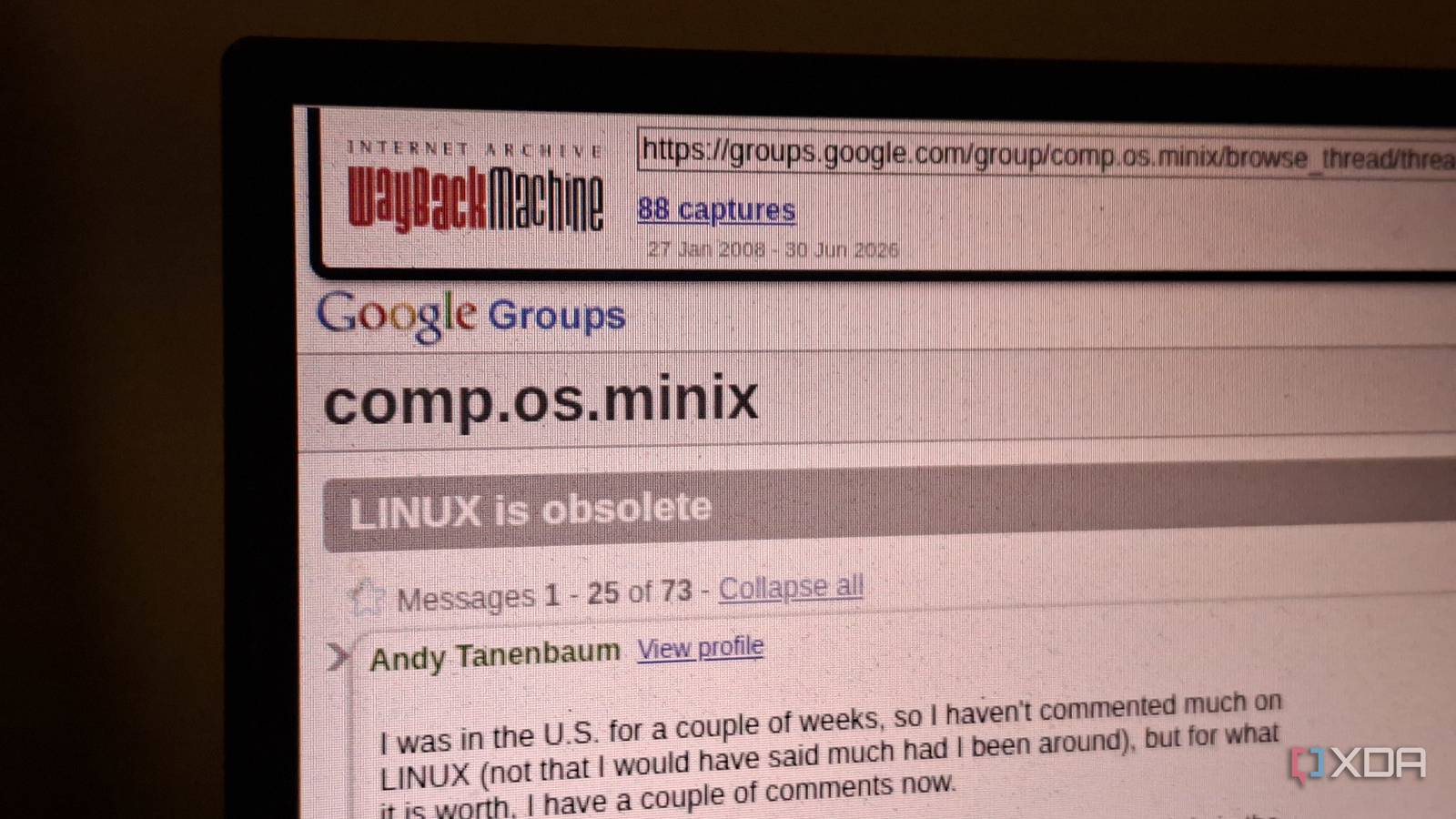
Published Sep 13, 2026, 8:00 PM EDT Simon is a Computer Science BSc graduate who has been writing about technology since 2014, and using Windows machines since 3.1. After working for an indie game studio and acting as the family's go-to technician for all computer issues, he found his passion for writing and decided to use his skill set to write about all things tech. Since beginning his writing career, he has written for many different publications such as WorldStart, Listverse, and MakeTechEasier. However, after finding his home at MakeUseOf in February 2019, he would eventually move on to its sister site, XDA, to bring the latest and greatest in Windows, Linux, and DIY electronics. Out of all of the internet arguments you see online on a daily basis, how many have you seen become famous? It seems odd for a digital scrap to reach the annals of history, but one debate on a Usenet site did just that. Back in 1992, the creator of the Minix OS, Andrew S. Tanenbaum, made a post claiming that Linux was obsolete and would soon die out, and while it obviously didn't quite pan out like that, Minix also managed to make its home in modern-day computing. Tanenbaum and Torvalds duel on a Usenet forum 34 years ago Two fledgling OSes tried to strike out on their own The debate started on January 29th, 1992, over on the comp.os.minix Usenet board. In a thread titled "LINUX is obsolete," Tanenbaum laid out why his hobby OS beat out Linus Torvalds' own pet project. His first point was based on how Linux ran: Most older operating systems are monolithic, that is, the whole operating system is a single a.out file that runs in 'kernel mode.' This binary contains the process management, memory management, file system and the rest. Examples of such systems are UNIX, MS-DOS, VMS, MVS, OS/360, MULTICS, and many more. Tanenbaum believed that his Minix system, which he called a "microkernel-based system," was the future. In this model, the operating system operates as processes mostly outside the kernel and pass messages to one another. The kernel acts as a "mailman," handling the message passing and handling any interrupts. Tanenbaum also believed that the Intel x86 was on the way out, the very CPU that Linux was hard-coded to run on. On the other hand, Minix was ready to adopt the upcoming RISC tech, which Tanenbaum believed would drive the x86 into extinction. And when you look at it like that, it's easy to see why Tanenbaum believed Linux was dead in the water before it could get properly started. Linux manages to take the lead with its open-source design The very things that made it "obsolete" ended up being its strength So, if Tanenbaum was calling some pretty well-researched shots as to why Linux was obsolete in 1992, why are we using Linux OSes instead of Minix ones? Well, as it turns out, Tanenbaum's predictions didn't quite pan out. The biggest one was his prediction about Intel CPUs. The Intel x86 didn't die; in fact, it became a solid basis for computing for decades. The RISC tech that Tanenbaum was banking on ended up being adopted within Intel chips, meaning there was no reason for the CPU giant to fail. And Linux was positioned to take advantage of the hardware from the very start. On the kernel side, it turns out that the microkernel-based system Tanenbaum touted over Linux's kernel-based system was really smart on paper; however, when applied in practical situations, it was slower on 1990s hardware. As clean as the microkernel system was, the end-user only saw a system that didn't respond as quickly as Linux did. To seal the deal, Linus Torvalds made a very smart move with his licensing. While Minix was locked behind a $69 fee and didn't allow redistribution and sharing, Torvalds published Linux using the GNU General Public License (GPL). This meant people could download it for free, tinker with it, and share it with whoever they want. This allowed Linux to get a foothold in the world of operating systems, and these days, it's anything but obsolete. Every single one of the top 500 supercomputers runs Linux, mostly because it's editable and free; two of the mantras that defined Linux from the very start. Similarly, 90% of public-facing cloud services run Linux; pretty good for an OS that was dog-eared for failure on a Usenet board 34 years ago. Minix also got to shine in a huge way Linux wasn't the only one that thrived Usually, in stories like this one, this is the point where the credits roll, we cheer the winner, and boo the loser. Linux wins the fight, Minix fades into obscurity, and that's that. It's a classic underdog story, a tale as old as time. But here's the kicker: Minix did not die out. In fact, if you're reading this article on a device equipped with an Intel CPU, you're using Minix right now. In 2015, starting with the Skylake processors, Intel adopted Minix 3 to run on a microprocessor within the CPU. Minix 3 would then run what's called the Intel Management Engine, which allows people to remotely access PCs even when they're off So, in a way, it was kind of a double happy ending. Linux didn't become obsolete; in fact, it became the default choice for anyone wanting a free, customizable OS without any licensing woes. Meanwhile, Minix's smart microkernel design was better suited to the world of CPUs, and now it runs silently on every modern Intel chip in the world. Turns out, both operating systems were valid; just for different reasons In a way, what started as a debate ended up with both sides taking a crown, just in entirely different areas of tech. Torvalds gets to rule over the open-source OS scene, while Tanenbaum's design sits at the core of every Intel CPU made since 2015. It's a good thing I'm a sucker for everyone getting a happy ending.
Linux was called 'obsolete' in 1992, and now it powers servers around the world
Full Article
Original Source
Read the full article at Xda-developers →KhanList aggregates and links to publicly available news content. We do not host full articles from third-party sources. Always verify important information with original sources.