
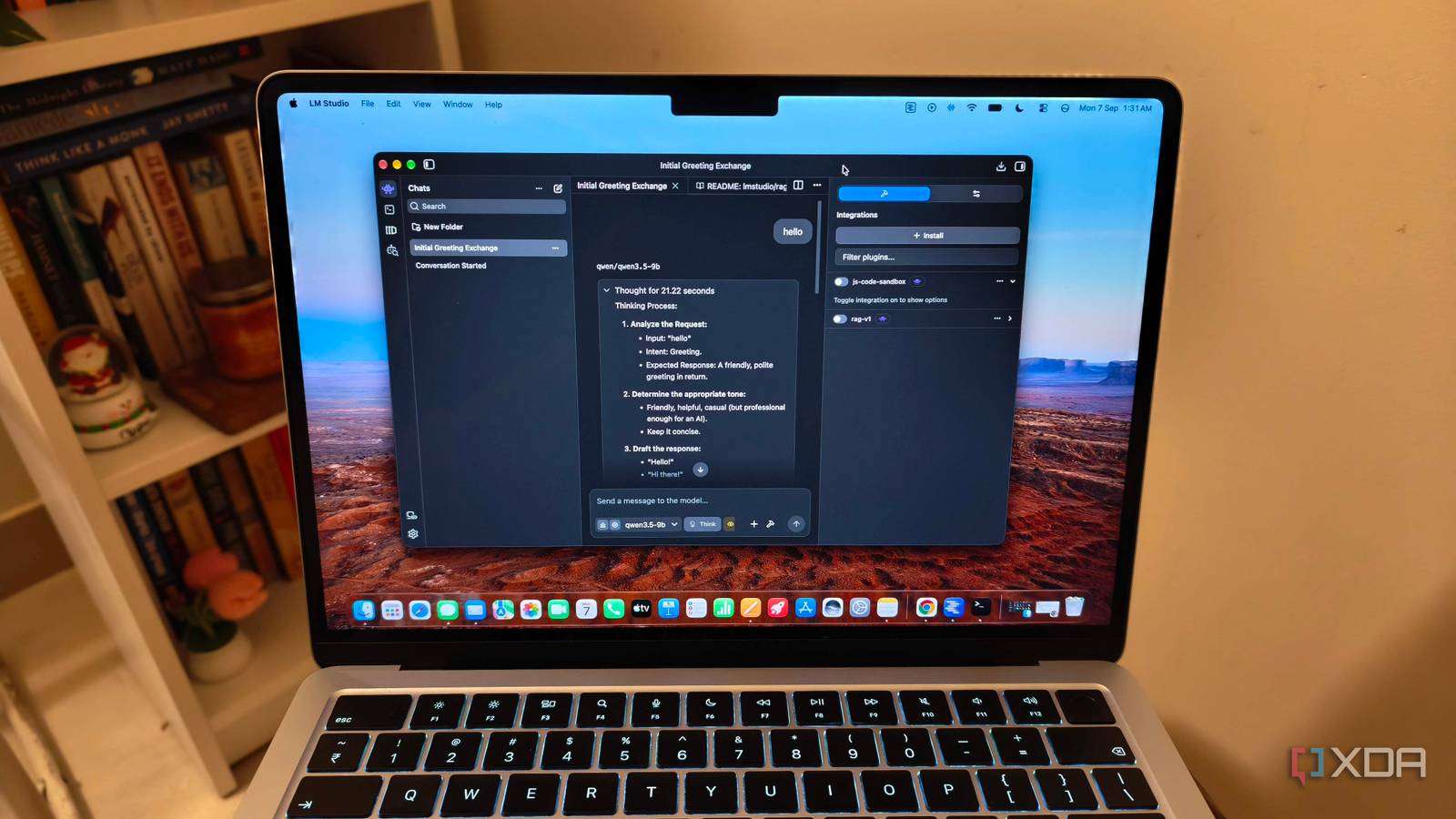
Published Sep 14, 2026, 7:30 AM EDT Anurag is an experienced journalist and author who’s been covering tech for the past 5 years, with a focus on Windows, Android, and Apple. He’s written for sites like Android Police, Neowin, Dexerto, and MakeTechEasier. Anurag’s always pumped about tech and loves getting his hands on the latest gadgets. When he's not procrastinating, you’ll probably find him catching the newest movies in theaters or scrolling through Twitter from his bed. Qwen 3.5-9B is actually quite a good alternative to cloud models. It strikes the right balance between being a general-purpose LLM and handling agentic coding. My hardware is an M5 MacBook Air with 16 GB of RAM, so it’s quite limited. I’ve been model-hopping to see what works best for me. Originally, I used a customized Qwen 2.5 Coder for tool calls. It was relatively fast, but it would often fail at calling tools correctly. I’ve been using Qwen 3.5-9B for some time now, and as part of an experiment, I used it for everything I would normally use Claude for. It didn’t let me down massively. However, it did struggle with two things Claude usually handles well for me: refactoring code across multiple files without missing related changes and working through a stubborn bug when the first fix didn’t solve it. Qwen 3.5-9B replaces Claude for me It's a very good general-purpose LLM Qwen 3.5-9B is a general-purpose model rather than one built exclusively for coding. It can handle regular conversations, reasoning, instruction following, and visual inputs. But it’s also capable enough for coding and agentic work. I am using it to maintain a SaaS tool that I have, and it does a very good job at doing that. I can use the model to add new features, fix bugs, and just manage the tool overall. Tool calling is one of the model’s stronger capabilities. Qwen specifically trained the 3.5 family for agentic use, allowing the model to select tools, format calls correctly, process the output, and continue working. If you pair it with a good harness, something like Hermes, OpenCode, or even Codex, it does a very good job at agentic work. The model also has a native context window of 262,144 tokens, although running the full context locally requires considerably more memory. It also supports thinking and non-thinking modes, so you can let it reason through a complicated request or use direct mode when the task doesn't require as much work. Most of my work didn’t need Claude "Most" The work I sent to Qwen wasn’t limited to small experiments. On my SaaS tool, it fixed a bug in the login flow that was preventing OTPs from being sent. It also added a feature that lets users export their results as a report. Both tasks required it to work with the existing app, and it completed them without me having to move the work over to Claude. I also used Qwen for some of my personal projects. It wrote Home Assistant automations that make better use of the devices and sensors around my home. I could describe what I wanted the devices to do, and the model handled the automation instead of requiring me to write everything manually. Qwen also has access to my server logs and regularly flags issues that require attention. A standard failure notification only tells me that something has gone wrong, which still leaves me digging through the logs to find the cause. The model can examine those logs and point me toward the actual issue. In some cases, it can also go ahead and fix the issues itself if I allow it to. The two tasks where Qwen got stuck But these are not deal-breakers for me One of the failures involved refactoring the report-generation code. The logic originally sat inside an API route, and I wanted to move it into a shared service so the website and background jobs could use the same code. Qwen created the new service and updated the main API route, but it didn’t follow the old implementation through the rest of the project. A background job still imported the original function, some tests expected the old arguments, and the frontend types no longer matched the response. It fixed each error as it appeared but then introduced another one elsewhere. The second failure was a report that remained stuck on “Processing” even though the background job had finished. Qwen initially treated it as a frontend problem and changed the polling logic so the page would request the status again. The problem remained because the status endpoint was returning a cached response. Even after I showed it logs confirming that the report had been generated, it continued editing the frontend component rather than tracing the request through the API and cache. Claude is, of course, better The tasks where Qwen 3.5 failed are what Claude does the best. It's more likely to question its first diagnosis, inspect a different part of the stack, and work backward from the evidence instead of continuing with small variations of the same fix.
I replaced Claude with a local 9B model for a week, and it handled 95% of my work
Full Article
Original Source
Read the full article at Xda-developers →KhanList aggregates and links to publicly available news content. We do not host full articles from third-party sources. Always verify important information with original sources.