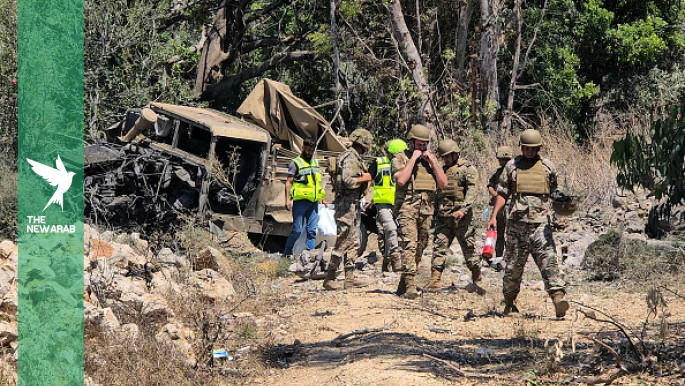
The Lebanese army has entered a US-backed "pilot zone" in southern Lebanon despite officials saying the designated towns were never occupied by Israel. Lebanese army soldiers deploy in Zawtar al-Gharbiya, the first town included in a US-backed pilot zone in southern Lebanon, despite local officials saying the area was never occupied by Israeli forces. [Getty] The Lebanese army began deploying on Tuesday in Zawtar al-Gharbiya, one of three southern towns included in a US-backed "pilot zone" plan, despite residents and local officials saying the area was never occupied by Israeli forces. The deployment raises questions over what Israel is surrendering under the trilateral framework signed with Lebanon and the United States on 26 June, which envisages Israeli withdrawals from parts of southern Lebanon in return for Lebanese army deployments and the removal of any Hezbollah military presence. The Lebanese army said its units had begun deploying in Zawtar al-Gharbiya, in the Nabatieh district, following contacts with the Military Coordination Group for Lebanon. It urged residents not to enter the town until the security situation had stabilised and called on them to follow instructions issued by deployed military units. A Lebanese army source told The New Arab that troops had entered the town and would begin implementing a plan aimed at establishing the state's exclusive control over weapons. "Coordination will be only with the Americans," the source said, adding that Israeli forces remained present on the outskirts of neighbouring Zawtar al-Sharqiya. Only Lebanese army personnel are currently being permitted to enter Zawtar al-Gharbiya, while residents remain barred from returning, according to the source. Military engineering teams are expected to survey the town, remove suspicious objects and unexploded ordnance, and conduct other operations intended to make it safe for civilians. The army also intensified patrols in the nearby towns of Froun and Srifa on Monday. Both are included alongside Zawtar al-Gharbiya in the first phase of the pilot-zone plan, although none of the three towns had been occupied by Israel. Residents and officials have challenged their inclusion, arguing that Israel was being credited with withdrawing from areas its forces never controlled. Lebanese security sources have also confirmed that towns included in the pilot arrangement had not been occupied, while residents said their designation allowed Israel to present the plan as a concession without relinquishing the positions it continues to hold elsewhere in southern Lebanon. Local officials have nevertheless stressed that the Lebanese army is welcome and that residents have no intention of obstructing its deployment. The US State Department announced on Monday that pilot-zone operations had begun in Zawtar al-Gharbiya, Froun, and Srifa under the supervision of the Military Coordination Group. "This milestone is a direct result of last week's talks between Israel and Lebanon in Rome," the department said, adding that Washington would continue working closely with both sides to implement the framework. Under the agreement, Israel is expected to withdraw from selected areas in southern Lebanon as the Lebanese army moves in and works to remove any alleged Hezbollah military presence. Israel, however, continues to occupy other positions in the south, including areas overlooking towns placed within the pilot-zone arrangement. The deployment coincides with Lebanese President Joseph Aoun’s visit to Washington, where he is expected to meet US President Donald Trump on Tuesday after holding talks with Secretary of State Marco Rubio on Sunday. Aoun stressed during the meeting with Rubio that implementation of the framework should begin with an actual Israeli withdrawal from the first pilot area. He also called for increased US support for the Lebanese army and other security institutions, along with greater American investment in Lebanon's energy, telecommunications, and transport sectors. Lebanon has insisted that verification of army deployments should be carried out by a third party rather than by Israel. Beirut has expressed a preference for a United Nations role, although no final arrangement has been reached. For now, monitoring is expected to be conducted through the Military Coordination Group under the supervision of US Central Command. Related Articles
Lebanese army enters 'pilot zone' town never occupied by Israel
Full Article
Original Source
Read the full article at Newarab →KhanList aggregates and links to publicly available news content. We do not host full articles from third-party sources. Always verify important information with original sources.