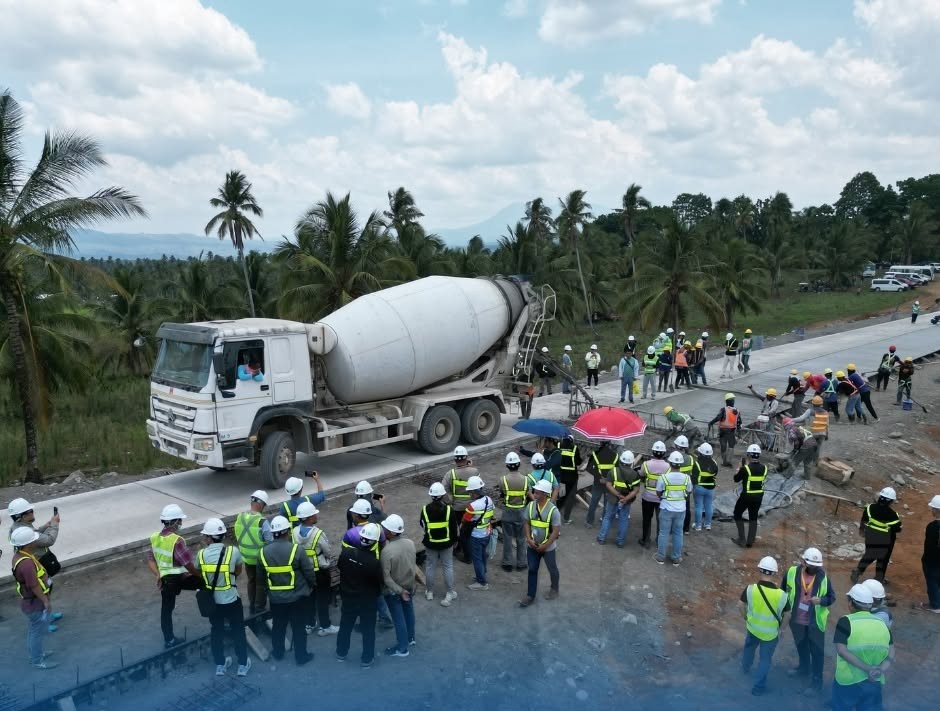
INSPECT. Officials inspect a road project in Basilan. courtesy of Basilan District Engineering Office Despite the regional government’s push to expand Basilan’s road network, nearly 70% of ongoing projects face delays or abandonment due to unresolved family inheritance disputes and informal tribal land systems BASILAN, Philippines – Thousands of farmers and residents in Basilan continue to bear the cost of stalled infrastructure projects, with unfinished roads driving up transport expenses, disrupting access to markets, and isolating communities. Nearly 100 road projects, mostly farm-to-market roads, remain stalled, unfinished, or suspended due to unresolved road right-of-way disputes, according to records from the Bangsamoro Ministry of Public Works. The ministry’s Basilan District Engineering Office this year secured a P627-million infrastructure program covering a road network across 11 municipalities of Basilan, including Lamitan City. A large portion of this year’s budget, as well as allocations from previous years, has been earmarked for farm-to-market roads intended to help farmers, fisherfolk, and consumers transport agricultural produce more efficiently to markets. But despite the regional government’s push to expand the road network of the province, nearly 70% of Basilan’s ongoing road projects have experienced “delays or project abandonment.” Some have remained unfinished for more than a year, while others have been delayed for several months. Acting District Engineer Alnaif Ronie Cuevas told Rappler that the delays stem from overlapping family inheritance disputes and informal tribal land systems. Cuevas said the biggest obstacle holding back these multimillion-peso contracts is the long-running problem of unresolved right-of-way disputes. In previous infrastructure projects, budgets were approved by the Bangsamoro Autonomous Region in Muslim Mindanao (BARMM) regional parliament based on informal, verbal “donations” of land secured from municipal and village elders. However, once construction equipment arrived, younger generations of heirs and adjacent clan claimants moved to halt paving operations, demanding compensation for the removal of thousands of mature rubber trees and coconut palms. The disputes have left some communities paying the price for unfinished roads. Most stalled projects are located in the interior areas of Sumisip, Tipo-Tipo, Tuburan, and Akbar. The absence of continuous paved routes has forced public transport drivers to charge double or triple the standard fares to cover vehicle damage caused by poor road conditions. For small-scale farmers, the higher transport costs consume much of their daily income. During downpours, unpaved sections become thick mud, isolating entire barangays and limiting residents’ access to emergency healthcare services. To address the issue, Cuevas said he has scheduled a meeting with contractors handling farm-to-market road projects across the province to discuss possible solutions to right-of-way problems. One of the most visible examples of the challenge is the Basilan Transcentral Road, where a dispute involving an estimated P18.5 million in compensation sought by local landowners has prevented the completion of about 8.5 kilometers of alternating dirt sections. Oversight data provided by Cuevas showed that key segments of the road, particularly mountain routes crossing the Sampinit Complex between Barangay Santa Clara in Lamitan City and Barangay Tumahubong in Sumisip, continue to face physical and legal obstacles. Despite significant funding releases from the BARMM regional parliament to complete the high-priority route, civil works on the final 8.5-kilometer stretch remain suspended. Tracking teams continue to encounter overlapping ancestral land claims, with clan heirs seeking a combined P18.5 million to cover land values and the replacement costs of thousands of high-yielding rubber trees scheduled for clearing. The BARMM public works ministry does not have flexible funds for property indemnity, leaving affected projects in the province indefinitely suspended. New law on right-of-way The problem in Basilan shows a broader challenge faced by infrastructure projects nationwide. During his 5th State of the Nation Address on Monday, President Ferdinand Marcos Jr. said the government has begun addressing persistent right-of-way disputes that have slowed project implementation, citing the 2025 Accelerated and Reformed Right-of-Way (ARROW) Act as a key measure to reduce delays. Signed into law in September 2025, the ARROW Act, or Republic Act No.12289, amended existing right-of-way rules to streamline land acquisition for government infrastructure projects while maintaining safeguards for property owners, including the payment of just compensation. Marcos said that in the context of his administration’s efforts to expand and improve the country’s transport infrastructure, pointing out that such concerns had been among the major obstacles affecting mass transit projects. The new law, he said, should help fast-track land acquisition and project completion. – Rappler.com How does this make you feel? Loading
Land disputes stall Basilan road projects, leave farmers paying price
Full Article
Original Source
Read the full article at Rappler →KhanList aggregates and links to publicly available news content. We do not host full articles from third-party sources. Always verify important information with original sources.