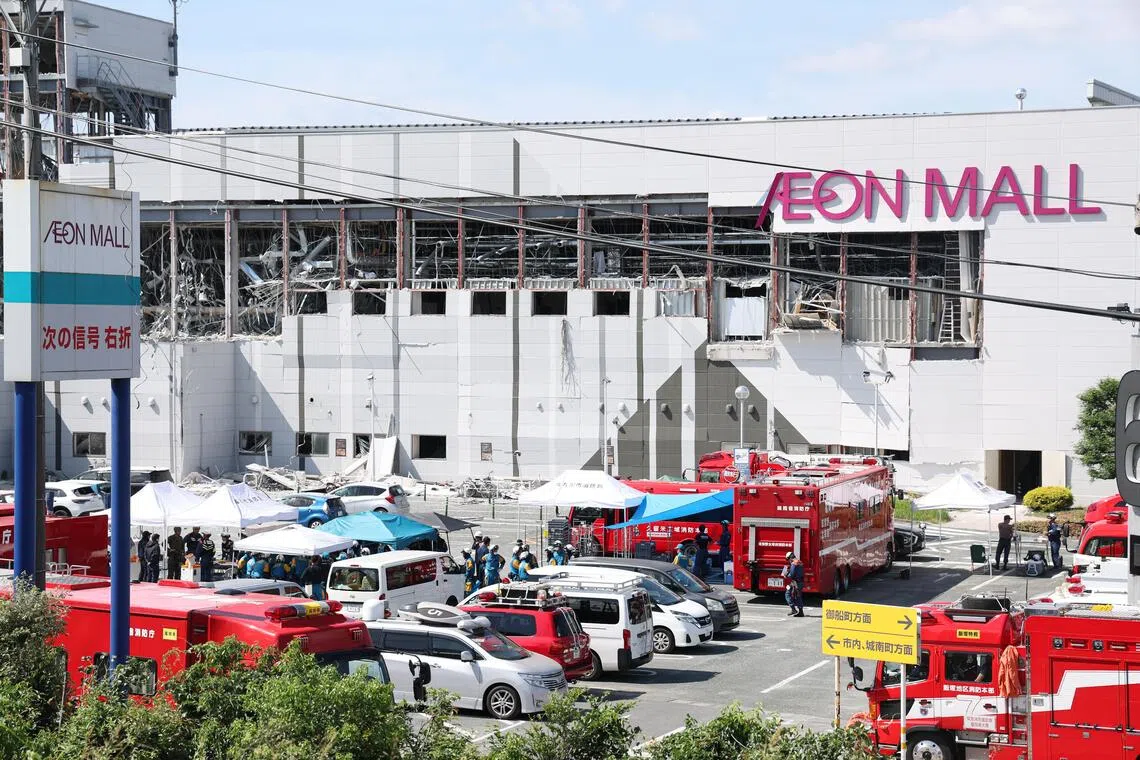
KUMAMOTO – The fatal explosion that severely damaged a shopping mall soon after the powerful earthquake on July 28 was likely the result of gas that had leaked from broken pipes, filled a particular space at the mall and then ignited, according to experts.“We couldn’t foresee that an explosion would occur,” a sombre-looking Aeon president Akio Yoshida said at a press conference held on the afternoon of July 29 in Kumamoto.“We will make every possible effort to identify the cause.”According to the company, three employees at stores inside Aeon Mall Kumamoto in the town of Kashima, Kumamoto Prefecture, had been confirmed dead as at the afternoon of July 29.The earthquake struck at 4.27pm on July 28. According to Aeon, workers at the mall began evacuating about 3,000 customers from the facility after the shaking subsided.The evacuation was completed at 5pm, after which employees also sought shelter outside the two-storey mall, which has a total floor area of about 120,000 sq m.The blast occurred at about 5.50pm – about 80 minutes after the earthquake – and devastated the central area of the second floor on the mall’s south side.LPG used for cookingObservers have said a gas leak could have been the cause of the explosion.During a search conducted by the Kumamoto prefectural police and fire authorities, there were reports of a smell of gas inside the building.“I think perhaps gas leaked and ignited, which resulted in the explosion,” a senior prefectural police official told The Yomiuri Shimbun.According to Aeon, liquified petroleum gas (LPG) is used for cooking at restaurants on the north side of the mall’s first floor and at the food court on the east side of the second floor, as well as for air conditioning.Gas from a storage tank that holds 9,367kg of LPG on the mall premises enters the facility through an underground pipe and then runs through a web of pipes in the floors and walls.Aeon-operated malls elsewhere reportedly use city gas.“It’s possible that the strong shaking ruptured the gas pipes, some gas leaked out and then some ignition source caused it to explode,” said Tokyo University of Science professor Kazunori Kuwana, an expert on fire science.Kuwana said that a shopping mall has open spaces where a large volume of gas could build up, which could increase the scale of the explosion.“Even a small spark, such as an electrical spark or static electricity, could cause this gas to explode,” he said.Law requires safety devicesThe Liquified Petroleum Gas Law states that devices that automatically shut off the gas supply after detecting shaking equivalent to 5 or more on the Japanese seismic intensity scale of 7 must be installed as a safety measure for LPG in the event of an earthquake.At the press conference, Yoshida said the mall’s gas pipes were regularly inspected and had been designed to meet earthquake-resistance standards.He said that no gas leak had occurred since the mall opened in 2005. The pipes reportedly had not been damaged by two powerful earthquakes that struck Kumamoto in 2016.Yoshida indicated the company planned to begin urgent inspections of gas equipment at Aeon facilities across the nation in the wake of the Kumamoto accident.Ritsu Dobashi, a professor at Tokyo University of Science and an expert in combustion and safety engineering, said: “The fact that the south side’s second floor was extensively damaged suggests that the gas leak source could also have been in that vicinity.“If a leak occurred despite the presence of devices that automatically stop gas flowing after detecting a gas leak or an earthquake, it’s possible those devices didn’t function properly.” THE JAPAN NEWS/ASIA NEWS NETWORK
Kumamoto quake: Broken gas pipes likely behind deadly mall blast, say experts
Full Article
Original Source
Read the full article at Straitstimes →KhanList aggregates and links to publicly available news content. We do not host full articles from third-party sources. Always verify important information with original sources.