
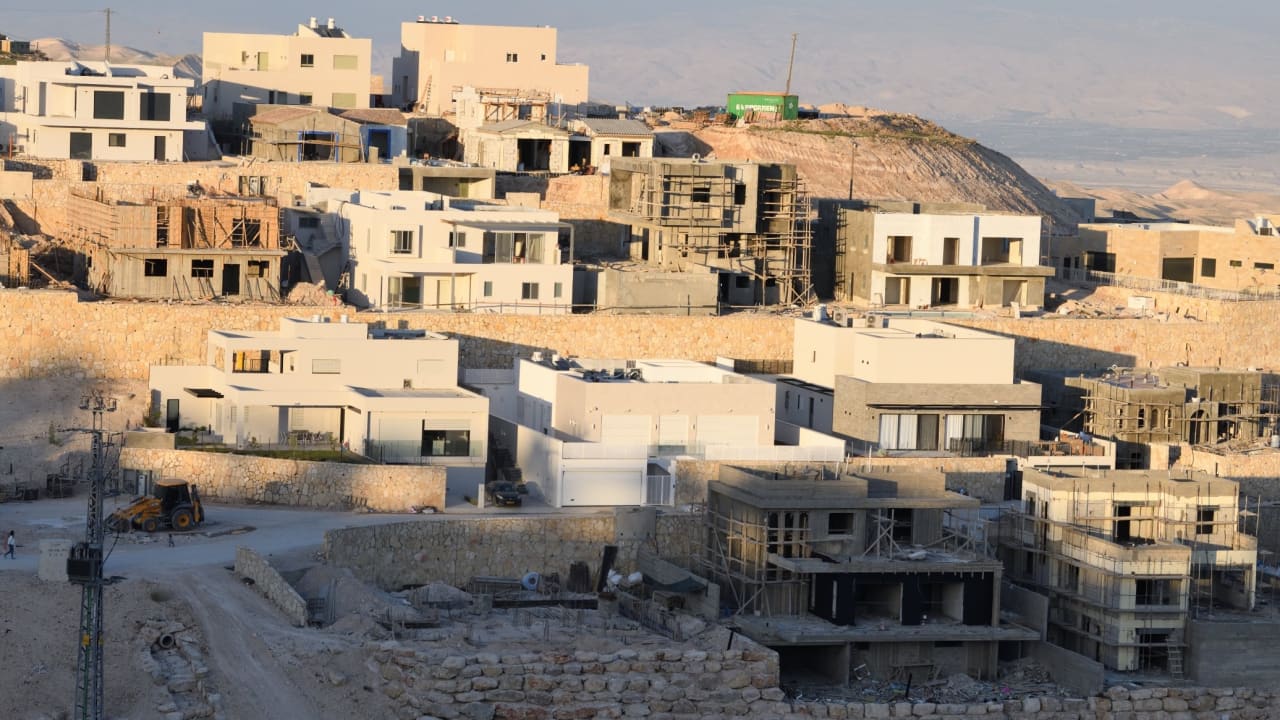
SEPTEMBER 5, 2026 16:10One of the most formidable academic opponents of settlement in Judea and Samaria, Prof. Arnon Sofer, recently passed away.Sofer was known for two important conclusions he drew from years of studying the geostrategic implications of Jewish and Arab spatial distribution patterns in Israel and Judea and Samaria.One was a dire warning that by increasingly relocating to coastal regions, especially to Gush Dan at the expense of Jewish settlement in the North and South, Jews were effectively giving up the State of Israel.This was particularly problematic, Sofer contended, given that the territory was won in a vicious and costly War of Independence, only for the “state of Tel-Aviv” to regress to the borders of “Jewish Palestine” as envisioned by the 1937 Peel Commission.As part of that foreboding, he castigated the Religious Zionist movement, which since the 1967 conquest of Judea and Samaria, has concentrated much of its energy in settling the West Bank beyond the confines of the relatively small enclaves.A general view of houses in the Israeli settlement of Maale Adumim in the West Bank (credit: AMMAR AWAD / REUTERS)The enclaves Sofer was referring to concern Gush Etzion, the corridor to Ariel, a little beyond the city of Ma’aleh Adumim, and parts of the Jordan Valley south and north of the Green Line, whose inclusion into the state is part of a broad consensus of Israel’s Jewish population and parties. He liked to quote the Talmudic adage, “tafasta merubah lo tafasta” – the maxim that one frequently loses in striving for too much – at his religious protagonists, urging them instead to concentrate their efforts on settling the Galilee and Negev in order to preserve a Jewish majority in both areas.Sofer had many followers, including Efraim Inbar, a noted expert on Israel’s geostrategic predicament. In a recent article in The Jerusalem Post, Inbar inveighed against widespread, broad-based settlement in favor of selective strategic settlement in the Jerusalem area and the Jordan Valley, claiming that not every hill in Judea and Samaria is strategic.Inbar is as wrong in this assertion as were Zionist leaders in the 1930s such as Eliezer Kaplan.Such leaders had, at the time, preferred selective Zionist settlement in the coastal regions of Tel Aviv, the Sharon, and the Jezreel Valley to the creation of Stockade and Tower settlements (Homa U’Migdal) along wider-flung areas in which there was hardly any Jewish settlement, for which the youth in Zionist movements clamored.Yet, these settlements were the ones to hold the line against the invading Arab armies, buying the fledgling IDF time to get its act together and slowly take the offensive until the total ouster of the Egyptian army in the South. Incidentally, the only significant swath of Mandate Palestine left unconquered, the West Bank, had no Jewish settlements.A swift travel from North to SouthGiven the Lilliputian dimensions of the Land of Israel, almost every hill in Judea and Samaria has strategic importance.From Juneid, the Arab name for the prison just west of Nablus, formerly an Israeli prison that incarcerated local terrorists, one can see the towers abutting Hadera’s Orot Rabin power station on the coast without the aid of binoculars.After all, Nablus, the most eastern city in the West Bank, is 35 kilometers from the Israeli coast as the crow flies. Primitive missiles also fly as the crow does.From the hilltops near the Palestinian town of Budrus, a former IDF general and his team zoomed in with a popular German camera to identify the name of the airline on the plane taking off from Ben-Gurion Airport.Further, from the hilltops of Dhahiriya, the large Palestinian town in the Hebron district in area A, which, according to the Oslo Accords, the Palestinian Authority has both military and civilian control over, all of Beersheba is visible to the naked eye.Once again, the town possesses the topographical advantage of being 400 meters above Beersheba.Yet even if most, if not all, of Judea and Samaria has strategic importance, why not just have the IDF in control? Why the need for widespread settlement?There are two interrelated reasons why one needs both. Terrorism, and beyond that, the creation of militias with formidable conventional power, is related to the extent to which the enemy enjoys sanctuary.Having a physical space allows it to prepare for lethal activities and, in the case of Gaza, a ferocious onslaught. Protecting settlers means less sanctuary, less possibility of unhindered planning, training, and attacking.It is no coincidence that the highest levels of Palestinian terrorism manifested in regions such as Jenin, where there was almost no Israeli settlement.This was also true during the 1936-1939 Arab Revolt in Mandatory Palestine. The October 7 onslaught, moreover, would have been inconceivable had it not been for the total withdrawal from Gaza and the destruction of Jewish settlements.The second reason is specific to the military. The IDF in hostile civilian population areas has an understandable tendency to withdraw into its bases. Still, the moral obligation to protect settlers, frequently a mother driving her young children, goes against this natural tendency. It gives the officers and soldiers on patrol a moral imperative independent of their ideological beliefs.An excellent example of the value of broad-based settlement is the farms set up with increasing frequency between the Jordan Valley and the populated Arab mountain ridge.These farms contributed to the recent dramatic reduction of terrorism and increased the sense of security for those plying the Allon road.Jewish settlement there and east of Nablus, another hotbed of terrorism, protected by the IDF, also sends a warning to the Palestinian Authority that, should it be tempted to mimic Hamas’s October 7 massacre to attack “the State of Tel-Aviv” to the west, it will be attacked from behind.Unfortunately, Hamas suffered from no such constraint.In Judea and Samaria, the dangers are ever-present and everywhere. Widespread Jewish settlement is part of the answer to this predicament.Hillel Frisch is a professor emeritus at Bar-Ilan University and a senior researcher at the JISS.Follow us on Google
Jewish settlement is a strategic necessity across the West Bank - opinion
Full Article
Original Source
Read the full article at Jpost →KhanList aggregates and links to publicly available news content. We do not host full articles from third-party sources. Always verify important information with original sources.