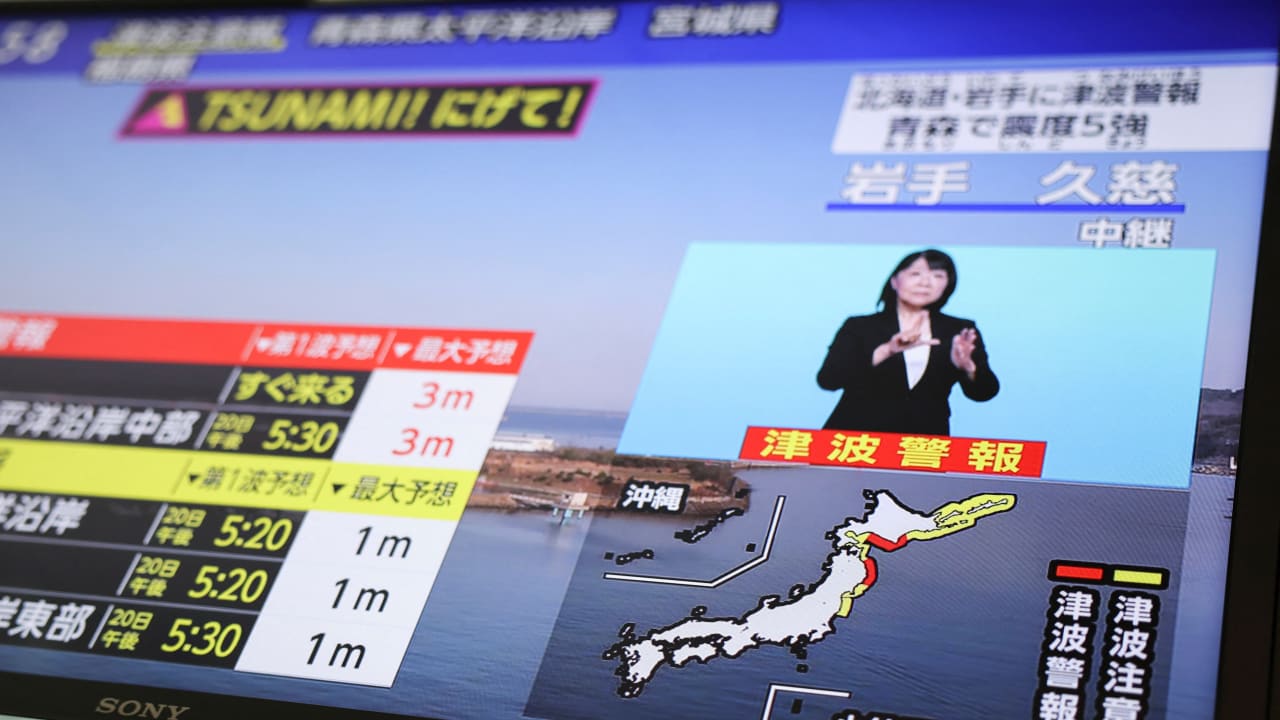
Jerusalem Post/Environment & Climate ChangeThe Japanese government issued emergency earthquake warnings for Kumamoto, Nagasaki, Kagoshima, Fukuoka, Saga, Oita, and Miyazaki prefectures, all on Japan's southern Kyushu island.Follow us on GoogleA television screen shows a news report on Japan Meteorological Agency's tsunami warning, saying it expected tsunami waves of up to 3 meters (9.84 feet) to reach large coastal areas in northern Japan after an earthquake struck off the coast of Japan, April 20, 2026.(photo credit: REUTERS/ISSEI KATO)ByREUTERSJULY 28, 2026 10:48Updated: JULY 28, 2026 11:02An earthquake with a preliminary magnitude of 7.1 struck Japan's Kumamoto prefecture on Tuesday, the Japan Meteorological Agency said.A tsunami warning for a wave measuring 1 meter (3.28 ft) was issued after the earthquake, the JMA said.The Japanese government issued emergency earthquake warnings for Kumamoto, Nagasaki, Kagoshima, Fukuoka, Saga, Oita, and Miyazaki prefectures, all on Japan's southern Kyushu island.The US Pacific Tsunami Warning Center (PTWC) said that there was no risk of a tsunami in Hawaii and American Samoa following the earthquake.Kyushu Electric Power said there were no reports of irregularities at its Sendai and Genkai nuclear power stations after the earthquake.Passengers look at electronic screens announcing suspension of Tohoku Shinkansen bullet train service due to an earthquake, at Sendai Station in Sendai, northern Japan April 20, 2026, in this photo taken by Kyodo. Ilustrative. (credit: Kyodo/via REUTERS)Train operator JR Kyushu said that it has suspended services, including its high-speed Shinkansen trains, following the quake.Second large-scale earthquake that hits Japan in 2026Tuesday's earthquake represents the second disaster of its kind to strike Japan this year, with a 7.5-magnitude event recorded off the coast of the islands, triggering tsunami alerts back in April.In that instance, authorities urged residents to stay away from coastal areas where tsunami waves of up to 3 meters (9.84 ft) were expected.The tremor had an epicenter in the Pacific Ocean and was 10 km deep, according to the Japan Meteorological Agency. The biggest waves were expected in the prefectures of Iwate, Aomori, and Hokkaido, authorities said.The quake measured an 'upper 5' on Japan's seismic intensity scale -- strong enough to make it difficult for people to move around. In many cases, unreinforced concrete-block walls collapse.Japan is one of the world's most earthquake-prone countries, with a tremor occurring at least every five minutes. Located along the "Ring of Fire" of volcanoes and oceanic trenches that partly encircles the Pacific Basin, Japan accounts for about 20% of the world's earthquakes of magnitude 6.0 or greater.There are no nuclear power plants currently in operation in the Hokkaido and Tohoku regions, but Hokkaido Electric Power Co 9509.T and Tohoku Electric Power Co 9506.T have several shut-down nuclear power plants there.This is a developing story.The Environment and Climate Change portal is produced in cooperation with the Goldman Sonnenfeldt School of Sustainability and Climate Change at Ben-Gurion University of the Negev. The Jerusalem Post maintains all editorial decisions related to the content.Follow us on Google
Japan registers magnitude 7.1 earthquake, authorities dismiss tsunami threat
Full Article
Original Source
Read the full article at Jpost →KhanList aggregates and links to publicly available news content. We do not host full articles from third-party sources. Always verify important information with original sources.