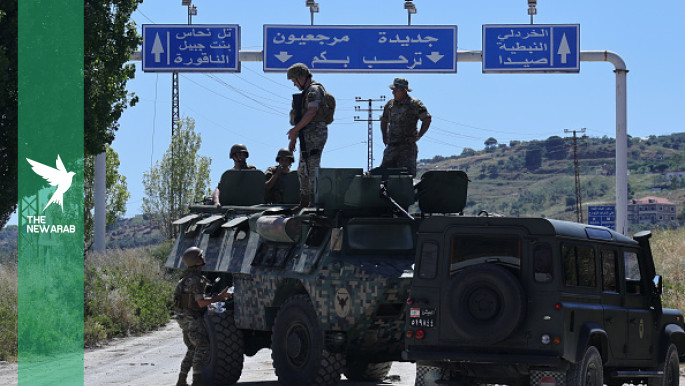
Lebanese Armed Forces enter the town of Dibbin, close to the border with Israel, after Israeli forces pulled out in June 2026 [Getty]Israeli forces are expected to begin withdrawing from the outskirts of the southern Lebanese village of Zawtar al-Gharbiya within hours, a diplomatic source said on Monday, as Washington announced the launch of the first “pilot zones” under its controversial Lebanon-Israel framework. The unnamed source told leading broadcaster MTV Lebanon that military officials expected the Israeli army to pull back from the village “in the coming hours” in implementation of the US-sponsored agreement. The US State Department separately announced that pilot-zone operations had begun in Froun, Srifa and Zawtar al-Gharbiya, following talks between Lebanese and Israeli delegations in Rome last week. US news outlet Axios reported that the Israeli military’s withdrawal from the initial areas was expected to begin on Tuesday. The development would mark the first limited Israeli pullback under the framework signed on 26 June, weeks after its implementation was stalled by Israel’s refusal to withdraw from the designated areas. The agreement provides for a gradual Israeli withdrawal from selected parts of southern Lebanon, followed by the deployment of the Lebanese Armed Forces and the removal of weapons and military infrastructure belonging to non-state groups. It does not, however, establish a timetable for Israel’s complete withdrawal from Lebanon and allows Israeli forces to remain inside a wider so-called security zone for the time being. Hezbollah has rejected the agreement in its entirety, describing it as an attempt to legitimise Israel’s occupation and link the restoration of Lebanese sovereignty to the group’s disarmament. Parliament Speaker Nabih Berri and his Amal Movement have also criticised the deal as unbalanced and warned that it could entrench conditions imposed by Israel. Implementation of the withdrawal, army deployment and disarmament provisions is to be overseen by the Military Coordination Team for Lebanon, known as MTC4L, under US Central Command supervision. In its statement, the State Department described the launch of the pilot zones as “a direct result of last week’s talks between Israel and Lebanon in Rome”. Washington said it would continue working with both sides to implement the framework, which it has promoted as a path towards a broader agreement between Lebanon and Israel. The Lebanese army began deploying in and around the designated villages last week, fuelling expectations that the framework was about to enter its first operational phase. However, reports that Israel was delaying its withdrawal had raised doubts over whether the agreement could proceed. Lebanon has consistently insisted that Israeli forces must withdraw before the army completes its deployment in the pilot areas. The dispute has centred partly on the location of the zones. Municipalities included in the plan have objected to their designation, noting that much of the territory concerned was not occupied by Israeli ground forces and that the Lebanese army was already present there. They nevertheless stressed that the army remained welcome and that residents had no intention of confronting or obstructing its deployment. Aoun seeks US pressure on Israel The announcement came as Lebanese President Joseph Aoun visited Washington for meetings expected to focus heavily on Israel’s continuing occupation and the implementation of the framework. Aoun met US Secretary of State Marco Rubio on Sunday and is due to hold talks with President Donald Trump at the White House on Tuesday. Lebanon has repeatedly called on Washington to use its influence to compel Israel to begin withdrawing in accordance with the June agreement. Aoun has said he intends to ask Trump to exert “the necessary pressure on Israel” to withdraw and allow Lebanon to restore its sovereignty. Israeli forces occupy a broad swathe of southern Lebanon following their expanded ground invasion, with hundreds of thousands of Lebanese residents still displaced from their homes. Israel has established a military zone several kilometres deep inside Lebanese territory, which it calls the “Yellow Line”, and has continued carrying out attacks on towns and villages both inside and beyond that area. The framework has drawn particular criticism because its first pilot areas include territory where Israeli troops were either not present or held only limited positions, while leaving the bulk of the occupied zone untouched. Israel’s defence minister has openly said the agreement allows Israeli forces to retain control of the wider security zone and prevent displaced Lebanese residents from returning to their communities. Disarmament remains key point of dispute The disarmament of Hezbollah and other armed groups is one of the framework’s central provisions and is presented by Washington and Israel as a test of the Lebanese state’s ability to establish a monopoly over weapons. Hezbollah argues that its weapons cannot be discussed while Israel continues to occupy Lebanese territory and carry out attacks across the country. The group has described the framework as “null and void”, accusing the Lebanese government of making unilateral concessions and crossing “all red lines” by tying Israel’s withdrawal to disarmament. Lebanon has also insisted that verification of the army’s deployment and the removal of weapons must be carried out by a neutral international party rather than Israel. Beirut favours a United Nations role, although no final decision has been made. Until then, field monitoring and verification will remain under MTC4L, with US Central Command overseeing the process.
Israeli army to withdraw from south Lebanon pilot zones Tuesday
Full Article
Original Source
Read the full article at Newarab →KhanList aggregates and links to publicly available news content. We do not host full articles from third-party sources. Always verify important information with original sources.