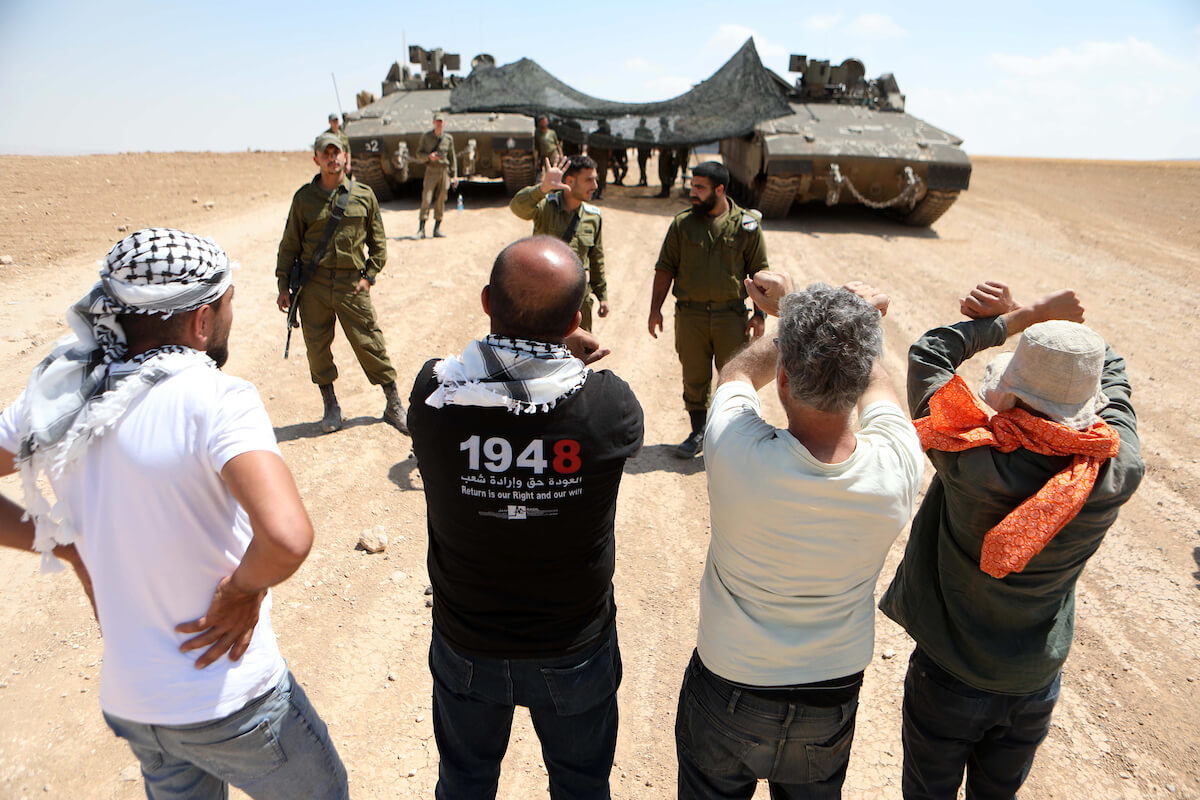
When the sun rises over Masafer Yatta in the West Bank’s Hebron Hills, orange light falls across the horizon, the shepherds bring out their flocks, and the struggle for survival begins anew. On March 15th, that struggle manifested in the form of a speeding car, a wounded child, and several international volunteers who were very, very far from home. It was early in the morning when Elijah, an American activist who asked to only be identified by his first name out of fear of retaliation by the Israeli state, realized that Siwar Hathaleen, a five year old Palestinian girl had been run over by a settler. “She was lying on the ground, and she was bleeding from her head,” Elijah recalled. “She was yelling, and the settler got out of his car and was approaching her and had a big assault rifle strapped to his front.” In the moments that followed the crash, bystander videos show how a crowd rapidly began to grow at the scene of the collision, as Israeli police, military, and EMS workers began to respond. In publicly available footage, the settler that hit the child can be seen asking the police to arrest the activists and “kick them out of the country.” “They were like, deport these guys, and were pointing out the three of us,” Eli recalled of the incident. While Siwar Hathaleen would survive the collision, Eli and the other activists were arrested just moments later under suspicion of committing property damage, owing to the settlers claims that his vehicle was harmed. “He wasn’t lying that his car was damaged,” Eli recalled. “Because that’s what happened when you hit a small body with your car.” Following their arrest, all of the activists were either deported entirely, or temporarily banned for entering the West Bank. Stories like this have become increasingly common among Palestine’s community of international volunteers. Increasing attacks, record-breaking violence, and a crackdown by security forces are pushing both Palestinians and supporters to a breaking point. Currently, “protective presence” operations in the West Bank are maintained by a rough patchwork of both Israeli and International organizations that place volunteers in villages throughout Palestine in hopes that their presence may reduce settler violence. Israeli settlers frequently kill Palestinians with virtual impunity, while attacks on Israelis or internationals tend to garner international condemnation. The prevailing philosophy of protective presence organizations capitalizes on the privileges that international citizens hold within the occupied Palestinian territories. These organizations also wager that, for settlers, the price of harming foreign activists is too high. In the past, this bold strategy has yielded mixed results and high casualties. During the second Intifada, activists with groups like the International Solidarity Movement regularly disrupted Israeli tank columns, established aid corridors under machine gun fire, and even provided presence inside Yasser Arafat’s besieged compound. Dozens of casualties were sustained in the process. Today, events like these can feel distant. Activists have increasingly found their efforts dwarfed by a widening Israeli security apparatus designed to thwart their presence and remove them from conflict zones. Scrutiny of international solidarity groups came to a head in 2024, following October 7, and renewed international participation in the West Bank. Members of Israel’s governing Knesset held a discussion to address what they called the “Agitating activity of activists in Judea and Samaria.” A short time later, the head of Israel’s internal security service, Itamar Ben-Gvir, announced a special police unit tasked with identifying and removing internationals working with Palestinians in the West Bank. Ben-Gvir referred to the task force as “the team for dealing with the anarchists.” Since then, reports of foreign activists being detained, deported, and turned away at the border have become routine. Sharona Weiss works for the Human Rights Defenders Fund (HRDF), an Israeli organization that runs a 24 hour hotline for solidarity workers, and assists with legal representation for many of the largest protective presence organizations in the West Bank. Weiss reports that, according to their data, instances of activists being denied entry into the country, deported, or detained have all increased since the declaration of Ben-Gvir’s task force. “There was a massive uptick that began in the wake of October 7, which really started accelerating in, according to our data, around April 2024,” she told Mondoweiss. According to the HRDF, two deportations were documented by the organization in 2023, followed by six deportations in 2024. However, between January 1 of 2025 and May of 2026, the HRDF recorded a 575% increase in removals from the country than in the two previous years combined. Of the 54 deportations recorded in this time frame, the most severe incident was the mass arrest of 32 international activists who that were deported in one particularly severe incident that took place in the South Hebron Hills in March of this year. However, because the HRDF hotline is not contacted by every activist arrested by Israeli forces, Weiss believes that the true number of solidarity workers that have been targeted is likely even higher, with many activists being deported following proceedings fraught with political bias. “These deportation proceedings are hugely, clearly very political and politicized,” she said. “We see it within a context in which you can see that Israel is trying to prevent and criminalize anyone who is working to expose the ethnic cleansing that’s happening in the West Bank.” The deportation of international solidarity workers has also seriously impacted villages across the West Bank, which have adopted international presence as a core part of their political strategy to resist displacement. Eid Suleiman, a resident of Masafer Yatta, who witnessed the car crash that preceded the arrest of multiple volunteers, believes that activists are being targeted not because of what they may have done, but because security forces believe that they posed a threat to the goals of settler groups. “They didn’t want them to witness what had happened in here,” he said. “They try to clear the area for settlers to be free to do their work without any accountability, without any witnessing, without any documentation.” Despite the best efforts of solidarity activists, the last year has seen record-breaking settler violence across the occupied Palestinian territory as hostilities stemming from the U.S./Israeli war with Iran ignite tensions. “Because everybody is busy with Iran, settlers just took advantage of the situation,” recalled Amira Musallam, the head of missions for Unarmed Civilian Protection (UCP) in Palestine. UCP is a group responsible for organizing international civilian protection teams traveling to Palestine. “They really are attacking to kill, not to intimidate,” she said, referencing the eight Palestinians murdered by settlers in 2026. Musallam reports that while volunteers are continuing their efforts despite increased danger from rocket fire and settler violence, the threat of deportation also hangs heavy. “With our team, we are very careful,” she remarked. “But, you know … maybe we are next.” Meanwhile, in villages like Suleiman’s, the situation continues to approach a breaking point, as worsening violence and absence of international support continues to leave Palestinian communities adrift. “We cannot guarantee our safety,” he said. “If the day passes quietly, we thank God. Then we begin preparing for the night.” C. FrancesC. Frances is a freelance journalist based between Palestine and the United States. Her work centers on social movements, repression, and conflict in contemporary political struggles.
Israel is deporting the foreign activists who are helping protect Palestinian communities from settler attacks
Full Article
Original Source
Read the full article at Mondoweiss →KhanList aggregates and links to publicly available news content. We do not host full articles from third-party sources. Always verify important information with original sources.