
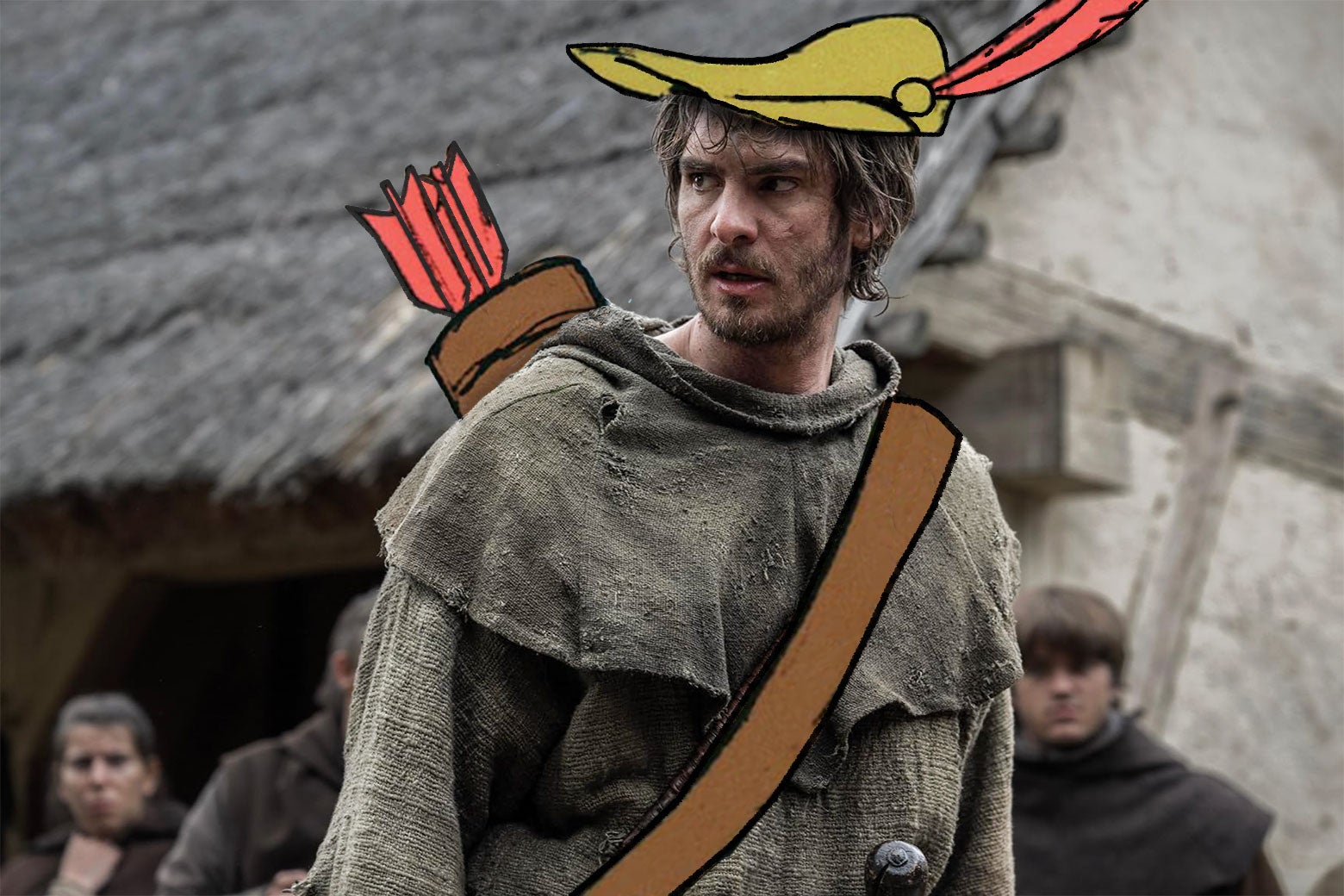
Movies Is The Uprising Really About Robin Hood? By Enter your email to receive alerts for this author. Sign in or create an account to better manage your email preferences. Unsubscribe from email alerts Are you sure you want to unsubscribe from email alerts for Nadira Goffe? Sept 09, 20269:01 AM Photo illustration by Slate. Photos by Betina La Plante/Focus Features and Walt Disney Studios. Sign up for the Slatest to get the most insightful analysis, criticism, and advice out there, delivered to your inbox daily. The trailer for The Uprising—a new action period drama directed by three-time Bourne director Paul Greengrass—starts with Andrew Garfield in 14th-century England, plowing fields, stating: “I am no soldier, I am no priest, I’m just a farmer.” What follows are glimpses of Garfield as the unnamed character dubbed “Ploughman,” leading a massive rebellion (alongside characters played by Cosmo Jarvis and Jamie Bell) of commoners protesting unjust taxation and the serfdom system in a widescale revolt that eventually makes its way to London and King Richard II himself, with fatal results for many. This is the story of the 1381 Peasants’ Revolt, or the Great Uprising, in England, a major point in British history writ large, but especially for England’s political left. While the film had not been getting a particularly large amount of buzz leading up to its Sep. 10 premiere, of the segment of people who were aware of the movie, many seemed excited to see The Uprising tackling such an overlooked part of England’s political history. So you can imagine the public’s confusion when U.S. distributor Focus Features revealed on social media, a mere few weeks before the film’s release, that The Uprising is also, somehow, a Robin Hood origin story. “To the rich, he was an outlaw. To the people, he was a hero. Witness the rise of Robin Hood in The Uprising,” Focus Features tweeted on Aug. 20, sharing a video that touted the film’s new tagline: The Uprising: The Rise of Robin Hood. Before this, The Uprising’s promotional materials had only claimed that the story would detail a more generalized “birth of a legend.” After the big Robin reveal, the film received a new synopsis, which read: “Set against the true events of the Uprising that helped inspire the legend of Robin Hood, [Andrew Garfield’s character] forms an army of the people to face the King’s might in a fight for justice.” This sudden reveal of “Surprise, it’s actually Robin Hood!” was confusing, to say the least. Fans and industry professionals alike were left wondering, Did they just say, “Hey, this sounds Robin Hood-esque. Let’s run with that!” Or was this the plan all along? The answer, I found, is: Yes, it is actually Robin Hood … sorta kinda maybe. If you track the actual production timeline of the movie, you’ll discover that all roads have always led to Nottingham’s greatest legend. In 2022, Deadline reported that Benedict Cumberbatch was set to star in a new film from Greengrass about a peasant farmer revolt, tentatively titled The Hood. Then, it was later announced that the picture would be titled The Rage and would star Matthew McConaughey. Then, as other dominoes fell and Garfield rose in their place, the current title of The Uprising was set, alongside the news that Garfield would be joined onscreen by Jarvis, Bell, Thomasin McKenzie, Tom Hollander, and more. But, to complicate matters further, just last week, the U.K. distributors of the film issued a statement to Metro denying any ties to Robin Hood, stating: “The Uprising is a historical epic about the Peasants’ Revolt of 1381, not Robin Hood. The U.K. marketing campaign does not make any reference to Robin Hood. Marketing materials posted by other countries that may appear in the U.K. online and on social media referencing Robin Hood are not issued or approved by us.” So what is the truth? To get to the bottom of this, we must turn to the movie itself. Now, after having screened The Uprising, I can definitively say that it certainly has some Robin Hood–ness thrust upon it, even if Garfield is never called Robin, or anything of the sort, by name. There is no beef with a Sheriff of Nottingham, no skill in archery, no loyalty to a rightful king, and no Maid Marian (though McKenzie’s tomboyish Alyce might come close). Ploughman does not come from the noble class, though it is unclear to me, a novice in English socioeconomic history, if he is from the yeoman class that Robin Hood is often thought of as hailing from. And yet, Ploughman totally embodies the whole vibe of Robin Hood, even if he doesn’t exactly rob the rich to give to the poor (or rob the government and give back to the overly taxed). The moniker of Ploughman is the first Easter egg that the character was meant to embody the hooded hero. It is likely a nod to the first references to Robin Hood, which are known to have appeared in the Middle English poem Piers Plowman, by William Langland, believed to have been written before the Great Uprising. On top of that, Ploughman dons a green, hooded tunic—of the sort commonly associated with the figure of Robin Hood—throughout the film. And then there’s the Robin-like vigilante nature of Ploughman’s journey. In 1381, England was devastated by the plague, which killed, as a title card in The Uprising states, an estimated one-half of the country’s population, including, in the story, Ploughman’s entire family. The council to the boy-king—Richard II, who is unfit to rule in his late father’s stead, as he has been mentally devastated by bad dreams of “rageful demons” that he sees as omens of the people’s wrath—is in need of money to finance the country’s feud with France, so they decide to unjustly tax commoners, because taxing the merchants would make those merchants feel entitled to “a seat at the table.” The poll-tax collectors and their guards are relentless, and when they visit Ploughman’s village, they physically assault women and girls by putting their hands up their skirts to check if they’re “of age” to be taxed, believing that some commoners are lying about their daughters’ ages to avoid paying. Ploughman, disgusted, and thus radicalized, fights back with his hand sickle and kills a soldier, which sparks a small rebellion. Word of this rebellion spreads to Kent and beyond. Soon, Ploughman realizes he has unintentionally started a massive revolt. Ploughman is steered as one of the protest’s main leaders by the real-life characters of Wat Tyler (Jarvis), the foremost leader of the Uprising, and John Ball (Bell), a priest who was deemed a heretic by the lords because of his preachings of social equality. Throughout the film, though Ploughman does seem to be his own genre of character, he occasionally speaks in Robin Hood–esque quips. He keeps his name hidden, replying “I am what I do” whenever the veracity of his title is questioned. He tells a lord to let the king know that “the laws he writes puts all us men in chains.” Wat Tyler and John Ball tell Ploughman to “cast eyes on those raised by your standard,” as a way to get him to see the number of people he has inspired to rise up against the regime. And yet, when things get heated, Ploughman remains principled by voicing his displeasure with the indiscriminate murder the mob of commoners is bloodthirsty for. “Where is God in any of this?” he asks. Without spoiling a real-life 600-plus-year-old event with an extensive Wiki page that I, yes, consulted extensively for this, let’s just say the uprising in The Uprising doesn’t necessarily go as planned. When the surviving revolters return home to find their lands and homes burned, Ploughman is radicalized once more. He digs his hands into the mud covering his family’s burial site, rubs that mud all over his face in anguish, pulls his hood and his mask up, and is seemingly transformed. The Uprising ends with a time jump, one year later, that sees Ploughman, looking most like Robin Hood now—the color grading, a little more vibrant, really shows the green of his tunic—as he stands, hooded and masked, in the middle of a road, blocking King Richard II’s passage. Ploughman’s presumably merry men ambush the king’s guards. Ploughman fights the king’s lead guard to the death, and almost kills the king before pulling back: “Kill a king, there’s always another,” he spits. Instead, he forces the young king to agree to his terms: “We rule ourselves now,” as there will be “no kings.” In short, yes, the movie is definitely depicting an alternative birth of Robin Hood, but trying to be demure about it. Still, none of this gets at the most important question: Why reveal this … now? If the idea was that uncloaking the film’s supposed ties to the legend of Robin Hood will increase ticket sales, that would be a surprising move, considering this year’s other movie about the folkloric outlaw, A24’s The Death of Robin Hood, all but bombed at the box office. And, as the Guardian notes, this tactic only further perplexed fans, given the seemingly incongruous source materials. Those who were excited for a gritty historical drama were nonplussed to find that The Uprising “would now contain a character best known for once being played by a cartoon fox,” as journalist Stuart Heritage wrote, while others pointed out the anachronistic nature of the plot device, noting that, per Heritage, “the stories of Robin Hood were set during the reign of Richard the Lionheart, who died nearly two centuries before the Peasants’ Revolt took place.” Need I remind everyone: Robin Hood is fictional, and it wouldn’t be entirely out of place for a writer to try to retrofit a well-known, canonically populist figure to a period of historical tumult that could birth, or rebirth, such a political icon. At one point, the Guardian presumes this themselves, hypothesizing that Greengrass could be “suggesting the Peasants’ Revolt helped reshape a mythical figure into a symbol of working-class resistance,” which I think is more in the right direction of Greengrass’ intent. Most charitably, I think it’s highly likely that Greengrass was mapping Robin Hood’s story onto the story of the Great Uprising as a neat way to underline the political overlap; I don’t think the director-writer was trying to literally retcon Robin Hood’s history by claiming that the Peasants’ Revolt definitively birthed the legend of the Lincoln-green-clad outlaw. As for why Focus Features announced this connection so late (or at all), while the U.K. distributors seem to just … disagree? That remains almost as muddy as the state of Andrew Garfield’s wardrobe throughout this two-hour film. History Movies United Kingdom
Is Andrew Garfield’s New Movie Really About Robin Hood? After Watching It, I Have an Answer.
Full Article
Original Source
Read the full article at Slate →KhanList aggregates and links to publicly available news content. We do not host full articles from third-party sources. Always verify important information with original sources.