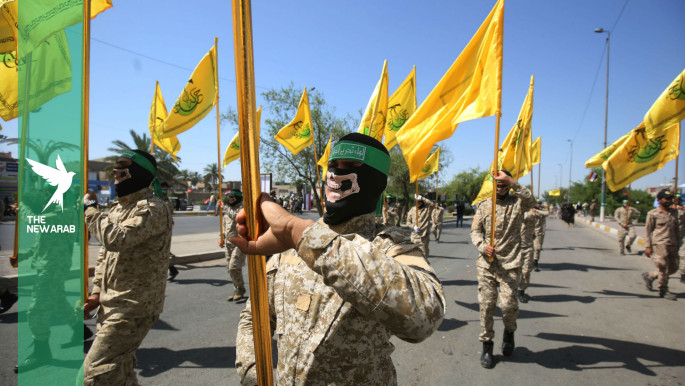
Hardline factions, most notably "Kataib Hezbollah" and "Harakat al-Nujaba", which operate under the name "Islamic Resistance in Iraq", announced their commitment to keeping their weapons and refusing to give them up. [Getty]Iraqi armed factions said they oppose handing over their weapons and refuse to implement the "restriction of arms to the state" as part of the programme of the Iraqi government led by current prime minister, Ali Al-Zaidi, announced after visiting Washington and meeting with US President Donald Trump. Iraqi armed factions, some of whom are linked to Iran, pre-emptively announced their rejection of the visit and its outcomes, considering it the beginning of "economic occupation", particularly as their leaders, like other Iraqis, followed the smooth progress of the visit, especially the meeting between Al-Zaidi and Trump. However, the meeting sparked a wave of factional anger that the groups had already been waiting for, linked to Trump's boastful question about the killing of former Quds Force commander in Iran's Islamic Revolutionary Guard Corps, Qassem Soleimani, and Popular Mobilisation Forces leader Abu Mahdi al-Muhandis in a US strike in January 2020 near Baghdad International Airport. Al-Zaidi refrained from answering and spoke about the future rather than the past, saying, "I was not a politician at that time, and I came here to talk about the future." Al-Zaidi's answer, although described as "diplomatic and smart", opened fire on him from Iraqi factions, which believed he was required to defend Soleimani and Al-Muhandis. Factional resentment over the visit intensified following meetings between the Iraqi government delegation accompanying Al-Zaidi and US companies and businessmen, which focused on outlining future cooperation between the two countries, as well as "opening Iraq's doors" to US investment. The visit also raised questions over the possibility that these groups, namely the factions, could obstruct Al-Zaidi's work or create internal problems to prevent him from continuing his projects and plans after returning to Baghdad. According to a source close to the Iraqi government who spoke to The New Arab, preparations for these plans are expected to begin in practice by creating the general conditions needed to launch them, particularly regarding delegations from US companies that are expected to take turns visiting Iraq in the coming weeks. Hardline factions, most notably "Kataib Hezbollah" and "Harakat al-Nujaba", which operate under the name "Islamic Resistance in Iraq", announced their commitment to keeping their weapons and refusing to give them up, coinciding with Al-Zaidi's visit to Washington. This was followed by a statement from Harakat al-Nujaba leader Akram al-Kaabi, in which he rejected the outcomes of Al-Zaidi's meeting with Trump, saying that "the resistance will remain on alert" and calling for the "expulsion" of US companies that he described as "suspicious". The enthusiasm of media platforms in attacking Al-Zaidi and his team in Washington was joined by a surprising statement from Ali Akbar Velayati, adviser to Iran's supreme leader. In an article published by Iranian media on Friday, 17 July, he said that "Al-Zaidi's visit to the United States was an unfortunate journey, inappropriate in its timing, and an insult to the struggles of the Iraqi people throughout their thousands of years of history." Velayati considered the Iraqi prime minister to be a "young and inexperienced" person. Commitments and agreements Al-Zaidi ended his six-day visit to Washington on Saturday night, 19 July, which resulted in security and political commitments, as well as economic agreements. At the end of the visit, the Iraqi Prime Minister stressed his government's determination to "move forward with embodying the strategic economic partnership between the two countries, strengthening mutual trust and a shared vision for the future". In a post on X, he said, "Based on the agreements, memorandums of understanding and cooperation that we concluded, which will lead to building a new phase of bilateral relations based on shared interests in various fields and joint coordination to consolidate stability and the path of prosperity in Iraq and the entire region." For his part, Iraqi Prime Minister adviser Mazhar Mohammed Saleh said that signing 48 agreements with Washington during Al-Zaidi's visit was a step towards strengthening economic openness, noting that memorandums of understanding with the United States reflect Iraq's direction towards attracting foreign investment. Saleh told the official Iraqi News Agency (INA) on Saturday that "these memorandums reflect, from an economic perspective, Iraq's desire to expand the base of international cooperation and attract foreign capital, sending positive messages to investors and global markets that the Iraqi investment environment is witnessing movement towards greater stability and openness". "The entry of international companies into the Iraqi market would contribute to transferring technology and administrative and technical expertise; improve the efficiency of productive sectors; create job opportunities; as well as support efforts to diversify the economy and reduce reliance on oil revenues through investment in the energy, industry, infrastructure, communications, and services sectors," he added. Iranian discontent In this context, a former adviser to the Iraqi government said that "Al-Zaidi's visit to Washington and his successful meeting with Trump angered many Iranian officials." He attributed this in comments to TNA to the fact that they "feel he may return [to Baghdad] more determined to contain the factions and their leaders and to exert strong pressure towards restricting their weapons to the state." According to the adviser, who declined to be named due to the sensitivity of the issue and its connection to armed factions, "the agreements Al-Zaidi concluded with the American side, involving official bodies and companies, will necessarily lead to abandoning the strong economic alliance between Iraq and Iran". The Kirkuk-Banias oil pipeline, which was recently revived between the governments of Damascus and Baghdad, was understood, according to the former adviser, to be "also directed against Iran, especially as it is under direct US sponsorship and supervision, and came to rehabilitate the crude oil pipeline with an initial capacity of up to two million barrels per day". "This step achieves extremely dangerous strategic objectives, the first of which is stripping Iran of its strongest current weapon, the Strait of Hormuz," he noted. He explained that "therefore, the transport of Iraqi and Kuwaiti oil through Syria, Saudi oil through the Red Sea, and Emirati oil through the Gulf of Oman would strip the Strait of Hormuz of its strategic value". However, the former adviser said that "the factions and groups loyal to Iran in Iraq are unable to confront or obstruct the plans of the current Iraqi government, because this government is supported by the majority of parties, including Shia parties that see abandoning Iran as an existential necessity." Implications of Al-Zaidi's visit to Washington Mohammed Alawiya, head of the Ishtar Centre for Supporting Democracy in Najaf, said that "Iranian concerns over Al-Zaidi's visit to Washington and the significant US attention the visit received have been reflected, and will continue to be reflected, in opposing positions towards Al-Zaidi's government by Iran-allied groups inside Iraq." Speaking to TNA, he added that these positions "make Al-Zaidi's declared mission of restricting weapons and fighting corruption more difficult and complex". In his view, "Al-Zaidi needs an intensive and high-level diplomatic effort, both internally and externally, through which he can mobilise the largest possible number of forces supporting the new equation that the Iraqi government seeks to formulate through rapprochement with the United States, rather than increasing opponents of this equation, to achieve an acceptable level of stability that guarantees the success of this complex mission". Iraqi political affairs researcher Ziad Tariq, for his part, pointed out that "the fierce attack launched by some armed groups against Al-Zaidi under the pretext of his meeting with Trump has nothing to do with sovereignty, but rather with calculations related to alignment against Iran." Speaking to TNA, he explained that "what proves the falsity of this principled uproar is the double standards and their Iran-allied armed groups' long silence over previous positions that were more severe". He noted that "we did not see this anger when Nouri al-Maliki [former Iraqi prime minister] laid wreaths on the graves of American soldiers [on two separate occasions in 2009 and 2011], nor did they act when Mohammed Shia Al-Sudani [another former prime minister] nominated Trump for the Nobel Peace Prize". Tariq considered that "the current anti-corruption campaign in Iraq being carried out by the Iraqi government is also directly linked to the positions of the factions, as this campaign threatened to open the files of the factions' economies, which dominate broad economic and financial sectors." Article translated from Arabic by Afrah Almatwari. To read the original, click here.
Iraqi factions are angry over Al-Zaidi's agreements with US
Full Article
Original Source
Read the full article at Newarab →KhanList aggregates and links to publicly available news content. We do not host full articles from third-party sources. Always verify important information with original sources.