
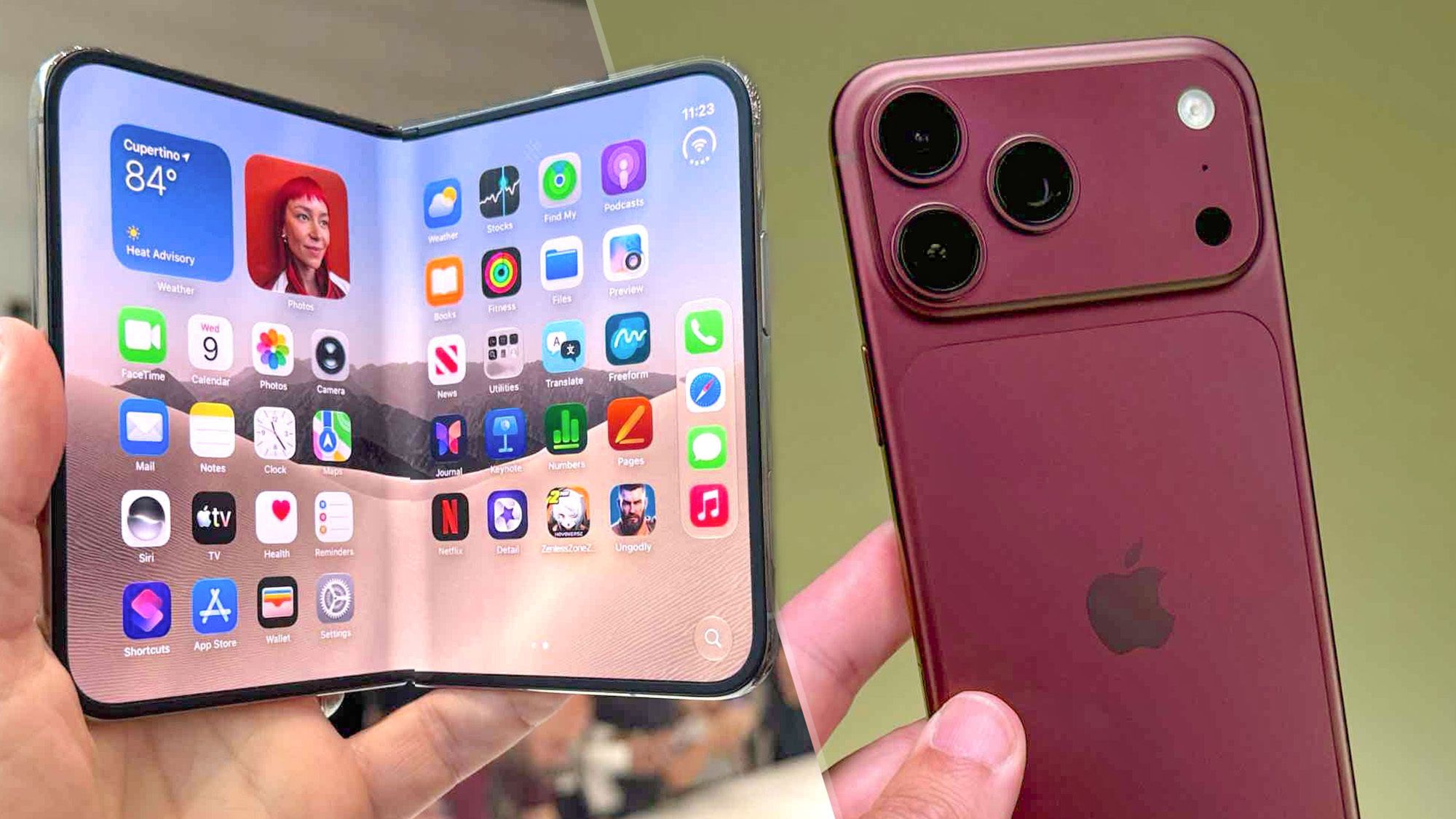
(Image credit: Future) I’ve spent the last couple of weeks testing both the iPhone 18 Pro and iPhone 18 Pro Max, which revealed some of their biggest upgrades — like the class-leading performance of the A20 Pro chip and improved battery life. But with the launch of the iPhone Duo right around the corner, plenty of people are likely still undecided about which one they should buy.The fact that the Duo is Apple’s first-ever foldable device is appealing all on its own. Who wouldn’t want the novelty of having an expansive 7.6-inch canvas to multitask and watch videos on the go? However, the price gap certainly gives reason to pause. With a starting price of $1,999, the iPhone Duo commands a massive premium over the $1,299 iPhone 18 Pro Max.Paying significantly more for the Duo doesn't just mean a lighter wallet — it comes with the reality of accepting some real compromises. And I'm not just talking about potential iPhone Duo dealbreakers we've already covered, like the lack of telephoto zoom and Face ID. After testing the 18 Pro lineup, these are the 7 features you’re giving up if you choose the iPhone Duo over the iPhone 18 Pro Max.Proper MagSafe compatibility (Image credit: John Velasco / Tom's Guide)MagSafe is no longer just an option for me — it’s a necessity given the utility it offers. While the iPhone Duo does include a magnetic ring, I won’t be able to use my favorite MagSafe accessories nearly as smoothly as I do on the iPhone 18 Pro Max.That's because the Duo's folding design shifts internal components and cuts into rear real estate. Meaning, standard-sized MagSafe accessories don't sit flush against the back. A perfect example is the MagSafe wallets I've tested, which would overhang past the bottom edge of the frame. Sure, they might still technically stick — but you lose the seamless feel that makes the ecosystem so good in the first place.Variable aperture (Image credit: Future)Even now, I’m constantly impressed watching the mechanical aperture blades over the main camera open and close on the iPhone 18 Pro series. This new system finally brings true optical versatility, letting me stop down to keep expansive landscapes in razor-sharp focus or open wide to produce authentic background blur in portraits.I won’t have that mechanical control on the iPhone Duo, leaving me entirely at the mercy of digital post-processing and simulated depth maps. Missing out on the iPhone 18 Pro Max's physical aperture also means losing creative flexibility in other shooting scenarios — like intentionally adding motion blur with moving subjects.Sign up to the Tom's iGuide weekly newsletter with coverage on everything from product launches to software updates, this is your go-to source for the latest updates on all the best Apple content.Action Button (Image credit: Future)Whether you stick with its default setting or customize it, the Action button on the iPhone 18 Pro Max offers genuine utility and granular control over how the phone behaves.I rely on it daily for tactile access to my flashlight, camera presets, and favorite Shortcuts — a luxury the iPhone Duo simply won't have. That absence stings even more on a foldable, where a programmable physical key could have effortlessly launched two apps side by side with a single click.Camera Control (Image credit: Future)I know I’ve been a harsh critic of the dedicated Camera Control, but it still proves its worth on the iPhone 18 Pro Max. While the capacitive button serves primarily to replicate a traditional physical shutter, its swipe-gesture recognition adds real utility. For instance, it lets me smoothly dial in hyper-specific framing — like locking onto an exact 25.5x zoom — without introducing handshake or jitter.On the iPhone Duo, I’d be stuck clumsily pinching the screen, constantly being over or under my target. For anyone who takes mobile photography seriously, the iPhone Duo will force you to trade tactile precision for awkward touch controls.ProRAW/ProRES (Image credit: Future)For serious shooters like myself, Apple ProRAW and ProRes on the iPhone 18 Pro Max provide an essential layer of control in the editing room. ProRAW captures uncompressed files with full sensor readout, giving me the ability to recover highlights, lift shadows, and fine-tune white balance. Pair that with ProRes video — which preserves 10-bit color depth and low compression for smooth scrubbing — and the 18 Pro Max can easily double as an A-cam when I can't use my professional setup.With the iPhone Duo, though, you’re limited to standard HEIF and JPEG photos alongside heavily compressed video. While those are perfectly fine for quick social shares, they strip away the post-production editing workflow that lets me get the most out of the cameras.Log recording (Image credit: John Velasco / Tom's Guide)Another video-centric feature that delivers noticeable quality gains is Apple Log on the iPhone 18 Pro Max. While the unedited footage looks flat and desaturated straight out of camera, the Log profile preserves maximum dynamic range in the highlights and shadows — giving me far more control when color grading. That becomes especially crucial whenever I need to match mobile clips to footage shot on dedicated mirrorless cameras.Because Log recording isn’t available on the iPhone Duo, I’d be stuck with Apple’s baked-in color science and contrast. That’s more than fine for casual social clips, but if you rely on your phone as a reliable B-cam, losing Log support makes the Duo a tough sell for serious video workflows.Spatial photos and videos (Image credit: Apple)Even if it isn't an everyday shooting mode for most people, the ability to capture spatial photos and videos has real perks. The iPhone 18 Pro Max has the calibrated sensor array required to record lifelike stereoscopic media ready for playback on Apple Vision Pro — while letting you preview that parallax effect right inside the Photos app.Because the iPhone Duo lacks a LiDAR scanner and the necessary lens alignment, spatial capture isn't an option. That's a miss in my book, especially given how much more pronounced and lifelike the 3D depth feels with static shots. It's way more genuine than the AI-assisted generation of Reframe. (Image credit: Future)Follow Tom's Guide on Google News and add us as a preferred source to get our up-to-date news, analysis, and reviews in your feeds. Make sure to click the Follow button!More from Tom's Guide Android president on Apple's iPhone Duo: 'I'm glad to see more people joining what is now the obvious party'Forget iPhone 18 Pro — 9 reasons to wait for the iPhone 20I finally unlinked my iPhone alarm from my ringer volume — here is where Apple hid it in iOS 27 John’s a senior editor covering phones for Tom’s Guide. He’s no stranger in this area having covered mobile phones and gadgets since 2008 when he started his career. On top of his editor duties, he’s a seasoned videographer being in front and behind the camera producing YouTube videos. Previously, he held editor roles with PhoneArena, Android Authority, Digital Trends, and SPY. Outside of tech, he enjoys producing mini documentaries and fun social clips for small businesses, enjoying the beach life at the Jersey Shore, and recently becoming a first time homeowner.
iPhone Duo: 7 features you’re giving up by not buying the iPhone 18 Pro Max
Full Article
Original Source
Read the full article at Tomsguide →KhanList aggregates and links to publicly available news content. We do not host full articles from third-party sources. Always verify important information with original sources.