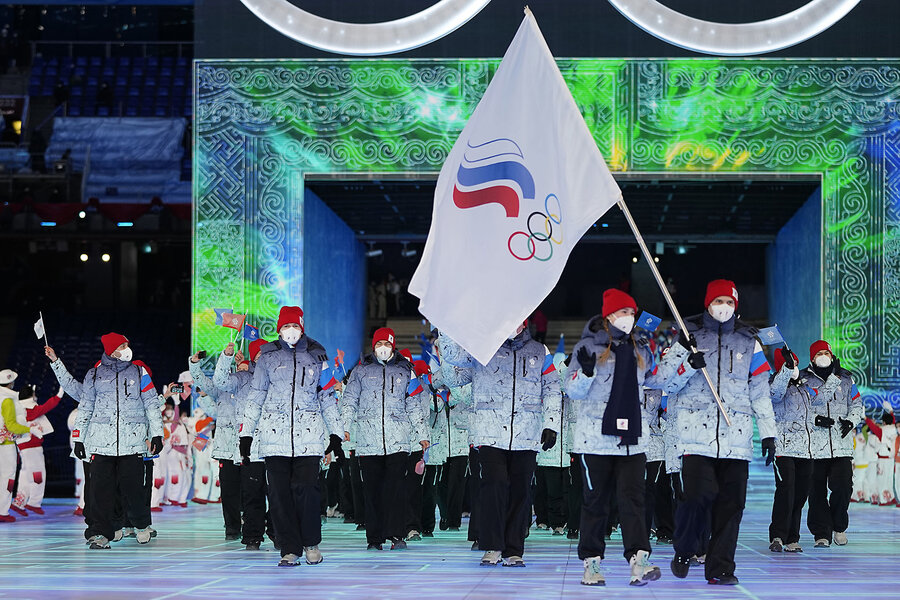
After a decade of partial isolation from international sports, Russian athletes and sports fans may finally see their flag flying at an Olympic Games in the near future.And it might be largely due to a quiet reversal by the Russian government on the inclusion of athletes from Russia-occupied Ukraine within its Olympic programs.The International Olympic Committee removed the suspension of its Russian affiliate this month, potentially paving the way for Russian teams to fully participate in the upcoming 2028 Summer Games in Los Angeles. Though it’s far from certain that all Russian athletes will be allowed to compete under their national flag and anthem, some Russians believe that this, along with a decision to remove restrictions on the Belarus Olympic Committee a couple of months ago, signals that Russia’s ban is coming to an end. Why We Wrote This One of the more painful parts of the break with the West for Russians has been their country’s exile from international sports competition. That might be in the process of ending now – though at a potential domestic political cost for Moscow. Kremlin spokesperson Dmitry Peskov hailed the IOC decision as a “great achievement,” made possible by a whole team of Russian negotiators working on the issue. Sports Minister Mikhail Degtyarev said Russia would be taking national sports federations to court if they continue to bar Russians, and warned that countries – such as Poland and the Baltic states – that refuse to host Russian athletes might lose their right to hold international competitions and “become marginal” in international sports.The mood was summed up by legendary figure skater and coach Tatiana Tarasova, who told state TV that “our liberation has begun. ... They treated us unfairly, they took it from us, and now they are slowly starting to restore it. We’re happy, but there’s nothing to thank them for.”Sergei Druzhinin, coach of Sokol hockey club in Krasnoyarsk in Siberia, which suffered when foreign players left the team after the 2022 invasion of Ukraine began, says it’s high time politics was removed entirely from the world of sports. “Competition should be at the highest level, as much as possible,” he says. “Only matching with a worthy opponent enables us to grow, and creates a real spectacle for the fans.” Russian Sports Minister Mikhail Degtyarev attends a memorial ceremony for Alexei Butovsky, one of the founders of the International Olympic Committee, in Moscow, July 9, 2026. A Kremlin rollback?Russia has been in the Olympic doghouse since a massive doping scandal in the wake of the troubled 2014 Winter Games it hosted in Sochi. Harsh scrutiny was focused on the Russian Olympic Committee and led to the exclusion of many Russian athletes, as well as bans on the displaying of national symbols by those allowed to participate.With the Kremlin’s full-scale invasion of Ukraine, the ban became universal, and only a few Russians have since been permitted to compete as “neutral” individuals. Only 15 Russian athletes were allowed to take part in the 2024 Summer Games in Paris, without any national identification, which led the Russian media to dub them “the Olympics of Hell” and the usually sports-obsessed Russian public to lose interest in the Games altogether.But the immediate reason for the IOC’s change of heart is an issue that’s been little discussed in Russia, and could present a political problem.The Russian Olympic Committee had been admitting local sports organizations in territories of Ukraine that Russia annexed in 2022 – Donetsk, Luhansk, Kherson, and Zaporizhzhia – under the Russian constitution. An overwhelming majority of countries view Russia’s annexation of those territories as illegal, and still considers them to be part of Ukraine. The IOC fully suspended the ROC in response to its actions.Over the past few years, the ROC has quietly purged the organizations and athletes from the occupied territories out of its ranks, bringing them back into compliance with IOC rules: a fact the international body recognized in lifting the suspension this month.Andrey Kolesnikov, a Moscow-based columnist for the independent Novaya Gazeta newspaper, says that Russian – and probably Kremlin – eagerness to return to the international stage explains the willingness to exclude people in what are referred to as the “new territories.”“I don’t think the sports ministry could pursue an independent policy, so they must have gotten approval from the top,” he says. “It’s about this great desire to restore relations, which so far is only happening in the field of sports.”This could come back to bite the Kremlin, because the ROC has effectively disenfranchised people in the occupied regions whom it has recognized as Russian citizens. The decision might have satisfied the IOC, but it opens the Russian government up to political attack from Russian nationalists, who are influential. Kai Pfaffenbach/Action Images/Reuters Volleyball player Sergey Tetyukhin carries the flag of Russia during the opening ceremony of the Olympic Games in Rio de Janeiro, Aug. 5, 2016. “We lost our edge”Efforts to create alternative competitions, such as annual games sponsored by the major emerging economies that make up the BRICS countries, or the Olympics-lite World Friendship Games held in Moscow two years ago, have given Russian athletes something to do. But they have not impressed the public.“Our athletes had to compete with sportsmen from Belarus and a few other countries for a decade, which was a retreat, a degradation,” says Oleg Shamonaev, an expert with Sport-Express, a leading sports daily in Moscow. “We lost our edge, and the rest of the world forgot about us. We need to go out and compete, broaden horizons, learn new things.”A March poll by the state-funded VTsIOM agency found that 44% of Russian respondents said that sanctions have negatively impacted the development of Russian sports, compared with 9% who thought it was positive. Nearly 90% agreed it was important to participate in international sporting events; 48% thought so even if Russians had to accept “neutral” status, while 39% believe they shouldn’t go under such conditions.The situation is looking a bit more hopeful for Russia’s return to world sports, says Mr. Shamonaev, but the damage has been done.“We lost a whole generation of athletes in biathlon because of these limitations, and it’s still not clear if the situation will return to normal,” he says. “The same is true about basketball, hockey, football. ... There is little to celebrate.”
IOC drops Russia ban, but it might not be all good news for the Kremlin
Full Article
Original Source
Read the full article at Csmonitor →KhanList aggregates and links to publicly available news content. We do not host full articles from third-party sources. Always verify important information with original sources.