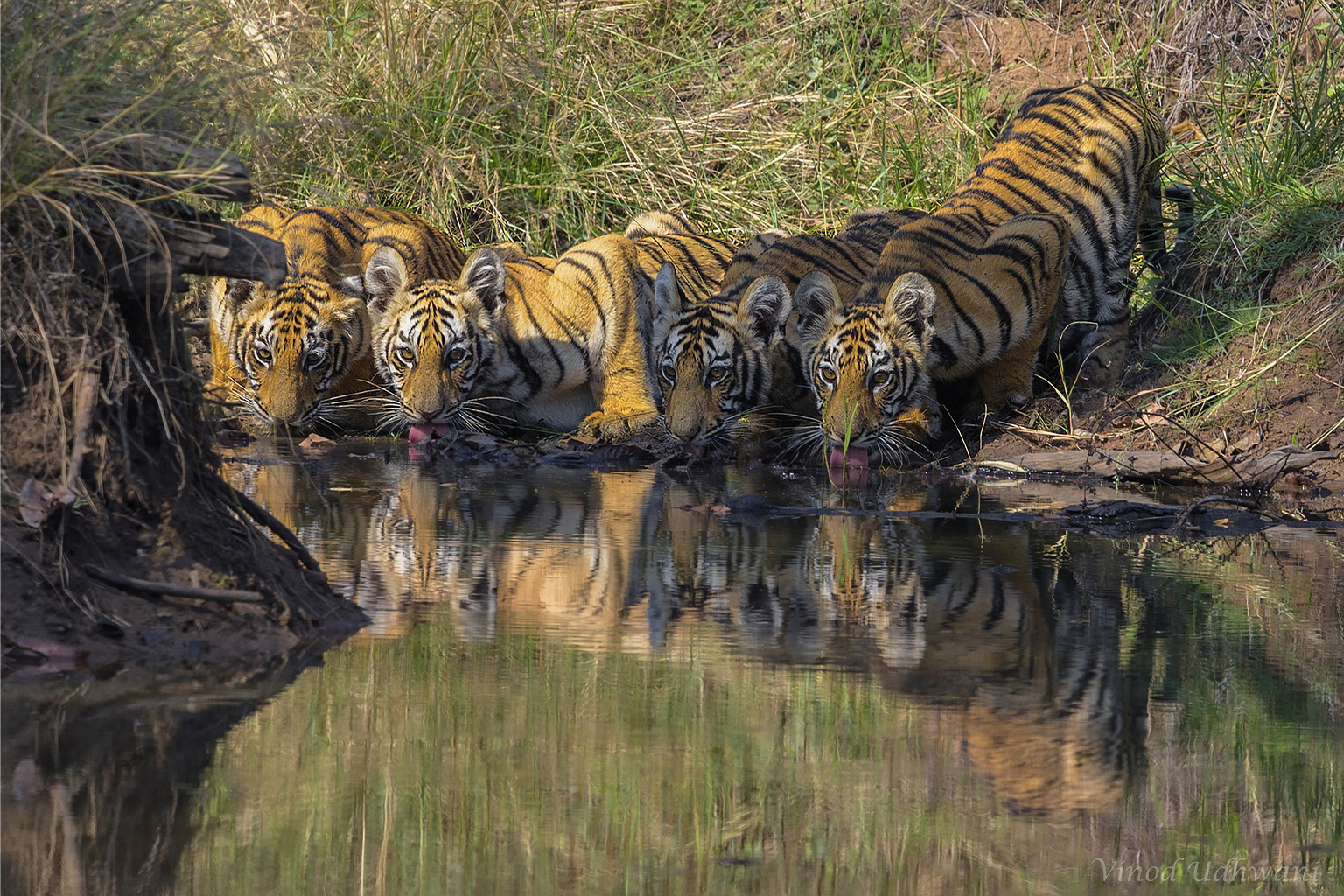
July 29 is International Tiger Day. Few species have benefitted from global conservation attention and funding like the tiger. Its numbers have seen a hopeful increase in recent years, yet the big cat continues to face localized pressures. Recent Mongabay coverage highlights three starkly different realities for tigers (Panthera tigris) across Asia. India’s corridors under pressure India remains the global stronghold for wild tigers, currently home to roughly 75% of the world’s remaining population. While India’s 2022 census shows numbers have rebounded to an estimated 3,682 cats, this success brings new challenges, reports contributor Nirmal Ghosh for Mongabay. As tiger numbers grow in protected areas, the big cats are forced to disperse out in search of new homes. They end up navigating human-dominated landscapes where they’re likely to run into conflict with people or infrastructure like roads and railways. Though India has invested heavily in building some of the world’s largest wildlife underpasses, Ghosh reports that vital ecological corridors remain under severe threat, and development proposals like mining and road infrastructure in protected habitats continue to be approved. Nepal’s controversial solution for ‘problem’ tigers Nepal has successfully tripled its tiger population since 2009 to 355 individuals, report Mongabay’s Abhaya Raj Joshi and contributor Mukesh Pokhrel. But this boom has led to a sharp rise in human-tiger conflict. Government records show 38 people died in tiger attacks between 2019 and 2023, leaving authorities struggling to manage the captured “problem” tigers, or individuals involved in killing and eating one or more humans. With overcrowded zoos and holding centers, Hari Bhadra Acharya, a senior ecologist with the Department of National Parks and Wildlife Conservation, said the government is proposing a 50-hectare (124-acre) fenced safari park funded by tourism. However, Hari Sharma, zoology professor at Tribhuvan University, warned that funding from tourism can be highly unstable and unreliable. Furthermore, researcher Babu Ram Lamichhane pointed to a 2017 study showing fewer than 5% of tigers cause conflicts, advocating instead for early-warning systems rather than large-scale captivity. Cambodia’s risky reintroduction In Cambodia, where wild tigers were formally declared extinct in 2016, the government is pushing an ambitious plan to introduce Bengal tigers imported from India into the Cardamom Mountains, report Mongabay India’s Arathi Menon and contributor Andy Ball. However, a 2020 study by the nonprofit Wildlife Alliance and the Norwegian Institute for Nature Research found that the proposed habitat suffers from severe prey depletion. A recent undercover investigation by Earth League International (ELI), reported on by Mongabay’s Spoorthy Raman, exposed a thriving, cartel-run domestic black market in Cambodia catering to an appetite for tiger parts. Debbie Banks, who serves as the tiger and wildlife crime campaign lead at the U.K.-based Environmental Investigation Agency (EIA), warned that without addressing this lack of enforcement and complicity, the fate of any translocated tigers to Cambodia “is very gloomy.” Banner image: A tiger in India. Image ©Vinod Udhwani via iNaturalist (CC BY-NC 4.0). Credits Topics
International Tiger Day: A complex landscape of recovery, conflict, and empty forests
Full Article
Original Source
Read the full article at News →KhanList aggregates and links to publicly available news content. We do not host full articles from third-party sources. Always verify important information with original sources.