
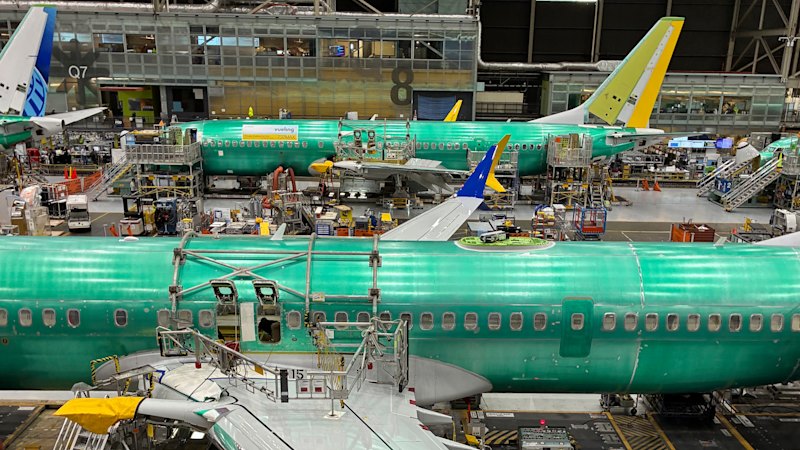
Few aircraft are more closely watched than the Boeing 737.Since first rolling off the assembly line in 1967, it has been in continuous production, and more than 12,000 airframes have been sold. In the process, it has created a legacy that has defined modern air travel, shaping how airports are built and the business models of airlines.There are 10 main stages to the production of a Boeing 737. Chris Zappone Boeing 737s are everywhere in global aviation – comprising whole fleets in some cases, and making up the backbones of others, such as those of Qantas and Virgin’s domestic operations.In recent years, however, the world’s most important commercial airliner has received attention for another, troubling, reason. The 737 has been tainted by design defects and quality control failures, most notably highlighted by the tragic crashes of two 737 MAX 8 jets in 2018 and 2019, which led to a worldwide grounding and direct US Federal Aviation Administration production oversight.The aviation icon now sits at the centre of a crisis of trust, but is, in a way, a symbol of American – and even Western – manufacturing. The symbolism is underpinned by commercial realities. The other pressing reason the 737 gets so much attention is that the world’s airlines remain hungry for new, more efficient 737 MAX airframes. The MAX uses 20 per cent less fuel than previous versions of the 737.Boeing says the MAX line offers airlines greater profit potential and it averages 7 per cent lower operating costs with up to 14 per cent lower maintenance costs than its competitor.This masthead recently secured access to a Boeing factory (after lengthy negotiations with the company) in Renton, Washington state. The facility has been the home of 737 production since 1970.Ten ‘flow days’The 737 begins life as the fuselage, shipped in by train from Kansas, where it’s made, and enters the factory.Fuselages arrive by rail, in the distinct green colour of their protective primer. From there, each fuselage is rolled and lifted into position in an elevated part of the factory, where it is inspected. Insulation, electronic, hydraulic, and mechanical parts are then installed.Fuselages fresh in by train from Kansas at Boeing’s Renton, Washington state, factory.Chris ZapponeAt this point, the fuselages are lined up closely three abreast as they undergo their first three “flow days” – a term for the station of production.It takes 10 flow days, with each day representing a specific stop along the assembly line for the fuselage – to put a 737 together. The first three comprise wiring (about 70 kilometres’ worth), and putting in hydraulic tubing, flight control cables, the dorsal fin, and the controls within the flight deck. A protective cover for the radar at the tip of the plane’s nose is also installed in this phase.In somewhat confusing nomenclature, the flow days are usually longer than 24 hours. The pacing of production is designed with enough of a gap to allow for minor delays or unexpected changes.On day four, the fuselages are moved down from the upper level of the factory onto the floor. To get them into lines, a crane mounted in the ceiling of the enormous facility moves them through a special gap in the wall into three parallel floor assembly lines.A busy but orderly floor at Boeing’s Renton factory.Chris ZapponeHere the fuselages are spread out nose to tail. The three floor assembly lines are called the West Line, the Central Line and the East Line.This year Boeing opened a North Line for 737 production. Based in Everett, Washington, the North Line will expand Boeing’s capacity to build 737 MAX-family jets to meet market demand, including a current order backlog of 4300.In the Renton factory, movement by crane happens at night, and it takes about an hour per fuselage. The factory runs 24 hours a day year-round except Christmas and the Thanksgiving holiday in late November.Boeing 737s have been made at the factory for decades.Chris ZapponeCompared with Airbus factories, Boeing’s shop floor is more densely filled with equipment, and seems more like a factory. Staff call out to each other over the machine sounds of production. Workstations where specialised tasks and technical problem-solving take place are positioned along the floor.Between the buildings, staff move on shuttles, cars and scooters. The train line bringing the fuselages from Kansas comes right through the campus.Flow day four is always the big one for the 737. This is when it gets its wings, horizontal and vertical stabilisers, and landing gear. (The winglets, or tips of wings that flare up and down, are primarily made at Boeing’s Melbourne facility in Fishermans Bend.)From there, the plane can rest on its own weight and is ready for the next step, in which the toilets, galleys and water and wastewater tanks are installed. The side walls, overhead bins and forward galleys are installed the day after.Carpeting and seats come on day eight. Boeing installs the seats using a machine similar to a hay baler, or an inclined conveyor belt that takes the seats up three at a time into the door, where technicians receive them and install them in the plane.Despite delays in cabin seat availability and FAA certification in wide-body planes, seats for the 737 have had less complexity, and hence, fewer hold-ups.On day nine, the engines are installed and connected to the electronic and hydraulic systems.The factory floor.Chris ZapponeAll up, it takes 15 days from the fuselage coming into the factory to the plane being completed and made ready for inspection by the purchasing airline. After that, test flights are conducted over central Washington state.Factory employees lunch within view of the planes in progress, either eating at canteens or bringing their own food, and sitting at lunch tables on the balcony overlooking the main action. The vast building also houses offices, which gives it a hive-like feeling.One Boeing employee said working in the office in this building was more fun simply because he could look out and see the planes being put together at scale.Chris Zappone travelled to Seattle as a guest of Alaska Airlines.The Business Briefing newsletter delivers major stories, exclusive coverage and expert opinion. Sign up to get it every weekday morning.Chris Zappone is a senior reporter covering aviation and business. He is former digital foreign editor.Connect via X, Facebook or email.From our partners
Inside the building of a Boeing 737 – from scratch
Full Article
Original Source
Read the full article at Smh →KhanList aggregates and links to publicly available news content. We do not host full articles from third-party sources. Always verify important information with original sources.