
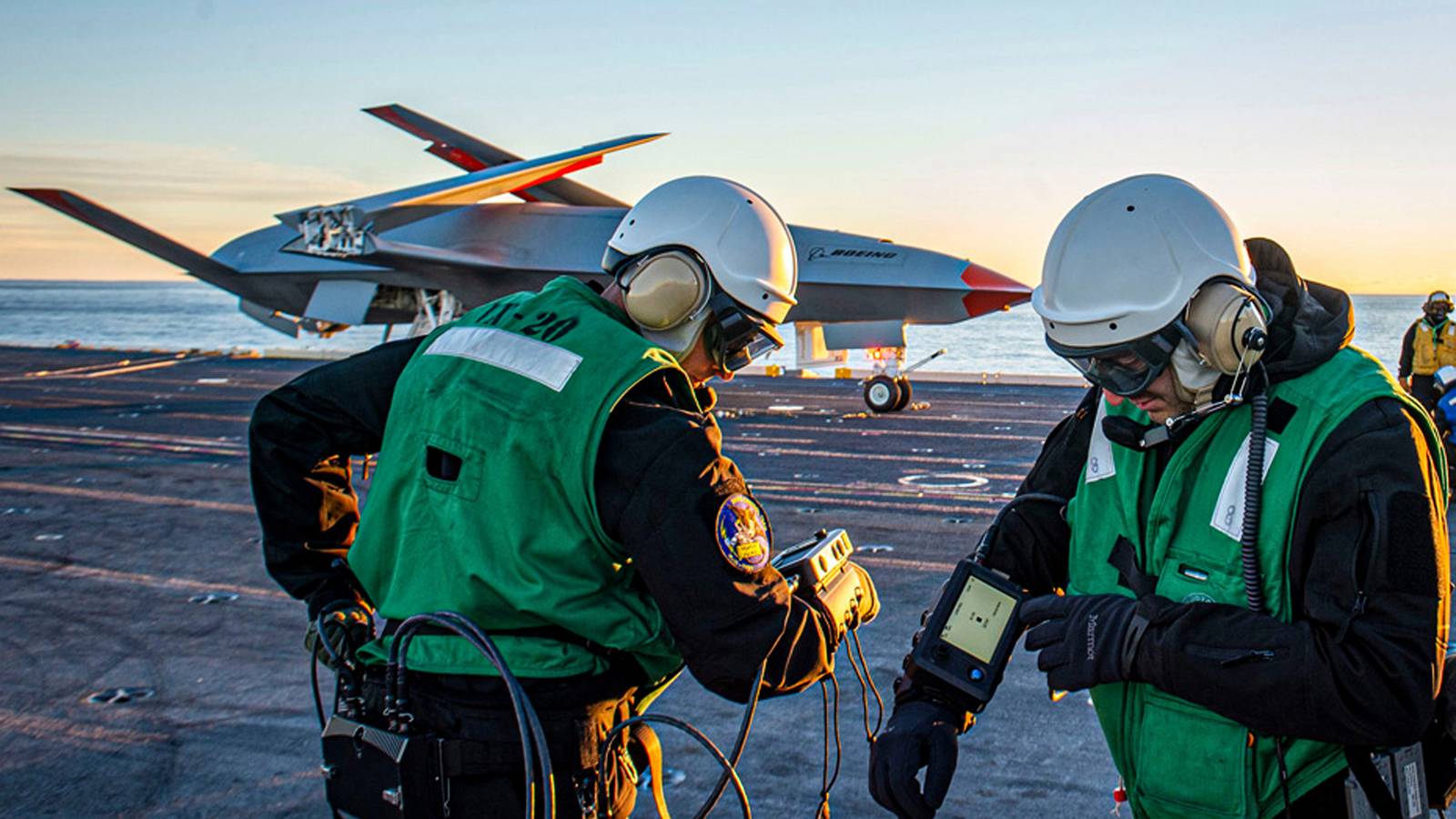
Published Oct 5, 2026, 1:00 AM EDT Luke Diaz is a freelance military writer with experience with active duty experience in the US Navy as well as defense and industrial engineering. He is a former Naval Flight Officer who performed tactical air control on the carrier-based E-2 Hawkeye. The US Navy has committed $562 million to begin producing its first operational carrier drone, just a month after the White House ordered a plan to remove the advanced launch system built to handle everything from light uncrewed aircraft to heavy strike fighters. The Lot 1 low-rate initial production award to Boeing was signed on September 14, officially moving the MQ-25A Stingray aerial tanker toward fleet integration. This major production milestone stands in sharp contrast to a presidential memorandum issued on August 13, which directed the military to draft a plan replacing the advanced electromagnetic catapults on the future aircraft carrier USS Doris Miller (CVN-81) with legacy steam-powered systems. The central question now facing top brass and shipbuilders is whether swapping the launch mechanism on a single ship class will undercut the capabilities of a next-gen carrier air wing the Navy has spent decades designing. Navy Funds First Carrier Drone As Catapult Debate Grows Credit: Boeing Boeing is making the new Stingray drone almost exclusively to perform one mission: aerial refueling. However, it will also be quick, with limited capacity for intelligence, surveillance, and reconnaissance, and its modular design could allow further mission expansion in the future. Taking over the 'buddy tanking' mission alone is a massive force enhancement for the US Navy Air Wing. The MQ-25A is engineered to deliver up to 16,000 pounds of fuel at a distance of 500 nautical miles (926 km) from the carrier, a specialized mission that takes the exhausting organic tanking role away from F/A-18E/F Super Hornet fighters and frees up strike aircraft for actual combat operations, as USNI covered. The $562 million fixed-price incentive contract funds three Lot 1 drones and covers parts for three Lot 2 aircraft, bringing the total number of MQ-25A Stingrays to 14. This followed Milestone C in May, marking the formal decision to enter low-rate initial production just weeks after the first operational test flight. The Navy plans to award Lot 2 next year and expects the first deliveries by 2029, making this a modest opening step toward a total program of record that calls for 76 aircraft. As the primary blueprint for how the Navy intends to handle uncrewed aviation on a crowded flight deck, the Stingray leaves open exactly what the executive order would disrupt. The Stingray measures 51 feet (15.54 meters) in length with a 75-foot (22.86 meters) wingspan that folds down to 31 feet (9.45 meters) for tighter deck handling. It is considerably smaller and lighter than any crewed 'tailhook' plane currently in the USN air wing. Launching it requires highly precise, lower-power catapult settings. Shifting the future carrier's design away from digital electromagnetic systems could fundamentally undermine the next-gen platforms of The Air Wing Of The Future. Executive Intervention And Industrial Penalties Credit: US Navy This mid-construction reversal stems from Donald Trump’s insistence that he understands military strategy and technology better than the Pentagon’s own leadership, as former Navy pilot and Senator Mark Kelly has pointed out. Doubling down on his assertion that he knows more about warfare than anyone, Trump is trying to single-handedly upend the Ford-class program that would support the MQ-25 and other next-gen platforms like the F/A-XX. By aggressively interfering with settled doctrine, this executive overrule threatens to ruin the technological foundation of Air Wing Of The Future. While critics point to early operational hiccups and years-long delivery delays during the Ford program's initial learning curve to justify the shift, forcing a complete midstream engineering pivot imposes severe industrial penalties on a major naval centerpiece. Prime contractor General Atomics has already completed nearly 50% of its EMALS installation for the next CVN, USS Doris Miller. Replacing that introduces massive cost, schedule, and integration risks. Navy engineers would need to figure out how to route high-pressure steam lines through a hull explicitly designed for electric cabling. This creates a severe bottleneck that delays carrier deployments and hands an advantage to foreign adversaries. Drone Tankers And The Future Air Wing Credit: US Navy Experts have repeatedly warned that electromagnetic launchers are essential for calibrating the precise launch profiles of autonomous aircraft, and forcing a return to less consistent steam mechanics risks dismantling the very technology needed to seamlessly launch next-generation air wings. Trump’s insistence that his personal instincts outperform naval engineers and the admiralty has driven a policy that threatens to ruin the future of carrier-based uncrewed aviation. While specialized launch systems are designed to precisely tailor acceleration for lightweight drones, Trump’s demand to reactivate legacy system tech upends decades of design. By micromanaging complex naval and aerospace design, Trump's interference disrupts a multi-billion-dollar modernization effort. The Navy has credited digital launch systems with faster resets and lower maintenance footprints, yet Trump’s reliance on obsolete tech forces shipbuilders backward. Even though upcoming carrier drones are being built with strict dual-compatibility requirements to fit both steam and digital decks, erasing the superior safety margins and precise digital calibration of electromagnetic systems compromises the fleet’s future capabilities purely to satisfy a political directive. Steam Versus EMALS: The Numbers Just Don't Add Up Credit: US Navy According to long-term calculations, the Ford design reduces operating and support expenses by roughly $4 billion per ship over a 50-year period. It drops the core crew to 2,600 personnel, and labor savings represent only half the case. The most critical operational advantage concerns what the ship can actually put in the sky. The Ford-class hull was engineered from the ground up around two A1B reactors that supply far more electrical power than a Nimitz-class supercarrier, primarily for the sake of EMALS. Naval architects can't simply repurpose previous Nimitz-class plans because current technology is integrated into the hull's architecture. It would cost several billion dollars to redesign the ship at this point to accommodate high-pressure steam lines. A conventional steam catapult needs water and condensation equipment, plus enormous high-pressure steam pipes that run straight from the nuclear power plant to the flight deck. In order to create space for digital technologies, this bulky plumbing infrastructure was purposefully removed from the Ford design. Industrial Overhauls And The Chinese Shipbuilding Threat Credit: US Navy Defense analysts warn that this mid-construction engineering overhaul could push carrier delivery timelines back toward the end of the next decade. Sacrificing electromagnetic launch capability for an outdated, delayed steam alternative directly jeopardizes the Navy's ability to deploy next-generation uncrewed air wings. In a contested Pacific area where China is actively pursuing naval superiority, this would make American attack groups extremely vulnerable. At a time when China's People's Liberation Army Navy is actively closing the capability gap with the US Navy and rapidly growing its blue-water fleet, this is a terrible delay. Since the Navy hasn't ordered a steam catapult system in 20 years, the supply chain is extremely precarious, which exacerbates the technical difficulty. The last set was produced for the USS George H.W. Bush (CVN-77), which went into service in 2009. Because no new C13 steam catapult components have been built in nearly two decades, finding a manufacturer and resurrecting the specialized tooling would require a sweeping, years-long industrial overhaul. Forcing such a regression threatens to stall American carrier production precisely as Chinese shipyards outpace US manufacturing capacity. Beijing is already rolling out advanced Type 003 and Type 004 carriers equipped with their own indigenous electromagnetic launch systems. Operational Maturity Refined On The High Seas Credit: US Navy EMALS has evolved, as evidenced by the USS Gerald R. Ford's return in May 2026 from the longest deployment since the Vietnam War: 326 days. During this tour alone, the air wing carried out 12,200 electromagnetic launches, exceeding the ship's lifetime total of 36,863 launches. This long operational history shows that the technology has successfully progressed past its challenging prototype stage after years of flight deck testing. Ford's digital catapults produce a higher sortie rate than traditional steam carriers, according to a high-tempo surge test conducted in February 2026. This concrete milestone proves that the hard-won engineering adjustments made to the lead ship have translated into superior, combat-ready performance. With the system finally perfected, abandoning it ignores a decade of valuable data. Surrendering The Technical Edge To Global Rivals Credit: US Navy As foreign navies make use of these insights, winding down the program now ignores them. France has acquired American EMALS hardware for its next flagship, while China's more recent Fujian carrier possesses three electromagnetic catapults. The USN is forced to give up an operational advantage that foreign competitors are actively vying for because of a design reversal. This hard-won mastery is at the heart of the opposition to going back to steam. Former Navy pilot Senator Mark Kelly publicly cautioned that complicated aircraft carrier machinery decisions shouldn't be dictated by outside political meddling. The fleet has already figured things out, as seen by Ford's successful 2026 deployment. An Air Wing On A Slower Clock Credit: Boeing A significant schedule conflict may be seen in the timetable. Although the future carrier is anticipated to arrive in 2034, the cutting-edge aircraft that will occupy its flight deck has not yet been finalized. Requests for new cooperative combat drones are still in the early stages of market research, and contracts for the F/A-XX sixth-generation fighter are still pending. The biggest risk comes at the end of this schedule, when switching the carrier back to steam carries the most risk. Even before the precise launch weights of autonomous drones and next-generation stealth fighters are known, the Navy would lock in an outdated launch technology. Despite the pressure to revert, the Navy is still quietly funding its electromagnetic future. The service recently awarded a $49.3 million contract for electromagnetic energy storage components, signaling that defense planners are still actively preparing to keep the advanced digital system.
$562 Million For MQ-25 & Billions To Undo EMALS: The Navy's Carrier Dilemma
Full Article
Original Source
Read the full article at Simpleflying →KhanList aggregates and links to publicly available news content. We do not host full articles from third-party sources. Always verify important information with original sources.