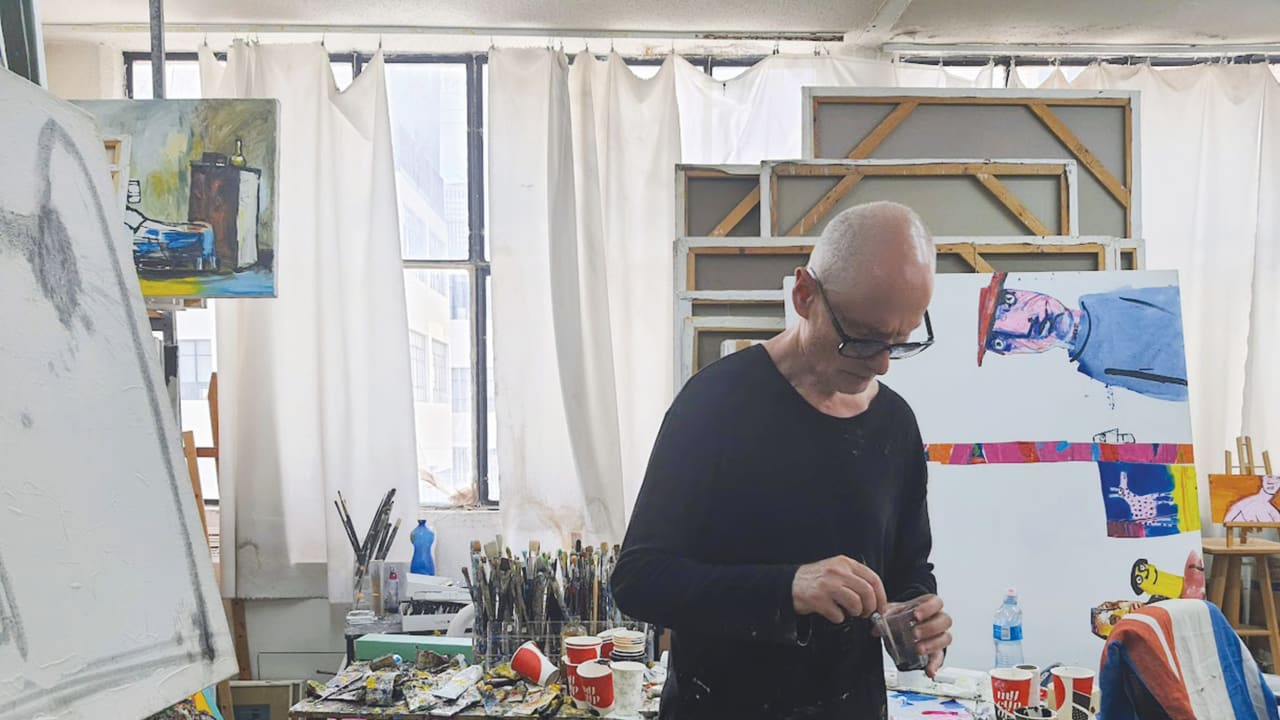
ByBASIA MONKAJULY 26, 2026 10:57Merging the everyday and the elevated, Leo Ray manages to capture the simplicity of everyday motifs - painting dogs, cats, birds, and people in slightly distorted images with classical art references.A known colorist, painter, graphic artist, and small-scale sculptor, he was born in Vilnius, Lithuania, in 1950 (then part of the USSR), where he studied theoretical physics at Vilnius University and art at Vilnius Academy of Arts. After making aliyah in 1991, he lived in Tel Aviv. Shortly thereafter, the same year, he showed his paintings in a group exhibition in Tel Aviv and entered the local art scene. Since then, he has had many individual shows in Israel and abroad. For over 30 years, up to the pandemic, he taught art at Art School, Ein Vered, and BASIS School of Sculpture, Beit Yanai, where he also headed the painting program from 2006 to 2014.He paints constantly, every day, exploring infinite painting, in which one canvas is a continuation of the previous one. During the interview for the Magazine, he showed me 99 paintings, like a chain of stories.'Donkey's Breakfast,' acrylic and oil on canvas, 80x120cm. (credit: Leo Ray)Renaissance, classical, often referenced in Ray's modern, eclectic compositionsThe Renaissance and classical art are often referenced in Ray’s modern, eclectic compositions. When he paints in colors, which is what he is known for, his colors are vibrant and defined. When he steps away from them, he paints just in black and white. His brushstrokes are very characteristic, and he seems to play with layering oil, acrylic, and gouache.Many define his art as naive and childlike; during the interview, he told me he disagrees with those opinions. But he agreed that his art can bring out the child inside of us.In my view, Ray’s paintings put a smile on viewers’ faces. That’s why I wanted to meet this artist and introduce him to The Jerusalem Post’s wide audience of readers. In the dark times we live in, Ray brings a basic way of joy into his work.We met in his modest art studio, filled with brushes and paintings, located between car repair shops and workshops, in the industrial zone of Tel Aviv. Leo Ray welcomed me with tea; he was covered with paint, taking a break from the endless painting to talk to me.When I first saw your painting three years ago, I literally smiled! A big yellow dog was smiling from the canvas back at me. Recently, at the Freshpaint Art Fair, I saw a collection of your paintings and smiled again. They make me happy. Is it your goal to make people happy?Absolutely. Life can be very difficult, and I think one of the great functions of art is to make people happy in this or other ways. I think that, for example, the art of Charlie Chaplin is no less important, great, and artistic than some, let’s say, tragedies. I think that laughter and joy are very valuable things.Thank you for doing it. And my other thought when I saw your paintings was that they’re like illustrations for children’s books. Was it right or not? No, I never illustrated children’s books, and some people say that my style is childish. I absolutely disagree.I wouldn’t say it’s childish, but I think when you paint dogs, birds, cats, and people in not-so-realistic proportions, in a dreamlike way, it awakens the child within us.Yes, of course! I think the child in us doesn’t die before we die.That’s a great sentence! Have you painted this way all your life? Well, that’s a question: if I’ve changed. Yes, I did. One of my friends said that the painting itself changed in a way; that the process of painting became more fun over the years.In your case, or in general? How come?In general. For example, if you compare a painting by [Johannes] Vermeer to a painting by Jackson Pollock, I think Pollock had more fun.Interesting, I didn’t think about it this way… and in your case?My fun is mainly discovering what appears in the painting, what is building up in a painting I am working on.So, you don’t plan the painting; it comes in the process? Sometimes I do plan the paintings and make sketches, but usually, when I start the real one, it changes everything.We’re sitting in your studio, and there are lots of brushes, from small to extremely large ones. Do you choose them, play with them, like with instruments?Of course, brushes are very important instruments, and every brush does what it does. It has individuality. My professor once said that there is no bad brush. And he is right, because [even] a used brush makes what it makes. No new brush can make the same. So, I’m using different kinds of brushes for different kinds of, let’s say, strokes.And you also use different kinds of paints. I paint in oil, acrylic, and gouache (when on paper). And I use Indian ink. I’m trying to be democratic with the painting. I don’t think the use of a kind of material describes the style of a painting.What would you say describes your style? I would say that I do things in a concise way. I like short sentences. I like short lines in poetry. And I like short jokes. So, this kind of brief message is my style.Brief messages. And why those very defined colors, like yellow and red? Because I love them.Trained in calligraphy, 'that's why I use brushes'In opposition to your colorful world, which you are known for, you also paint only in black and white. Which kind of paint do you use for this? Sometimes I’ll use acrylic, but if I work on paper, it’s Indian ink.What do you like about black and white?In the academy, I had a leading professor who was teaching calligraphy, so I’m a little bit trained in calligraphy, and so I love it a lot. That’s why I use brushes.In your paintings, there are repetitive characters.Yes. My principal male character is a nobody. So he can have any name you want to give him. I cannot say anything about the women.This is interesting. You said the man is nobody, and women have some character? They always have some character, and they are always very tempting. And they are beautiful and gracious.Do the dogs, birds, and cats in your paintings have names? No. I don’t give names to cats and dogs. They have to think about that themselves.Are there, or were there, real cats and dogs in your life? Yes. I came here with a cat.From Lithuania, from the collapsing Soviet Union? A few months before the collapse. I came from the Soviet Union formally. I had to refuse Soviet citizenship and so on… So, I came with my cat.What was his name?It was Otto, because of the perfect symmetry of the name and the perfect symmetry of the cat.Your cat, in the painting that I’m looking at, has a symmetric face - but its legs are not symmetric... It depends on the viewing angle. If it’s a little bit twisted, you don’t see the symmetry.Your paintings often have rich textures. When do you decide to apply layers of paint? For example, this painting is mostly flat, but the child’s face is covered in more layers of paint, and the cat’s eyes are more layered.It is not a rational decision. It’s a feeling that I need here to do something. Every color, every texture has its meaning.What meaning does it have to you? The meaning is mysterious. Painting is a mysterious thing. I once said that the ultimate purpose of a painter is to deepen the mystery. And I was very surprised to find out not very long ago that almost the same words were said by Francis Bacon.So, I think like everything that is in the world, like astronomy, physics, mathematics, chess, love, and painting. These are mysterious things that can be explained, only to have a purpose to spoil them.The paintings we are talking about, despite the fact that you don’t want to describe them as naive, have naive and surrealistic elements. But you also paint in a more realistic style.Yes, there was a period when I tried to combine the realistic images with my traditional style, [by this I mean] the flat, two-dimensional, bright-colored things, and see if they go together well. I have a series of the so-called Rembrandt women, where I combined paintings made from some images from Rembrandt, more or less in a realistic style, with my images.You also portrayed Rembrandt himself in your paintings.Yes, sometimes.Apart from paintings, you also sculpt. Is it very different from painting for you?It’s a different kind of thinking; it’s a different kind of three-dimensional thing you have to plan.You grew up in Lithuania when it was still part of the Soviet Union and began your artistic education as a teenager. Could you tell me a little about that?When I was 14, I asked my parents if they would allow me to attend an art school, and they did.Can you tell me something about your parents, your family? My parents were Jewish, of course. Many generations of Vilnius Jews. Both of my parents were scientists in the field of chemistry. My sisters also went into science.So there were no art traditions from home. And what do you recall from the way you were taught art in that school? At this art school for children worked [at the time] very good Vilnius artists. I met some outstanding personalities. It’s a pity that as a child, you didn’t fully understand with whom you were dealing.The way of teaching was rather traditional. Every day we had to draw cubes, and we had to draw plastic casts of ancient, let’s say, gods and philosophers. Well, it was very hard for me as a child.Why was it hard? Well, drawing with a pencil, because when you don’t understand what you are doing, the teachers put some models, some still lifes, and you had to draw them.But despite that, you continued your art education afterward.Yes, I did. It was a master’s five-year program at the Academy of Art in Vilnius. But I’m learning all my life, whenever I start a new painting.You came to Israel in 1991, with the big wave, the aliyah of Soviet Jews. From a very different reality. Was it a cultural shock for you to come here? Yes, but now it’s gone.What was your first impression of the local art scene when you came here? I don’t remember. I don’t think that I saw the art scene when I came here. I was busy with very different things. But I started painting, of course, immediately. As if I knew what was going to happen.I came here in April 1991, and in September (same year), there was a big exhibition of newly arrived painters, organized by the Association of Artists in Tel Aviv. Two galleries chose my works from the photographs.We’re talking about the pre-Google era, so was the fact that they heard about you already a success?No, they didn’t hear about me. It was advertised everywhere; you just had to send photos and your materials to the Association of Artists. And there, the commission, the jury, chose what they liked.And since then, you... Since then, I somehow entered the art scene. One gallery in Tel Aviv chose me, and I worked with that gallery for four years.When did you start teaching in Israel? I started teaching maybe in 1993. It was the private art school established by my friend and sculptor David Zundelovitch. I taught at this school, later called the BASIS School of Sculpture, Beit Yanai, until COVID.When you taught art, what was your message to the students? I didn’t have one message. I taught them mainly composition. I think that composition is the most important thing that the art student has to learn to understand the principles, and then you can do it with anything that you want. Skills come while working, in the process.Speaking of process, please tell me about your infinite painting practice? When you say infinite painting, does it mean that each painting has a story that continues on the next canvas?Absolutely, yes. When I came up with the idea that I am moving on with the painting, I’m adding canvases one to another, and it’s an infinite thing. I thought about other infinite things, and I understood that infinite things contain everything. So, I tried there to paint things that I can paint. There are abstract pieces, there are realistic pieces, and there are realistic people.For example, these wrapped paintings [Ray pointed] are my infinite painting, so-called infinite painting, which now has 99 canvases joined together. It was exhibited in Israel and in the US.Ninety-nine? That’s very impressive! Do you paint every day? Yes. I come to the studio in the morning or early afternoon. It’s the best time to paint. Best light.Are you preparing a new exhibition right now? No, I’m just working on separate works.At the end of our conversation, I have to ask how you speak Polish, my native language, so well (we spoke on the phone before the interview, and you surprised me). Polish is a completely different language from Lithuanian and even from Russian. Where did you learn it?At first, as a child, we had a Polish-speaking nanny there, a woman who helped my mother. But I really learned it when I was young and wanted to read books that weren’t published in the USSR. There was a bookstore in Vilnius that sold books in Polish and German, and I chose Polish to read them. I really like the language. [He smiled.]Dziekuje [thank you, in Polish] for talking to me.Dziekuje for visiting me at my studio!www.leorayart.comFollow us on Google
Infinite painting, boundless experience: How Leo Ray finds joy in an increasingly dark world
Full Article
Original Source
Read the full article at Jpost →KhanList aggregates and links to publicly available news content. We do not host full articles from third-party sources. Always verify important information with original sources.