
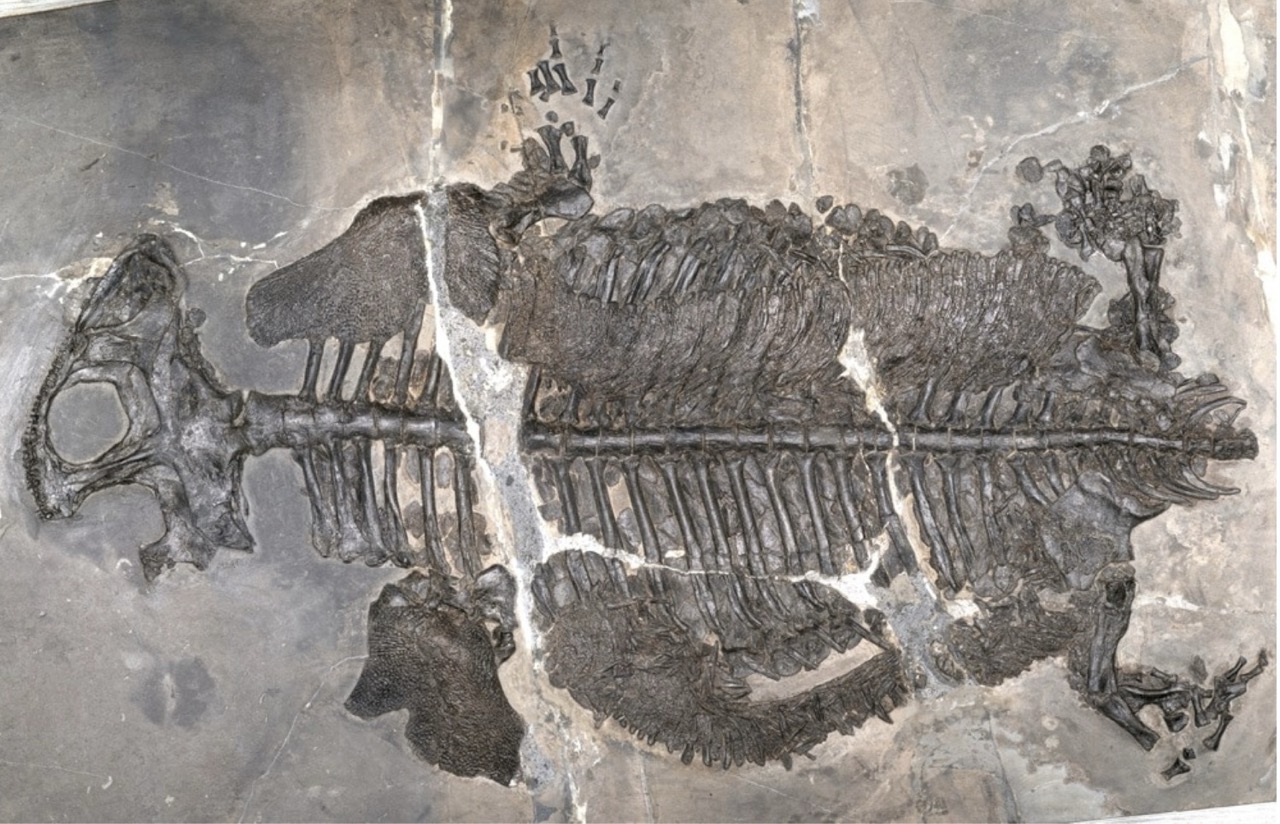
Unlike modern amphibians, Gerrothorax maritimus was likely a “full-time” oceanic dweller, which scientists say makes it one of a kind.(CN) — Amphibious creatures, named for and characterized by their transitions between land and water habitats, might as well be evolutionary celebrities.Modern mammals, reptiles and other species derive originally from primordial aquatic life that developed limbs hundreds of millions of years ago to better make use of their surrounding environment.One ancient amphibian, though, became a seafaring specialist instead.In the late Triassic period, roughly 230 million years ago, the species Gerrothorax maritimus lived in briny underwater depths and hunted for prey on the ocean floor, according to research published Monday in the journal Nature Ecology & Evolution.“Amphibians simply do not do that,” wrote Ryosuke Motani, a professor at the University of California, Davis and an author of the new study alongside Beijing-based paleontologist Dayong Jiang.“Modern amphibians rely on their permeable skins for many basic things, such as drinking and breathing,” Motani said in an email. “The wonderful skin, however, does not work the same [with] seawater. When a frog swims in seawater, it loses its body water because the seawater sucks out the body water through the permeable skin through osmotic pressure … it loses body weight and will have to rest in fresh water to recover, and this key feature prevents amphibians from becoming fully marine.”In contrast, Gerrothorax maritimus could handle constant salt exposure, the scientists found after testing the chemical signatures of two nearly complete skeletons discovered in Guizhou Province, China.The organism was something of a tiny Triassic tank: compact, at under two feet long, and covered in body armor that kept its internal fluids intact while submerged. Gills allowed it to breathe underwater.Motani told Courthouse News that the amphibian’s heavy armor also could have protected it from other threats, such as a nearly 20-foot long predator called Guizhouichthyosaurus.Remains of this big ichthyosaur were found in the same rock bed in Guizhou Province that contained Gerrothorax maritimus fossils. Now a landlocked region, that part of the world was blanketed by sea during the Triassic period.Though Gerrothorax maritimus is a “dead-end lineage” with no living descendants, Motani said, the findings expand on what is known about amphibian evolution. The specimens, originally collected by local farmers in 2004, are on display in a geological museum in the city of Guiyang.Subscribe to our free newslettersOur weekly newsletter Closing Arguments offers the latest about ongoing trials, major litigation and rulings in courthouses around the U.S. and the world, while the monthly Under the Lights dishes the legal dirt from Hollywood, sports, Big Tech and the arts.Additional Reads
In dinosaur times, a ‘unique’ armored amphibian species spent life at sea
Full Article
Original Source
Read the full article at Courthousenews →KhanList aggregates and links to publicly available news content. We do not host full articles from third-party sources. Always verify important information with original sources.