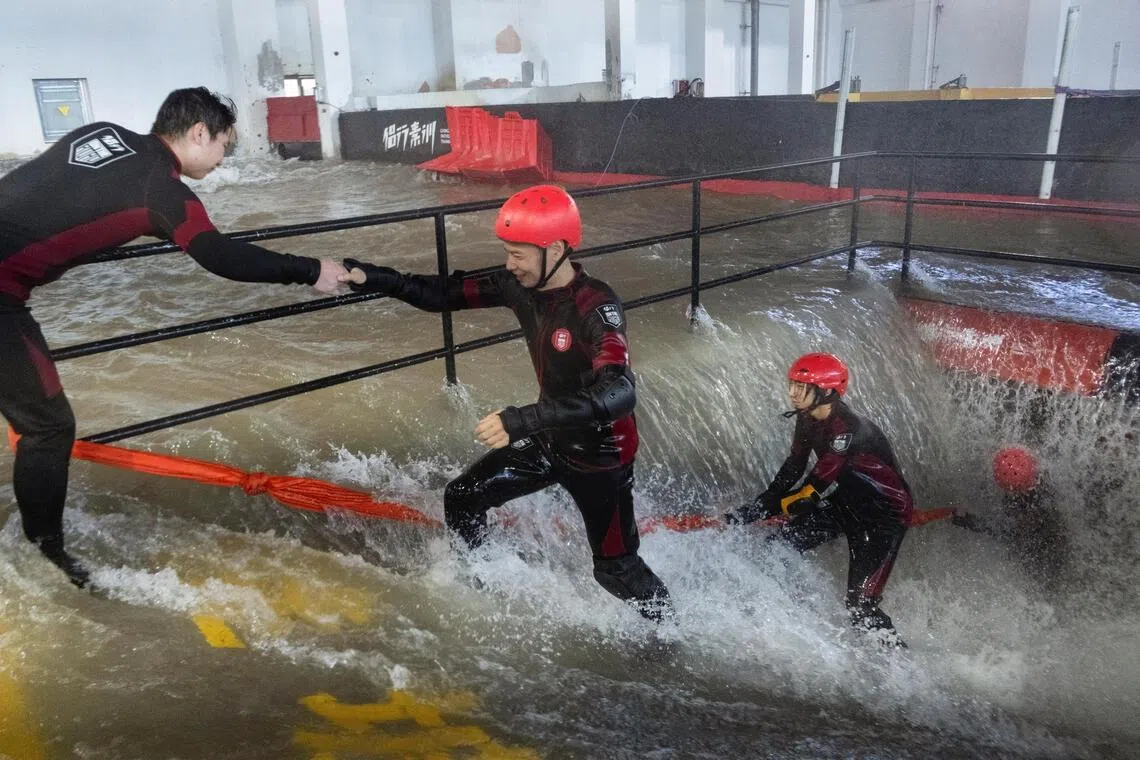
HANGZHOU, China – Huang Zhen, 34, shut his cafe for a day last week to be buffeted by surging waters and powerful winds that knocked him off his feet – training for extreme weather events that are increasingly afflicting China.Huang was one of a dozen people attending a session at the Lvxing Disaster Simulation Training Centre in Hangzhou, eastern China. For 1,599 yuan (S$304) per day, it offers a realistic experience of what it is like to be caught up in a typhoon or a flash flood, albeit with the advantage of wearing a wetsuit, a helmet and having a safety instructor to guide you.The centre says it is the first of its kind in the world to provide typhoon training, with its simulated experience generating wind speeds of up to 165kmh alongside torrential rain.In a separate section, 900,000kg of surging water are unleashed to mimic mountain flooding, while in another, participants must wade – sometimes thigh-deep, sometimes shoulder-deep – through 400,000kg of water in a mock urban environment.“Over the last two years, the weather has become increasingly unpredictable,” Huang said. “An opportunity like this... gives us a better idea of what different levels of disasters might actually be like, and helps raise our awareness of disaster preparedness.”Participants walk through simulated typhoon-force wind and rain during a typhoon survival training session at the Lvxing Disaster Simulation Training Centre. PHOTO: REUTERSClimate change is increasingly exposing the world’s second-largest economy to destructive weather events, scientists say. 2026 is of particular concern due to the emergence of the El Nino weather pattern, which can drive up temperatures and fuel more intense typhoons.China’s National Climate Centre has said it expects up to six typhoons to form in the North-west Pacific and South China Sea in July, more than the average of 3.8.One of those was Typhoon Bavi, which brought severe floods and forced millions of Chinese to evacuate.“Typhoon Bavi hit just a couple of days ago, making people realise that typhoon hazards are far more of a threat than we thought,” said Wu Zijian, a 44-year-old freelance worker who travelled from nearby Shanghai to attend.More than 160,000 people have attended sessions at the centre since it opened in May 2025. Wang Kuanghan, the centre’s chief instructor, said there are plans to open five more centres in China within the next three years. These will include simulations of other natural disasters such as fires and earthquakes.For those who can’t make it there yet, Wang has a tip.“If you ask me, the most important survival skill during a typhoon is simply not to go outside,” he said. “Stay indoors and keep yourself safe at home.” REUTERS
In China, people brave simulated typhoons to prepare for the real thing
Full Article
Original Source
Read the full article at Straitstimes →KhanList aggregates and links to publicly available news content. We do not host full articles from third-party sources. Always verify important information with original sources.