
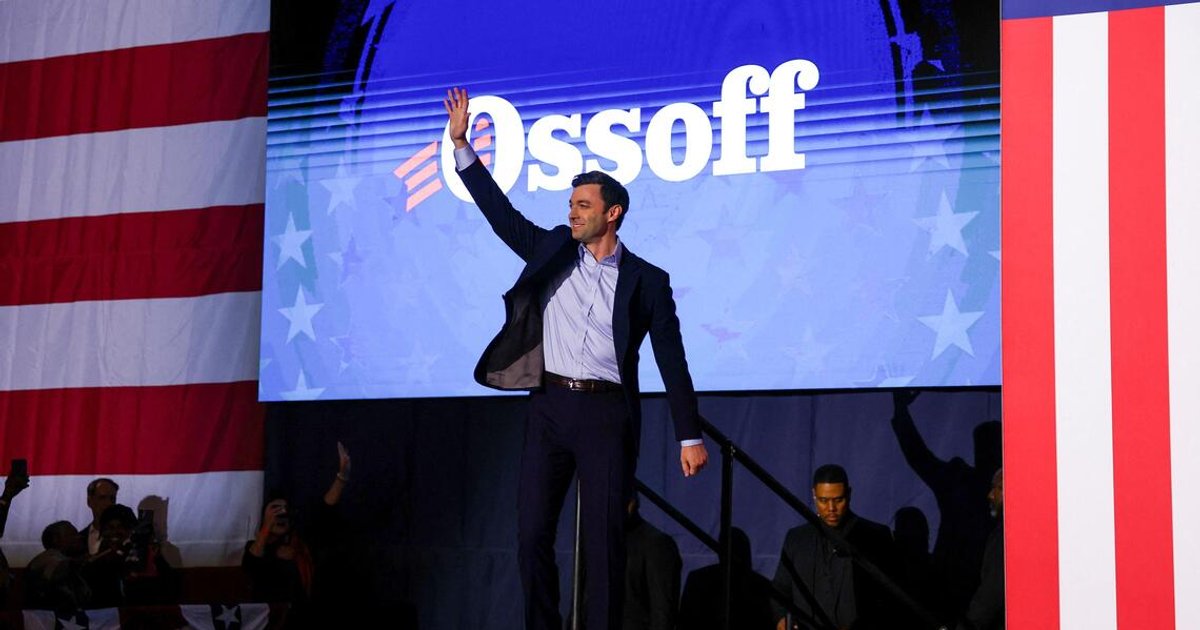
WARNER ROBINS, Georgia – Candy Bautista was smiling as she helped herself to some fluffy pancakes at a brunch buffet. A 23-year-old economics graduate struggling to find a job, she voted for the first time the day before, on Nov 3, not really expecting an electoral earthquake.“But I went to bed in a red state and woke up in a blue one,” said Bautista, an independent voter.The sentence captured Georgia’s dramatic swing in the 2026 midterm elections; it elected a Democrat as governor for the first time in over 20 years. An even more stunning upset was in neighbouring South Carolina, which chose a Democrat senator for the first time in nearly 30 years. Jordy Stevens, a nurse in Lexington, South Carolina, had something to do with it. His vote had always gone to the Republicans by default. “It is just how I was raised in a Republican family,” he said. “But this year, look what I did.” The high cost of petrol was the chief reason the 30-year-old went against his party. “They forgot about us,” he said. “Now I know what that vote is worth, and our government knows it too.”Voters like Bautista and Stevens have scrambled President Donald Trump’s political coalition and set the pulses racing for the 2028 presidential election. For a decade, Trump so dominated the political landscape that others defined themselves through their opposition to him. Now, with his party chastened and his presidency approaching its term limit, other figures are becoming visible.There are no major declared contenders yet, but Americans could find themselves spoilt for choice in 2028. The Democrats, riding on newfound confidence after the diminishment of 2024, have the more expansive field. The Republicans have the more formidable task: How much of the Trump baggage should they carry into 2028 and what can be safely disposed of without offending his base.A Fox News/NORC voter study described their predicament. Nearly four in 10 Republicans from Trump’s Make America Great Again (MAGA) movement want his successor to adopt both his policies and his leadership style, while half want only his policies. Even among non-MAGA Republicans, 45% want his policies continued.Among the independent voters, though, six in 10 want a break from both Trump’s policies and his style.That invokes the eternal nomination problem – first rally the party faithful, then hope to succeed with voters who sneer at the faithful. A successful post-Trump Republican candidate can have either Trump’s coalition or the independents, the largest bloc of American voters.Vice-President J.D. Vance, 42, has begun this negotiation. “The reason we lost is the war,” he wrote on X after the midterms. It is a useful formulation for a vice-president seeking to establish that the administration’s failure in the unpopular Iran war was not entirely his own.But Vance has publicly defended the Iran war, whatever his reservations in behind-the-scenes White House debate. He cannot simply step aside.US Vice-President J.D. Vance speaking at a campaign rally ahead of midterm elections in Ohio on Nov 2. PHOTO: REUTERSOhio adds another embarrassment. In his home state, Democrat Amy Acton defeated Vivek Ramaswamy for governor; Sherrod Brown won the Senate seat held by Vance’s appointed successor Jon Husted. That complicates Vance’s claim to understand the industrial Midwest, despite his hillbilly roots, and speak for the “left-behind” men and women.Still, he remains formidable, with high visibility and access to donors. Secretary of State and National Security Adviser Marco Rubio has been quieter since the midterm election, with his aides moving quickly to quash rumours that he is leaving the administration. He has previously said he would not challenge Vance. Polls do not show it yet, but the popularity of the former Cuban American senator from Florida is second to none with the more traditional Republicans. And the man who inspired countless social media memes – an astronaut, the Easter Bunny and a cardinal – has ardent admirers within the MAGA alumni as well as independents. The 55-year-old has both youth and name recognition. I have never heard anyone ask “Rubio, who?” the way I had seen people shrug when Trump roped in Vance as his running mate in the presidential campaign of 2024. But Rubio, in charge of foreign affairs and national security, cannot dodge the Iran war taint either.Secretary of State and National Security Adviser Marco Rubio has previously said he would not challenge Vance. PHOTO: AFPSafest from any association with the war is Florida Governor Ron DeSantis, 48. He has taken credit for Republican victories in Florida: Byron Donalds as governor and Ashley Moody for senator prevailed in tight races. The man behind Florida’s bitter culture wars has described party performance in the midterms as a near “extinction-level event” and a rebuke of Trump. Which Floridian can excite the party remains an open question; current surveys show a DeSantis surge, but Rubio maintains the lead.Florida Governor Ron DeSantis has taken credit for Republican victories in Florida. PHOTO: REUTERSThe field could widen if Vance stays vulnerable. Texas Senator Ted Cruz, 55, has left the door open for another presidential run, and former UN ambassador Nikki Haley remains among the names discussed. Tucker Carlson, the former Fox News host, while denying presidential plans, could help shape the argument over foreign intervention, whether as a commentator, organiser or political insurgent. A 2024-type crowded race – when at least 10 high-profile candidates ran in the primaries – is plausible. So is a familiar outcome where a divided opposition allows the candidate with the most committed minority to prevail.But the Republicans can nurture hope. A midterm loss is like being sentenced to hard labour; it is not a death sentence. After a Democratic wipeout in the 2010 midterms, Barack Obama was re-elected convincingly two years later.Democrats: A wealth of new political talentThe Democrats have emerged from the midterms with a version of “100 ways to win an election”. Unlike the Republicans, they do not have to wrestle with the Trump deadweight, but they do have an ideological maze of their own. Before the election, the New York Times/Siena survey found that nearly half want the party to move towards the centre, while around a quarter want to swing left. Independents also give the Democrats a hard time. Nearly three in four want Democrats to move towards the centre. It is a sign that progressive politics does not really own the day.Almost all polls ranking Democratic Party nominees currently show Georgia’s re-elected Senator Jon Ossoff, 39, at or near the top. The breakout star of the midterm election has emerged with a convincing argument for electability: An 18-point win in a presidential battleground Trump carried in 2024. His direct attacks on Trump’s corruption and fitness for office became the talk of the nation.I saw him in a roomful of Democratic volunteers, rolling up their sleeves to go door-knocking on an overcast day. He spoke like Obama, but looked like a less polished but more earnest version of the Chicago senator in 2008. Some critics fault him for striving hard to create a perfect image, in the way that an expert film-maker would. And given his antecedents as an investigative documentary maker for eight years, perhaps the critics are not far wrong.In a party that has not had a national leadership since the Biden presidency, he has stirred up undeniable excitement.But is he the runaway hot favourite?He has said he has “zero interest” in running. But political circumstances can change, and he is certainly not short on ambition.One survey shows him on a par with five-term New York congresswoman Alexandria Ocasio-Cortez, 37. The wait is on for AOC, as she is known, to announce her run. US Representative Alexandria Ocasio-Cortez already has national recognition, with tens of millions of social media followers, and a formidable fund-raising operation. PHOTO: AFPThe progressive politician already has national recognition, with tens of millions of social media followers, and a formidable fund-raising operation. However, beyond the liberal blue states such as New York and California, Ocasio-Cortez’s popularity remains to be tested.A version of that question – the potential for cross-sectional appeal – also looms over Michigan’s Abdul El-Sayed, the first Muslim to be elected senator. Soon after his victory in a major battleground, he registered a political action committee, seen as a precursor to a presidential run.Democratic US senator-elect Abdul El-Sayed speaking after his victory in the US midterm elections in Michigan on Nov 4. PHOTO: REUTERSInevitably, the newly blue Texas also has its own claimant. James Talarico, 37, has created a dazzling national opportunity for himself by winning a red fort once considered impregnable by Democrats. Any argument for expanding the map in 2028 has to begin with him. After all, Texas offers the prize of the second-largest number of electoral votes, after California, in a presidential contest.Add in his squeaky clean appeal and boyish charm, and the package is too good to miss. A short Senate apprenticeship need not prevent his advancement; Obama was a junior senator when he bid for the White House. James Talarico has created a dazzling national opportunity for himself by winning a red fort once considered impregnable by Democrats. PHOTO: HAIYUN JIANG/NYTIMESStill, other surveys have favoured former vice-president Kamala Harris, 62, who retains nationwide recognition and the relationships with donors and voting blocs from her 2024 run. California’s outgoing Governor Gavin Newsom, 59, also has viability; he has tried to cultivate a profile through mocking confrontations with Trump, and fund raising. He has also said he would not run if Harris does.But Harris must explain why a second presidential attempt would succeed after 2024. And Newsom must defend California’s expensive housing-and-living environment and homelessness record.Former US vice-president Kamala Harris retains nationwide recognition and the relationships with donors and voting blocs from her 2024 run. PHOTO: REUTERSPennsylvania Governor Josh Shapiro, 53, is thought to have an edge because building a Democratic presidential coalition is difficult without winning states like his. His interest is clear: He released his memoirs in January and registered a federal political committee.His challenge, as a Jewish man, includes navigating Democratic divisions over Israel, although he opposes the Iran war.Pennsylvania Governor Josh Shapiro’s interest is clear: He released his memoirs in January and registered a federal political committee. PHOTO: REUTERSOther governors in contention include Andy Beshear, 48, the two-time governor of Kentucky, a red state, and Illinois Governor JB Pritzker, 61, who packs an anti-Trump identity and the wealth to sustain a long campaign. Also popular is Pete Buttigieg, 44, former president Joe Biden’s transportation secretary and Indiana mayor, with national experience and a fund-raising network.Former envoy to Japan and Obama aide Rahm Emanuel, 66, is considering a candidacy built around moderate renewal in opposition to candidates like Ocasio-Cortez.As the jostling continues in the two-year marathon from now to November 2028, the Republicans must decide who can inherit Trump’s voters, while the Democrats must find someone who can unite their factious party.Millions of voters, like Bautista and Stevens, will be watching with a renewed sense of their own power after the momentous midterms.
In 2028 race, Democrats have new stars and Republicans have succession squabbles
Full Article
Original Source
Read the full article at Straitstimes →KhanList aggregates and links to publicly available news content. We do not host full articles from third-party sources. Always verify important information with original sources.