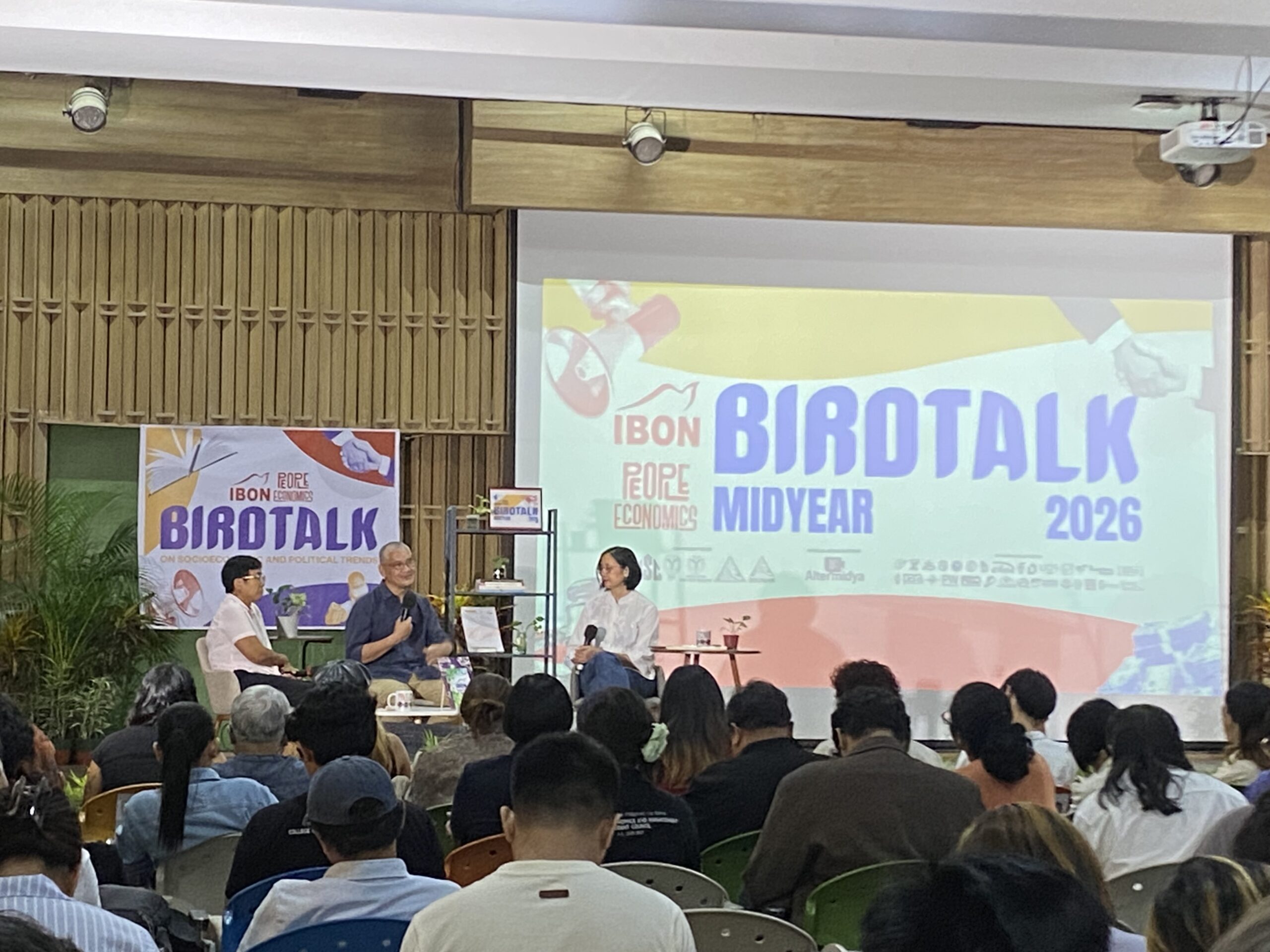
BIRDTALK MIDYEAR 2026. Executive Director Sonny Africa and Research Head Rosario Guzman share their insights on the country's economic situation during IBON Foundation’s Birdtalk Midyear 2026 at UP Diliman. Jim Caponpon Despite the World Bank's recent upper-middle-income upgrade, think tank IBON Foundation warns that the country's income classification masks deeper structural weaknesses in employment, inequality, and industrial development MANILA, Philippines – Ahead of President Ferdinand Marcos Jr.’s fourth State of the Nation Address (SONA), IBON Foundation warned that the Philippines’ recent economic upgrade to upper-middle-income (UMIC) status masks the daily struggles of millions of Filipinos, calling the figure detached from reality during its Midyear Birdtalk on Wednesday, July 23 at the University of the Philippines Diliman. IBON Foundation executive director Sonny Africa described the World Bank classification as a “mere statistical classification,” saying it masks deeper structural problems in employment, inequality, and industrial development. “The growth model that resulted in the statistical reclassification can expand economic output, but is unable to create decent work with livable pay for the majority of Filipinos,” Africa said. The Marcos administration has described the World Bank reclassification as a “vote of confidence” in its economic policies, a characterization that IBON disputed during the forum. A ‘disguised crisis of joblessness’ While the government frequently highlights low official unemployment rates, IBON’s analysis indicated that employment has increasingly become a coping mechanism rather than a pathway out of poverty. According to the group’s data, a staggering 78% of the workforce, about 38.7 million Filipinos, are trapped in “vast informality”. The think tank noted that this includes millions of self-employed individuals, unpaid family workers, and laborers in unregistered establishments enduring volatile working conditions. UPPER-MIDDLE-INCOME. IBON Foundation presents Philippines’ position among upper-middle-income economies based on the World Bank’s 2025 gross national income (GNI) per capita classification during its Birdtalk Midyear 2026 forum at UP Diliman on Wednesday, July 23. Image from IBON Foundation Although the country’s economic growth was enough to qualify it for UMIC, IBON stressed that the purchasing power of the working class has eroded, estimating that the average minimum wage is worth 21% less today than it was in 1989. The group’s presentation showed that 14.4 million families, representing roughly 70 million Filipinos or 62% of the population, remain poor or low-income. This reality, IBON argued, contrasts sharply with the immense concentration of wealth at the top of the economic pyramid, driven by an exclusionary growth model that favors large conglomerates. The decline of domestic production IBON argued that these labor market conditions stem from the long-term weakening of the country’s productive sectors. “It is critical to reverse agricultural decline, industrial erosion, and worsening technological dependence, with a determined program of rural development and Filipino industrialization that qualitatively transforms the economy’s producing structure,” Africa said. According to them, instead of building local industries, the Philippines has undergone decades of deindustrialization. IBON’s data showed that manufacturing has dropped to just 17.4% of the country’s gross domestic product, its smallest share in 76 years, since 1949. Meanwhile, the agricultural sector has shrunk to a historic low of 7.9%. The think tank asserted that this lack of a strong industrial and agricultural foundation is exactly why the economy struggles to generate high-quality, secure jobs, exposing the “exhaustion” of the country’s growth model. GROWTH AND POVERTY. IBON Foundation presents data comparing annual GDP per capita with self-rated poverty. Image from IBON Foundation Pax Silica and foreign-reliant development IBON cited the US-led Pax Silica alliance as an example of the development model it argues has deepened the country’s dependence on foreign capital. The initiative aims to transform a portion of New Clark City into an AI-native “Economic Security Zone” anchored by foreign tech giants. However, IBON also warned that without deliberate state intervention, such as binding requirements for technology transfer and local supplier development, these high-tech hubs will not lead to genuine Filipino industrialization. “Mega-hyped efforts like the US-led Luzon Economic Corridor and Pax Silica will not deliver promised industrialization because these will be implemented under the same one-sided foreign investment regime that has held the economy back for decades,” Africa said. Under proposed “joint governance” frameworks with the United States, IBON raised concerns that the Philippines may simply remain locked in a subordinate role within the global value chain. The think tank argued that the country risks merely supplying prime real estate, critical minerals, and cheap labor for foreign supply chains, while foreign corporations retain control over operations, technologies, and profits. “There will likely be a lot of optimism during the SONA. But this will ring hollow because the Marcos administration is unable to deliver real economic reforms while the people’s conditions continue to worsen,” Africa said. IBON argued that national development cannot be measured by gross national income (GNI) averages alone or achieved solely through foreign investment enclaves. Instead, the group said the country needs secure employment, stronger domestic agriculture and manufacturing, and economic growth that translates into tangible improvements in Filipinos’ lives.– Rappler.com How does this make you feel? Loading
IBON Foundation: Upper-middle income milestone doesn’t reflect Filipinos’ realities
Full Article
Original Source
Read the full article at Rappler →KhanList aggregates and links to publicly available news content. We do not host full articles from third-party sources. Always verify important information with original sources.