
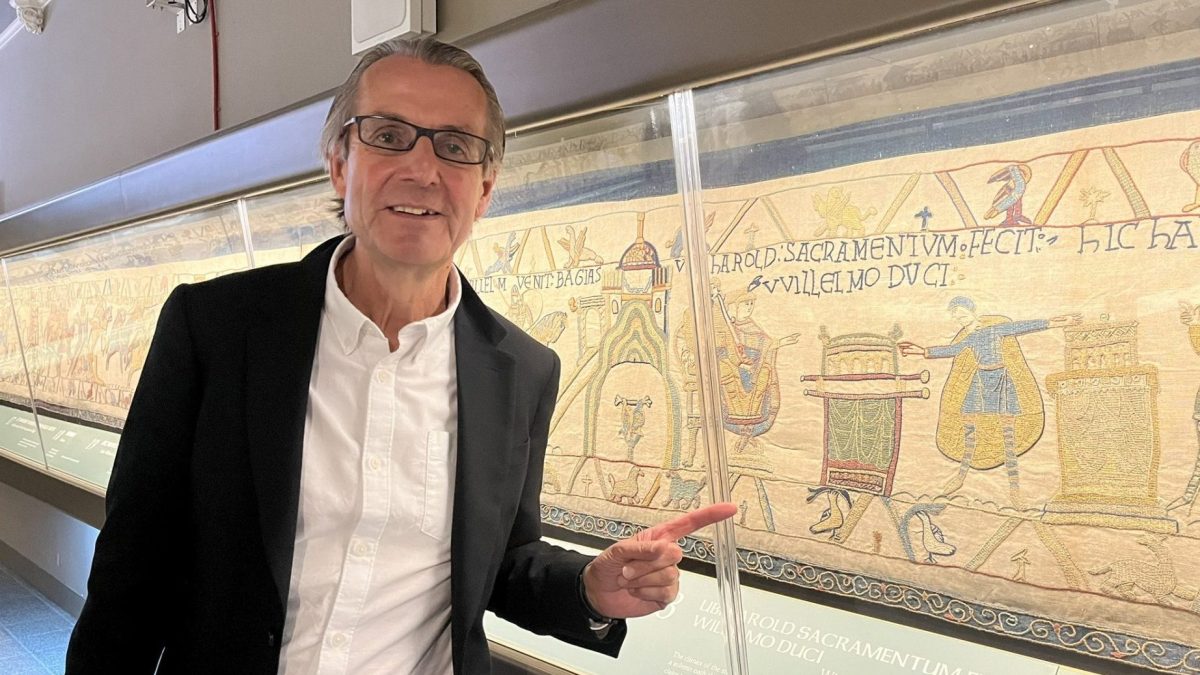
Why see one Bayeux Tapestry when you can see two, courtesy of a 55-minute rail journey spanning almost 1,000 years of English history, with long stops in the medieval and Victorian eras? There can’t be many in the realm unaware that the Bayeux Tapestry, that magnificent work depicting the Norman invasion of 1066, is back in England for the first time in over 900 years and has just gone on display in the British Museum in London. Indeed, tickets have sold out for this year – bookings for the first three months of 2027 will open on 21 October. Fewer will be aware that there is a very good replica of the tapestry – embroidery more precisely – that is on permanent display in Reading and which itself has a fascinating history stretching back to the late 19th century. Adrian Bridge got in early at British Museum’s new exhibition of the Bayeux Tapestry The original is, of course, the superior work; critics have declared the exhibition an unqualified triumph, a crowning (or indeed decrowning) moment in English cultural life. I confess a shiver went down my spine as I entered the darkened gallery of the British Museum in which the tapestry is so brilliantly illuminated. I knew the outline of the story, but little of the background – the succession crisis in England sparked by the death of Edward the Confessor, the journey to France by Harold Godwinson in which, apparently, he swore an oath of allegiance to William; Harold’s subsequent decision to take the throne himself and the famous battle near Hastings in which the issue would be settled once and for all – in the Norman’s favour. It is a story told on multiple levels with all manner of messaging in the main body of the narrative and the smaller illustrations drawing on Aesop’s Fables in the borders above and below. The British Museum’s exhibition has sold out for this year, but more tickets will be released in October Given the age of the tapestry – believed to have been stitched by English women in Kent under direction from William’s half-brother Bishop Odo and then conveyed to France – there is an extraordinary power and vibrancy to it. There are the great scenes including Harold’s coronation, William’s fury at discovering the “betrayal” and the final, fatal arrow in the eye. It features wonderful details – the weathervane being attached to a newly constructed Westminster Abbey, the stripey long stockings favoured by the English, labourers tilling the fields, nude figures hinting at sexual scandal. There is a terrific momentum to it – particularly when the story turns to the battle itself. The dyed wool may have faded, but the colours remain vivid and the faces, though simply delineated, are deeply expressive. Visitors to the British Museum will have just 40 minutes to assimilate and appreciate all this, hardly long enough, but much better than nothing. I wanted to extend the experience – so made a dash for the train at nearby Tottenham Court Road station that would whisk me in just under an hour to Reading and the museum containing a remarkable replica of the tapestry. It was fitting to travel on the Elizabeth Line, a fabulous addition to the London transport system, opened by the late Queen herself. With its rich purple hues, it conveys majesty – a reminder that while the French long ago dispensed with a monarch, the tradition remains integral to English and British life. Adrian used the Elizabeth line to travel between the two works The decision to create this replica in the Victorian era followed a visit to Bayeux in 1885 by Elizabeth Wardle, leader of the Leek Embroidery Society in Staffordshire, in which, after seeing the original, she declared: “England should have a copy of its own.” The 35 members of the society, guided by photographs of the original, spent a year stitching the replica using wool and dyes as close as possible to those used in the 11th century. It was then taken on tour in the UK, Germany and the United States. “The tour got the word out about the tapestry to a global audience,” said Dr David Musgrove, co-author of The Story of the Bayeux Tapestry and content director of HistoryExtra magazine and podcast. “It undoubtedly helped to cement its fame.” After a decade of touring, the replica was bought by the town of Reading for £300 and today occupies pride of place in the main museum. It is a faithful replica, but there are differences. The Victorians, not surprisingly, added clothing to the nude figures. The ladies who embroidered the work introduced decorative swirls of their own in an extra border area along with their names – unlike their anonymous predecessors. But the story follows the same dramatic narrative arc and its denouement is the same. “The [original] work was commissioned by the Normans and while it does not glorify their conquest, it does seek to legitimise it,” said Musgrove. His sentiments were echoed by Bohemia Aslin, who guided me around the Reading replica, adding a few thoughts of her own. “Although the work appears to be non-biased, it was essentially propaganda on behalf of the Normans,” she said. “William is always seen to have the power and Harold is depicted as a smaller person who went back on his word.” We paused by the scene in which Harold swears the fateful oath to William. “This is the pivotal moment,” said Bohemia. “But is that really the way it happened?” What were the Normans trying to pull the wool over Anglo-Saxon eyes? Was this, in fact, an elaborate stitch-up? There will never be definitive answers to these questions, but my visits to the two tapestries whose stories are so closely interwoven made it clear that there’s more than one way of looking at them. Mystery and intrigue will always surround the Bayeux Tapestry, that’s part of its enduring appeal. This depiction of rivalry, retribution and overarching ambition is indeed a tale for the ages; a rip-roaring yarn in every sense of the word. How to do it British Museum: The original Bayeux Tapestry is on display until July 11, 2027; adult tickets are £33. Viewing slots are sold out until the end of December; the first tickets for next year will be available in October; britishmusuem.orgReading Museum: The Bayeux Tapestry replica can be seen daily except Sunday and Monday; admission free; guided tours, £10 (next available slots, January 2027); readingmuseum.org.uk The direct link: The Elizabeth Line runs regular services between Tottenham Court Road and Reading, from £16.80, off-peak; £33.30, peak; tfl.gov.uk
I visited the Bayeux Tapestry and its replica in a day – one is free to see
Full Article
Original Source
Read the full article at Inews →KhanList aggregates and links to publicly available news content. We do not host full articles from third-party sources. Always verify important information with original sources.