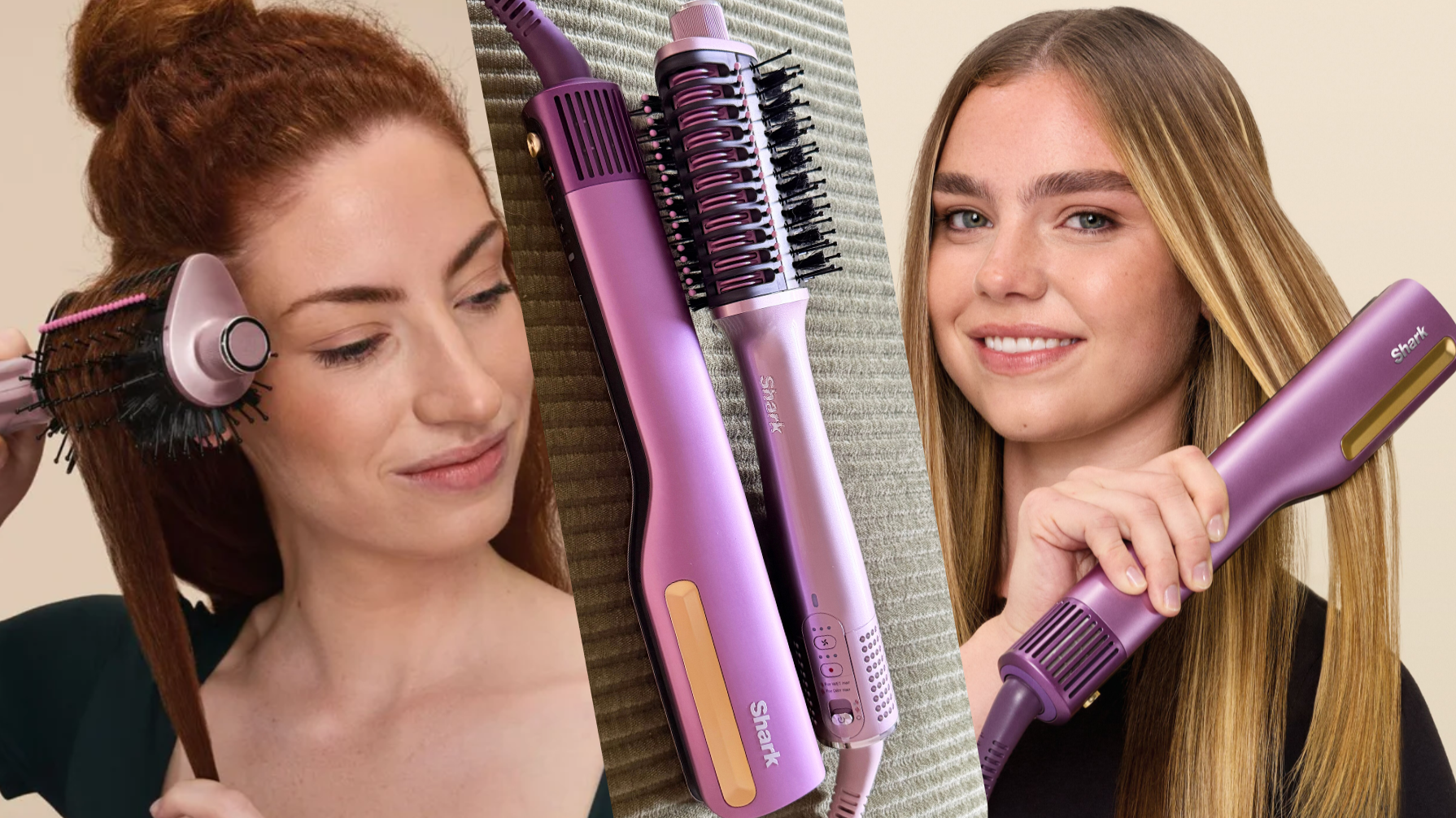
(Image credit: Future / Lucy Scotting / Shark) There's nothing worse than heat damage. It can cause breakage, impact your hair and scalp health, and leave ends severely dry. Thankfully, Shark Beauty has thought of everything to eliminate heat damage, with the launch of two new wet-to-dry stylers in Australia.Designed with heat damage in mind, the new Shark SilkiPro Straight and Glossi maximise airflow and heat settings to ensure minimal hair damage. As a hair tool reviewer, I was beyond eager to get my hands on the first wet-to-dry stylers for the brand.I did approach using the stylers with a degree of scepticism, however. Although I appreciate airstylers because they minimise hair damage, I typically have to rely heavily on hairspray to keep my styles intact. This is largely because airtools like the Dyson Airstrait do not use heated plates, effectively cutting down on the amount of direct heat applied to the hair, and therefore, don't clamp the hair into a pin-straight finish.This was the case during my Dyson Airstrait review. Even though the Airstrait excelled at drying and styling my hair from wet to dry in a matter of minutes, it only achieved a naturally straight finish with its angled airflow. However, the SilkiPro has ceramic elements, meaning there's a heated plate at play alongside Shark's impressive heat and airflow tech. While my experience with the Dyson Airstrait was generally positive, I was curious to see if the SilkiPro’s ceramic plates could offer a more polished finish.On the other hand, the Glossi also has ceramic elements, but it's a blowout brush with wet and dry modes. In my experience, blowout brushes can be used on damp hair, but not soaking wet, so my curiosity was piqued. Both tools can also be used on totally dry hair to achieve shiny, frizz-free styles.I put both of Shark's wet-to-dry stylers to the test to see how they fare — and ultimately which one I'd recommend — below. If you're keen to check out Shark's other highly-rated hair tools, including the Shark Glam and the Shark FlexStyle, you can view them in the widget below.Shark SilkiPro Straight Image 1 of 5 Shark SilkiPro Straight in purple (Image credit: Future / Lucy Scotting) Using the HeatSense ceramic plates — which automatically monitors and adjusts temperature to minimise heat damage — and the airflow from the high-velocity air vents, the Silki acts as a comparable Dyson Airstrait dupe.Get instant access to breaking news, the hottest reviews, great deals and helpful tips.Retailing at AU$449.99, the Shark SilkiPro Straight really puts Dyson's inflated AU$749 price tag to shame. Not only is it AU$300 cheaper, the SilkiPro performs — dare I say — better, but there are a few caveats involved in that judgement.Throughout my month of testing, I used both wet and dry modes of the SilkiPro Straight and used all three of the styling comb attachments. I also used each of the three temperature settings — low (100℃ wet / 160℃ dry), medium (110℃ wet / 190℃ dry) and high (120℃ wet / 220℃ dry) and the three airflow settings — again, low, medium and high — throughout my tests.Much like when using the Dyson Airstrait, you need to rough dry your hair before using the SilkiPro on wet hair by clamping the styler together and locking it into place. The rough dry didn't take long during my first use, around 5 minutes or so, and I was ready to start straightening.Shark recommends that your hair is at least 70% dry before straightening in wet mode. Shark also recommends sectioning your hair in smaller 2.5cm to 5cm sections to ensure you have minimal passes when straightening. I took this advice on and set the styler to the recommended heat and air settings for my hair type — which was medium heat and high airflow for my wavy hair.Even though the presence of ceramic plates left me slightly confused as to why airflow would even be necessary for styling, it turned out to be vital. The angled design of the airflow significantly accelerated the overall wet-to-dry process. Image 1 of 2 Before using the SilkiPro Straight on my naturally wavy hair (Image credit: Future / Lucy Scotting) Sure enough, after extensively sectioning and straightening, my hair was damn near perfectly straight, thanks to the plates and airflow combination. I could have stopped there, considering my hair was completely styled and dry, but the brand suggests using the dry mode on the device to help lock in the style and shine. I opted to use medium heat and airflow to minimise thermal damage and dry mode was pretty spot on at correcting any imperfections.After using the SilkiPro a few more times throughout the month, I ultimately decided that high heat and airflow worked better for me in wet mode. If I needed to touch up any strands, I used dry mode on medium settings to straighten things out.The styling combs are supposed to help straighten and lengthen hair, but they didn't do too much for my wavy, thick hair. I didn't love using the comb attachments on my hair when it was wet, but I found the experience much more pleasant when it was dry. Regardless, I am still not convinced that the combs are overly necessary to the SilkiPro experience and may work better for those with curly or coily hair.Overall, I was highly satisfied with the SilkiPro and turned to it more than my Dyson Airstrait. This is largely due to the results, as my hair turned out much straighter, shiner and lasted longer using the Silki. However, I know that this is because of the Silki's ceramic plates, making it much more comparable to the results of a normal hair straightener. The Silki's plates use lower temperatures than other straighteners, so it still minimises heat damage, but you can't guarantee that your hair will be totally damage-free. And that's just part of the risks involved with hair stylers and hot tools in general, not just the SilkiPro Straight.Shark Glossi Image 1 of 4 Shark Glossi bristle brush (Image credit: Future / Lucy Scotting) Out of all the hair tools I've tried, I always struggle styling my hair with a blowout brush. I've watched many hair tutorials on TikTok and Instagram, and even invested in the Revlon Volumiser 2.0, thinking I could do a 90s-style blowout with ease. But I was so wrong.That said, the Shark Glossi has really surprised me as a one-pass-wonder (yes, I've coined that term) in a wet-to-dry styler. Priced at AU$199.99, the Glossi is a much more affordable option for most blowout lovers. It did take some time to get used to how to properly work the brush, but if you've managed to get a voluminous, bouncy blowout by using a roller brush and hair dryer before, then I could see it eliminating that strenuous process entirely.Unlike other hot brushes, one side of the Glossi is dedicated to a standard bristle brush, and the other is a ceramic plate-coated comb. The ceramic side is supposed to support shine and lock in smoothing styles, whereas the bristle brush is for volume and bouncy waves. Personally, I prefer silky finishes with some volume by my roots, so I leant towards the ceramic side in most use cases, and finished my roots with the bristle.Much like the SilkiPro, the Glossi has a wet and dry mode, and has three temperature and airflow settings. Unfortunately, much to my dismay, I couldn't use it on soaking wet hair, as per the brand's instructions, so I had to rough dry my hair before styling. This wasn't the biggest deal — I had suspected as such with most blowout brushes that it couldn't be used on sopping wet hair — but I was a touch disappointed that I couldn't reach for it immediately out of the shower. Before and after of using the Shark Glossi on my naturally wavy hair (Image credit: Future / Lucy Scotting)Instead, wet mode is largely exclusive to 70% damp hair, like the SilkiPro. I followed Shark's instructions for wet mode by detangling my hair, sectioning it in smaller 5cm sections and placing the ceramic plates at my roots before turning the styler. In each turn, I allowed the bristles to grip my hair and help it comb through the ceramic in an anticlockwise motion to ensure sleek, yet bouncy waves.Getting the perfect blowout for my hair was a bit tricky. I was a bit perplexed by the airflow and heat settings on the Glossi, as there were no strict brand recommendations for my hair type. The highest airflow was very powerful — to the point where my hair was flying all over the place — and the lowest heat setting did very little for my ends. After some trial and error, I landed on high heat and medium airflow, and that delivered great results every time. I also found myself reaching for the Glossi to fix my bangs and apply volume when I felt they were falling.Again, the brand recommends using dry mode to smooth and correct any imperfections, and after doing so for the initial test, I didn't find myself needing to lock in the style with dry mode. Sure, I could have easily guaranteed a longer-lasting hairstyle by following through, but the Glossi wet mode results just speak for themselves. The Glossi's dry mode also has to heat up for 45 seconds before use — and if I'm being honest here, I didn't always feel like waiting… sue me.Which one should I buy? (Image credit: Future / Lucy Scotting)After a good month of washing my hair at least a dozen times for science, it's safe to say that Shark's newest wet-to-dry stylers did not disappoint me in the slightest. While the devices have very similar use cases — they do dry hair after all — both tools tick different styling boxes.I am a fan of the Shark Glossi for its simplicity and price point. Although, practically, it felt like I was unlocking a whole new skillset to to get the best blowout out of it. However, I am very much impressed with the device and I'm beyond certain that it would garner a happy fanbase.But tete-a-tete, I'm an even bigger fan of the Shark SilkiPro Straight for my everyday routine, especially as it's a dryer and straightener all-in-one. And dare I admit, it's coming for my Dyson Airstrait's crown as it can deliver pin-straight results without any touchups. Did I mention it's also AU$300 cheaper?So if you're thinking of upgrading or stepping into the world of wet-to-dry hair stylers, Shark Beauty's range is one to consider. (Image credit: Future)Follow Tom's Guide on Google News and add us as a preferred source to get our up-to-date news, analysis, and reviews in your feeds. Make sure to click the Follow button!More from Tom's GuideI cut my curly hair routine from 2 hours to 20 minutes. Here’s the 'lazy girl' method that'll help you do the sameI used Google's Nano Banana to try a bunch of different hairstyles — and the results blew me awayShark's new wet-to-dry styler is cheaper than the Dyson Airstrait, and comes with this one unique featureI tested the Dyson Airwrap i.d. Curly + Coily on my hair — the hype is completely justified Lucy Scotting is a staff writer for Tom’s Guide Australia, primarily covering lifestyle, streaming and internet-related news. Lucy started her career writing for HR and staffing industry publications, with articles covering emerging tech, business and finance. In her spare time, Lucy can be found watching sci-fi movies, working on her dystopian fiction novel or hanging out with her dog, Fletcher.
I tried Shark's freshly launched wet-to-dry stylers — and they might just be my new favourite hair tools
Full Article
Original Source
Read the full article at Tomsguide →KhanList aggregates and links to publicly available news content. We do not host full articles from third-party sources. Always verify important information with original sources.