
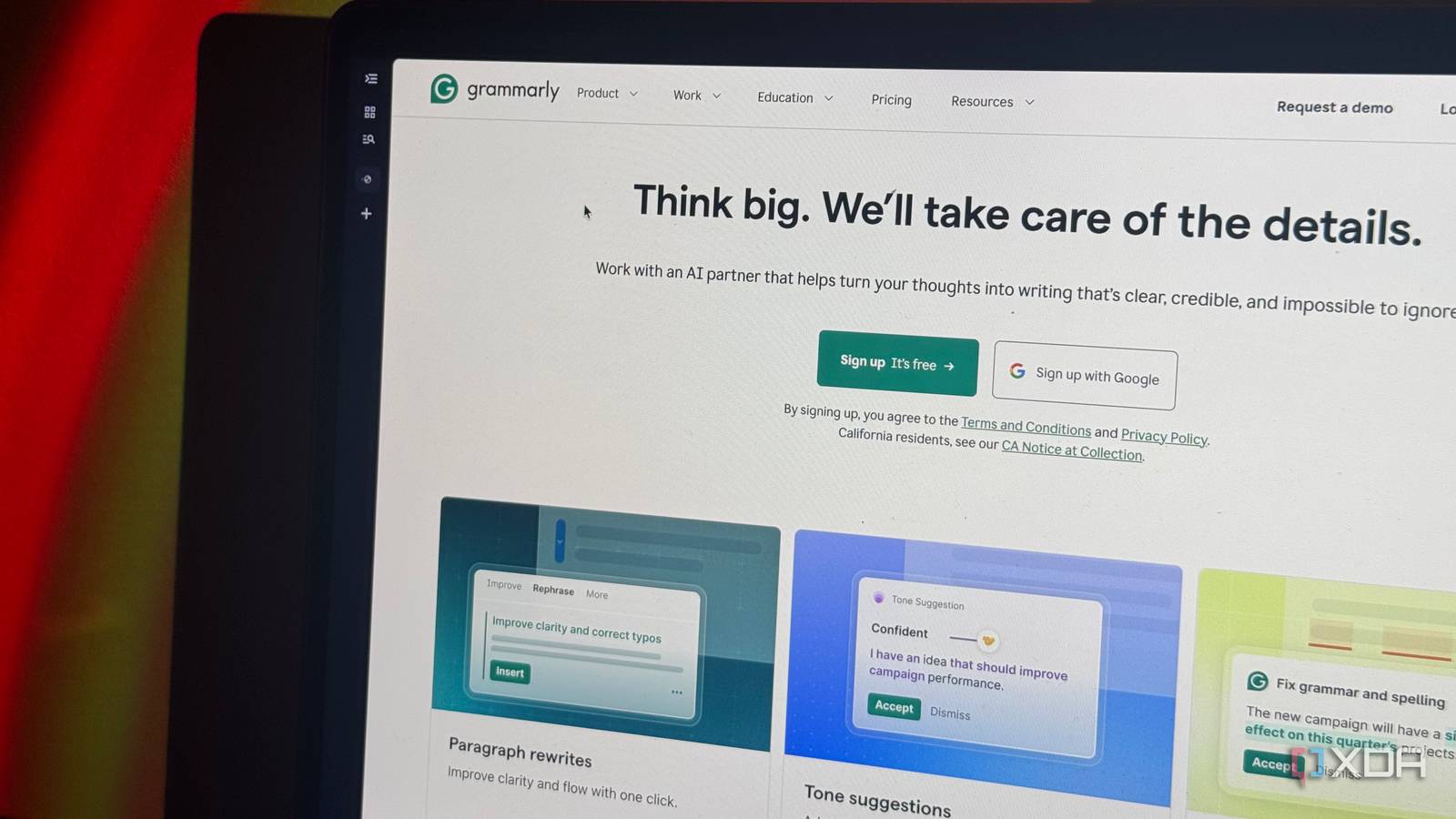
Published Oct 3, 2026, 2:00 PM EDT Mahnoor Faisal is a tech journalist covering AI and productivity tools with bylines at XDA, SlashGear, MakeUseOf, Laptop Mag, and Android Police. She's been writing professionally since she was sixteen, and has since penned hundreds of articles. This includes in-depth coverage of AI tools like NotebookLM to breaking news across the AI space. Her passion for technology started when she received her first iPod Touch (4th generation) on her 8th birthday, and she's been deep in the tech world ever since. Currently pursuing a degree in computer science, Mahnoor brings both a journalist's eye and a technical foundation to her coverage of how AI is reshaping the way we work and learn. If there is one thing I massively miss about the pre-AI era, it's writing. I know, I know. I'm just another journalist ranting about how AI is ruining writing. My issue isn't that AI can "write" (which, to be clear, it's only able to do because it learned from writing created by actual people in the first place.) What bothers me is how writing itself is now treated like a tedious middle step that should be automated. Have an idea? Throw it into ChatGPT or Claude, ask it to turn that into a polished paragraph, tweak a word or two, and voilà. You're a writer now. Except, to me, the annoying part is the whole point. Sitting there rewriting the same sentence five times because it doesn't sound quite right, realizing halfway through a paragraph that you've taken the wrong approach, obsessing over one word because none of the alternatives feel right. All of that is where your voice comes from! It's also why, despite spending so much of my time using AI, I don't let it actually do my writing for me. What I will happily let it do is clean up the mess afterward. While that once used to be Grammarly's job, I've now replaced it with a local LLM. Grammarly isn't what it used to be I miss when Grammarly just fixed grammar There was once a time when the top tool anyone would recommend for writing help was Grammarly. By "writing help," I mean tasks like catching typos, flagging obvious grammatical mistakes, and occasionally pointing out that a sentence is harder to read than it needs to be. Exactly what you'd expect from an app that describes itself as a writing assistant. Well, now that it's turned into an AI writing assistant, it seems to want to focus on the AI writing aspect a lot more than the assistant bit. Instead of stopping at catching mistakes, it increasingly wants to rewrite sentences, adjust your tone, rephrase entire chunks of text, and suggest alternatives for things that aren't even necessarily wrong in the first place. What was once a solid second pair of eyes now feels like an incredibly annoying editor (no shade to any of my editors, I love all of them) hovering over your shoulder and suggesting changes every five seconds. As you'd imagine, the content it ends up "rewriting" more often than not screams AI slop. It's gotten to the extent that one of the publications I used to write for banned writers from using Grammarly altogether! That said, the concept behind Grammarly is still incredibly useful. No matter how much you write, you're going to miss the occasional typo, repeat a word without realizing it, or write a sentence that made perfect sense in your head but reads horribly once you come back to it. So, I definitely still want that second pair of eyes. I just don't want Grammarly to be the one providing it anymore. Local LLMs are perfect for this kind of simple work This is exactly what small models are for I know, I know. I just complained about Grammarly AI-fying human-written work, and my next suggestion is to replace it with... more AI. The difference, though, is in what I'm asking the AI to do. When I realized what Grammarly would do to my work, I began toying around with different AI chatbots. They were obviously terrible at the actual writing part, but I noticed that they cleaned up text pretty well — only if and when you used the right prompt, though. Instead of asking them to rewrite anything at all, I started giving them very specific instructions: catch typos, flag grammatical mistakes, point out awkward phrasing, and tell me when something doesn't read quite right. In other words, I wanted them to act more like the old Grammarly than the new one. Here's the exact prompt I've been using for months now: Please clean this up very, very slightly. Do not change anything that does not need to be changed. Keep all edits extremely minor and focus only on improving flow, grammar, clarity, or awkward phrasing where necessary. Do not rewrite sentences just because you think they could sound better. Do not change my tone, voice, structure, or wording unless there is a clear reason to. I want the final version to remain as close to my original as possible. Again: keep the changes very minor. All I do is paste my actual written work, and then the prompt above. I get essentially the same thing back, just with all the typos fixed, any obvious grammatical mistakes cleaned up, and the occasional awkward sentence smoothed out. That's it! None of my sentences are merged into one super-condensed line, my tone isn't randomly made more formal, and perfectly fine wording isn't swapped out just for the sake of changing something. While I'd initially been doing the above with cloud LLMs, I began experimenting with local models a while back. I have a MacBook with only 8GB of RAM right now, so I can't really run any fancy, massive models locally. But for something as simple as proofreading with the prompt above, I quickly realized I didn't need to. For instance, Gemma 4 has been incredible! I've been using it for months on my iPhone, and it was one of the first models that made me realize just how capable smaller local models could be for this kind of work. I've been using the same prompt as above, and for this kind of work, that's more than enough. It doesn't need to do anything particularly complicated. It simply needs to understand what I wrote, catch what looks wrong, and leave everything else alone. My words stay out of the cloud, too The cloud doesn't need my drafts The reason why I turned to a cloud LLM for this wasn't just because they can handle the task well. It was also because they're convenient. ChatGPT and Claude are already open in my browser half the time anyway, so pasting in a paragraph and asking for a quick cleanup takes seconds. However, pasting my writing into a cloud LLM has always made me uncomfortable. For starters, AI has stolen enough from us. It's been trained on enough of our words already, and I don't appreciate the idea of voluntarily feeding it even more of mine every single type I want a typo fixed. There's also the fact that a lot of what I work on isn't necessarily public information when I'm writing it. The press often gets access to information before it's published, and that can include embargoed announcements, product details, briefing notes, or other material that simply isn't meant to be public yet. Even if I'm only pasting in a paragraph for proofreading, sending any of that to a cloud service has always felt a little uncomfortable! So, moving this entire workflow to a local model solved two problems at once. I still get the convenience of having AI clean up my writing, but the actual text never has to leave my device.
I replaced Grammarly with a local LLM, and none of my writing leaves my laptop anymore
Full Article
Original Source
Read the full article at Xda-developers →KhanList aggregates and links to publicly available news content. We do not host full articles from third-party sources. Always verify important information with original sources.