
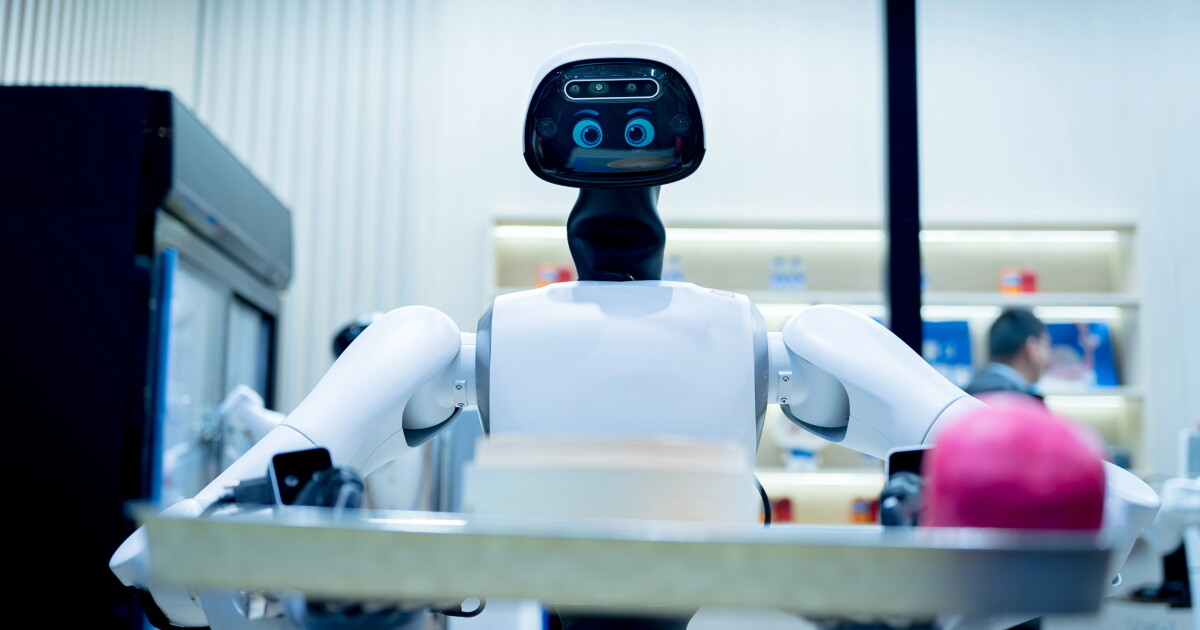
For all its intelligence – and it can be extremely intelligent – giving instructions to AI can sometimes feel like talking to a toddler. You provide a detailed prompt explaining exactly what you want, and the AI does something that may be related to it, but definitely not what you meant. Scientists have now developed a system that can detect that unspoken “That's not what I meant” response directly from your brainwaves, potentially allowing an AI to realize it has misunderstood you and attempt to correct itself in real time.Researchers at the Korea Advanced Institute of Science and Technology (KAIST), in collaboration with Microsoft Research Asia, created a brain-computer interface technique called Neural Value Alignment (NVA). The system uses electroencephalography (EEG) to detect different brain responses produced when a person sees an AI pursue the wrong goal or take an unexpected action. Those signals can then be used as feedback to help the AI work out exactly what it got wrong and adjust its behavior accordingly.If humans and AI are to work together seamlessly, the AI needs to understand exactly what a person actually intends to achieve. Current AI systems mostly infer this from things they can observe, such as prompts, speech, actions, and gestures. The problem is that human behavior can be quite ambiguous, even to other humans, never mind an algorithm.As the researchers explain, the same action can serve several completely different goals, while a single goal can also be achieved through several different actions. If you pick up a cup, for example, you might be planning to drink from it, wash it, move it somewhere else, or hand it to another person. On the other hand, if your actual goal is simply to quench your thirst, you could pick up the cup, grab a bottle of water, or ask somebody else to bring you a drink. This creates what the team calls goal-action ambiguity, where observing the action alone does not necessarily reveal either the true goal or the preferred way of achieving it.The researchers’ solution was to stop relying only on what the person was physically asking, either by action or direct prompting, and instead receive confirmation from the brain itself. Our brains continuously predict what should happen next, and when the outcome differs from that prediction, characteristic neural responses can appear. The team focused on two of these responses: reward prediction error (RPE) and state prediction error (SPE).Reward prediction error reflects a discrepancy in the outcome or goal and, in the NVA system, can indicate that the AI has misunderstood what the person ultimately wanted. For example, you tell a household robot, “Bring me something to drink.” You actually want water, but it brings you coffee. The goal or outcome itself is wrong, so your brain generates a reward prediction error.State prediction error is slightly different. It reflects an unexpected state transition, meaning the goal can still be correct while the AI's chosen action, intermediate step, or method differs from what the person expected. An SPE can therefore effectively tell the system, “Yes, that's where I wanted you to go, but not like that.” So, for example, you want water, and the robot correctly understands that. But instead of picking up the bottled water beside you, it walks into the kitchen and fills a glass from the tap. You still get water, so the goal is correct, but the action or sequence of states differs from what you expected. That can generate a state prediction error.The researchers conducted experiments that produced distinct brainwave patterns depending on whether there was a reward prediction error, a state prediction error, or both errors simultaneously. They then applied deep learning to these EEG signals, allowing the system to classify how the person was responding to the AI’s behavior. This lets the AI detect and distinguish when the goal is wrong or the method is wrong without a person saying anything.The team implemented the system via a “Neural Value Alignment-based human–AI synergy algorithm” that uses the decoded neural signals as feedback for the AI's decision-making. In addition to being able to detect that something is wrong and what, the system can use this feedback to change its course of action in real time depending on which of the signals it detects.The significance of the work goes beyond eliminating the occasional frustrating chatbot conversation. A system capable of detecting this kind of unconscious disagreement could eventually prove useful anywhere humans and AI-controlled machines need to work closely together. A household robot, for example, could potentially notice from its user's neural response that it has misunderstood an instruction, and change course without waiting to be verbally corrected.Similar feedback could eventually be useful in industrial robots, autonomous vehicles responding to driver judgment, medical or rehabilitation robots for people who have difficulty speaking or moving, and educational systems that adapt to a student's cognitive state.“This research is meaningful because it shows that AI can move beyond inferring human intent only from visible behavioral outcomes and instead directly use cognitive signals generated in the brain during collaboration with AI,” said Prof. Sang Wan Lee, who led the research.Obviously, there are at least a few steps between this research and being able to glare at a robot and have it stop in its tracks. For one, the system was demonstrated in simulations, not a full real-world demonstration in which a freely operating robot continuously read someone's EEG and corrected its behavior around the house.Additionally, EEG requires electrodes to measure the tiny electrical signals produced by the brain, and those signals can be noisy and considerably less convenient to acquire outside controlled experiments. Exactly how reliably NVA works during natural interactions, with people moving around and dealing with much messier situations than laboratory tasks, will therefore be important to establish.The research was published in the journal IEEE Transactions on Cybernetics.Source: KAIST
Mind-reading tech aims to make AI actually intelligent
Full Article
Original Source
Read the full article at Newatlas →KhanList aggregates and links to publicly available news content. We do not host full articles from third-party sources. Always verify important information with original sources.