
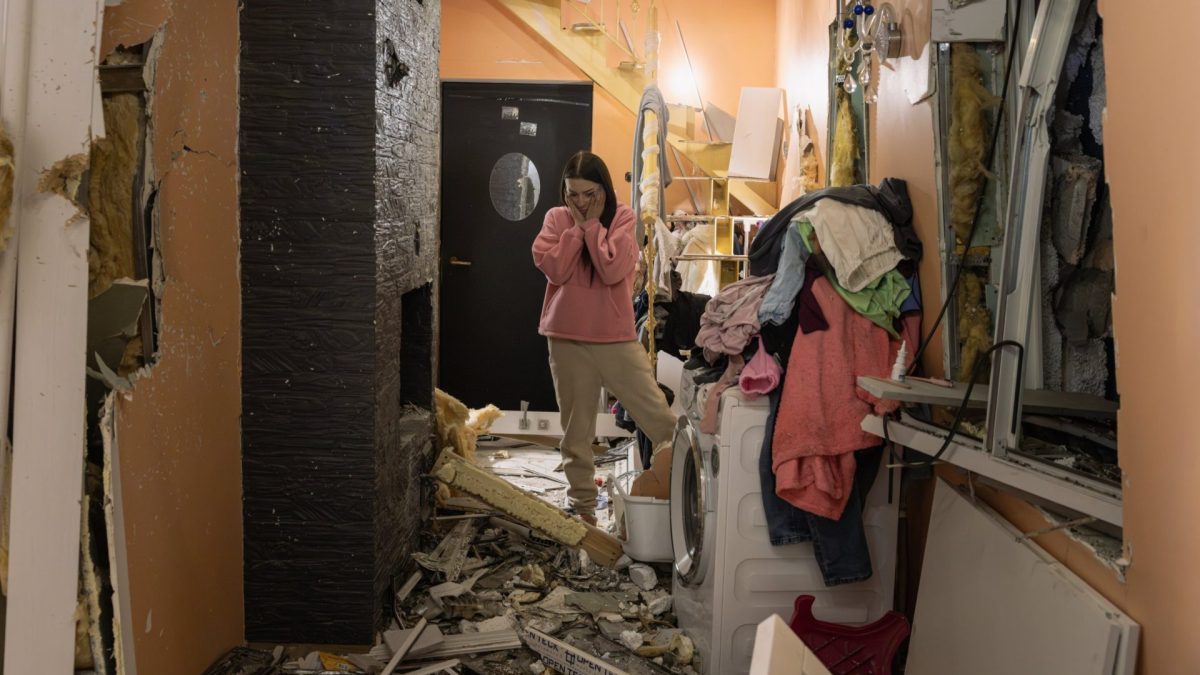
In Kyiv, explosions have become part of daily life. Whether at work, in a café or late at night, you will regularly hear the sound of missiles exploding, even in the centre of Ukrainian capital. A diving Shahed sounds a bit like a German Stuka divebombing in an old war film – a high-pitched scream followed by a deadly boom. Each explosion comes with disruption and tragedy. People can’t get to or from work, their internet and power goes off continually, and they worry about the safety of their children every time they go to school. Innocent civilians are killed as Russian missiles, whether directly aimed at them or not, crash into their apartment blocks and workplaces. The situation is markedly worse now than when I last visited in February, and highly likely to deteriorate even further this winter. The recent crisis is due to Russia’s widespread use of jet-powered Shaheds and ballistic missiles. The former are often still called “drones”, but this is a misnomer – they are by now essentially cruise missiles. The Ukrainian defenders have struggled to deal with the sudden surge of these weapons, and are racing to upgrade and improve their own interceptors to match the threat. Worse are the ballistic missiles – the descendants of the Nazi V2 Rocket – that are fired high towards or into space before hitting their target at extreme speeds. These cannot be countered by normal air defence systems. Due to the war in the Middle East, the West has essentially run out of the American Patriot PAC-2 and especially PAC-3 interceptors that are used by Ukraine to defeat Russian ballistic missiles. As such, cities like Kyiv are acutely vulnerable to these devastating weapons, which can smash through entire apartment blocks if they score a direct hit. In addition, they travel so fast that there is often no time for civilians to get under cover once they hear an alert. Unlike lower-level drone interceptors, anti-ballistic missile systems are complex and cannot be designed or built from scratch quickly. Without them, Ukraine is going to suffer particularly badly this winter. Ukraine’s experience is not the exception to the rule, but the forerunner. As we have seen in the Middle East – and my friends and family have directly experienced – hostile states across the world are more than willing to lob ballistic and cruise missiles at urban areas. Britain needs to accept that an adversary would do the same to us in times of war. There are several lessons that Britain needs to learn from Ukraine’s current experience. The first is the crucial importance of missile defence, particularly against ballistic missiles. This does not mean an “Iron Dome”-style system of comprehensive drone and missile defence, as has been suggested by the Conservative Party. Such a project would be enormously expensive, impractical, and take vital resources away from the frontline forces needed to take the fight to Russia. It is always better to fight in the enemy’s backyard than our own. However, this does not mean that we should do nothing. Britain currently has almost no anti-ballistic missile defences, including for our key military, political and economic sites. At the start of a war, if I were Vladimir Putin, I would fire long-ranged ballistic missiles at GCHQ in Cheltenham, our nuclear submarine base in Faslane, our major military headquarters, and at Whitehall in London. Direct hits, combined with sabotage and cyberattacks – true “hybrid warfare” – could cripple our ability to wage war effectively almost before we’d even started. The Epicentr shopping centre destroyed by a Russian strike on Thursday in Kyiv, Ukraine (Photo: Yan Dobronosov/Global Images Ukraine via Getty Images) So how do we avoid this? The best option for the UK is first to support Ukraine’s new Freyja anti-ballistic missile project wholeheartedly. This is not just an act of charity – if Freyja comes online, as it is hoped will happen next year, it could be a future source of affordable anti-ballistic missile interceptors that could also defend the UK. The alternatives in the short-to-medium term are the American Patriot, the future supply of which is unreliable for both political and practical reasons, or ground-based launchers for the French-Italian Aster 30, which arms our Type 45 Destroyers, but is built in limited numbers. The Type 45, our most sophisticated air defence capability, has well-documented issues with reliability and availability, but beyond that it is meant to fight the Russians far out to sea – it cannot defend inland Britain. We need something more than just a handful of ships to counter the threat. The second lesson is the vital importance of good civil defence. Ukraine’s response to attacks is not just military, but also includes the heroic work of the State Emergency Service, volunteers, and thousands of electricians and engineers who race to repair damaged infrastructure. We don’t have anything like this in the UK. A new civil defence corps should be formed, able to provide suitably trained people who could quickly respond to crises in their local area. In addition, there also needs to be far more integration of national plans with local government, because it will be local communities that will have to bear the brunt of initial crisis response. This is not just a wartime measure either – the instability of the world and global warming require us to be ready for multiple crises, whether flooding, extreme weather, or another pandemic. Thirdly, the importance of continuing to support Ukraine and damage Putin’s war machine cannot be overstated enough. This includes providing more weapons and money to Ukraine so they can strike Russian targets, and directly countering Russian attempts to destabilise Europe through sabotage and information warfare. We cannot be complacent – Ukraine is in a dangerous position right now, and it’s only going to get worse through the winter. If Putin is to be thrown back and deterred from striking Europe, he needs to be defeated in Ukraine. Ukrainians are defending their freedom, and Europe, with their lives. They also know more about modern warfare than anyone in the UK, and are willing to share their knowledge with us. They deserve and need our support – and we need them. If we support them now, they will be the key to our security in the future. Matthew Palmer is a freelance writer at Cracking Defence. A former British soldier, he is also an Adjunct Fellow of the Council of Geostrategy think-tank and an Associate of the Milkwood Group. All views are his own
I just came back from Ukraine. What I saw should be a warning to the UK
Full Article
Original Source
Read the full article at Inews →KhanList aggregates and links to publicly available news content. We do not host full articles from third-party sources. Always verify important information with original sources.