
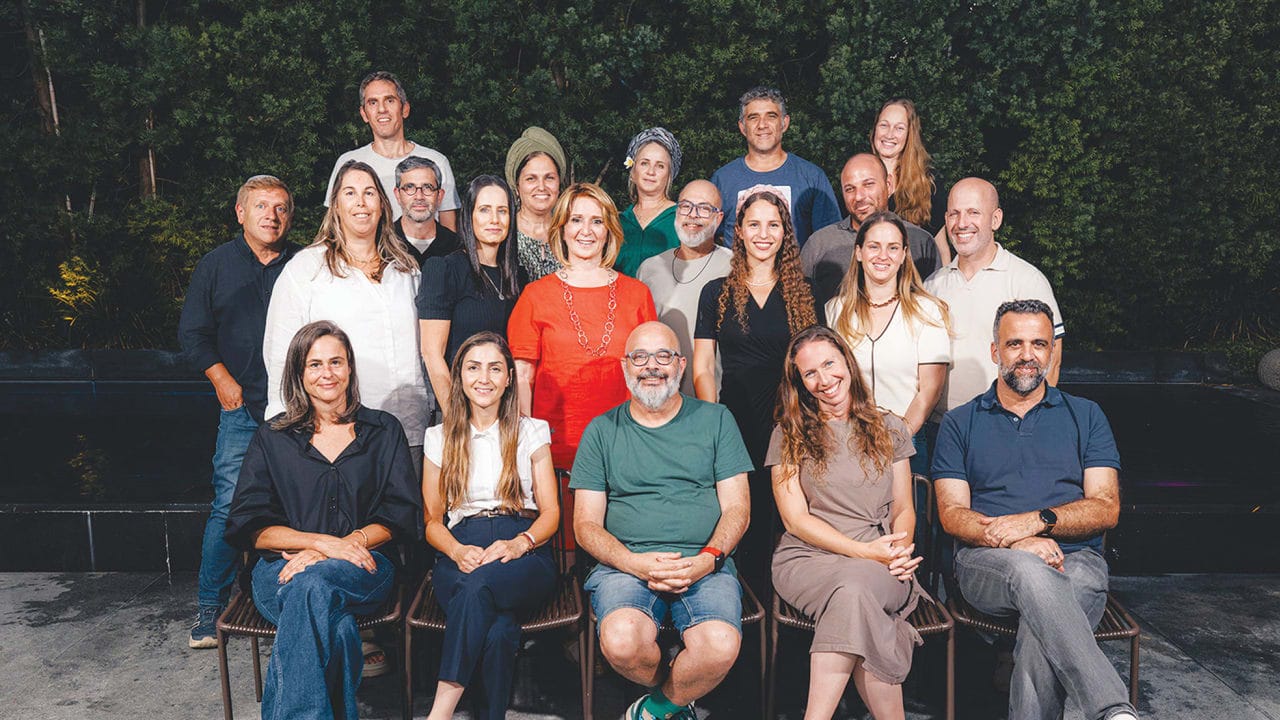
OCTOBER 24, 2026 15:46Moshe Shapiro wants Israelis to learn to live together with the same seriousness with which they learned to protect wildflowers.Shapiro, whose son Aner was killed on October 7, 2023, while throwing grenades back out of a roadside shelter to protect fellow Nova music festival-goers, is among the bereaved relatives behind Hamechane, an initiative seeking to make social cohesion a national responsibility.Ahead of the elections, he joined Hoda Daxa and Shai Zohar in an interview with The Jerusalem Post about what that would require – and whose place in Israeli society needs to be recognized.“Unity is an operating system, an approach,” said Zohar, the uncle of Capt. Omer Neutra, a lone soldier from New York who was killed on October 7. His body was taken to Gaza and returned in November 2025. Daxa’s husband, Col. Ehsan Daxa, commander of the 401st Armored Brigade, was killed commanding troops in northern Gaza in October 2024.For Shapiro, the wildflower campaign offers an example of how such a change can take root. Beginning in the 1960s, it combined legal protection with public education, turning a cause championed by a small group into something generations of children grew up knowing. He wants respect for others, even across deep disagreements, to become just as ingrained.A woman cries at the Nova music festival memorial site on October 6, 2026. (credit: MARC ISRAEL SELLEM)A search for common ground“Hamechane,” meaning “the denominator,” expresses the search for common ground. The organization’s members include bereaved families, captivity survivors, and people wounded in the Israel-Gaza War. They want the next government to establish, within its first 100 days, a national framework for social cohesion.For the three interviewees, the urgency comes from lives they are trying to honor, and a country they fear could repeat its failures.Zohar argued that the divisions preceding October 7 helped bring Israel to catastrophe. He regards internal polarization as the country’s greatest existential threat and warned that, without addressing it, Israelis risk paying that price again. He cautioned that Israelis cannot risk slipping backward, that it is “something we must prevent at all costs.“We have already paid an immense price,” he added.His warning accompanied a more personal admission: Until he heard Daxa, a member of Israel’s Druze community, speak about the Nation-State Law, he had not understood what it meant to her community.“It went over my head,” he said. “Today I understand it better.”The 2018 Basic Law reserves national self-determination in Israel to the Jewish people, defines Hebrew as the state’s language, and gives Arabic special status. It contains no explicit guarantee of equality. Druze critics have argued that it excludes them from the country to which they belong and for which their community’s soldiers fight.The High Court upheld the law in 2021, interpreting it as compatible with equality protections. The dispute nevertheless returned during the war: In November 2023, Druze spiritual leader Sheikh Muwaffaq Tarif called for constitutional recognition of the community’s rights, while the coalition promised separate legislation on Druze status.For Daxa, the question of belonging also arises in ordinary encounters. She recalled traveling by train with her children and speaking Arabic. Nobody said anything, she explained, but she noticed passengers’ discomfort.“Hatred doesn’t distinguish,” she said.She was explicit about the limits of a unity understood only as solidarity among Jews.“There are partners here,” she said, describing people who already feel part of Israeli society and want to contribute as active participants.The group’s work, she explained, begins with what its members have come to understand through loss. They bring different opinions and will vote for different parties. What makes conversation possible is a willingness to learn rather than being certain that one side is right and the other wrong.“We come with an open heart,” she said.Shapiro described a yearlong process of developing a shared vision. He had participated in other initiatives, including efforts to encourage dialogue during the judicial reform legislation dispute. In Hamechane, he found religious and secular Jews, ultra-Orthodox (haredim), Druze, and people from the Right and Left.“This is the face of Israeli society,” he said.The relationships formed through that process imbued him with the confidence that cooperation is possible. Nobody, he emphasized, has had to conceal or abandon their opinions.His own family contains sharp political differences, he said. Learning to handle them means recognizing that the relationship matters, while allowing disagreement to be expressed respectfully, he explained. He wants that responsibility extended to the country.His grandfather Haim-Moshe Shapiro signed Israel’s Declaration of Independence and served as a minister. Before the Six Day War, he pressed prime minister Levi Eshkol to bring opposition parties into the government and appoint Moshe Dayan defense minister.Moshe recalled his grandfather’s insistence on bringing political rivals into government as Israel faced the prospect of war. In June 1967, just before the Six Day War, the government was expanded to include two opposition parties: Gahal, led by Menachem Begin, and Rafi, whose members included Dayan. Begin joined the cabinet, and Dayan became defense minister.Aner’s writing gives that inheritance another voice.Kaleidoscope of religious, secular, right-wing, left-wingIn a social media post written before October 7, Aner reacted to graffiti defacing an image of the Lubavitcher Rebbe. He questioned the categories through which Israelis were seeing one another: religious, secular, right-wing, left-wing. People were speaking in black-and-white terms, dividing the world between those on their side and “them.”“There really is no ‘them,’” he wrote at the time.In an essay on otherness, boundaries, and dialogue, psychoanalyst Shmuel Ehrlich links the possibility of dialogue to recognizing the other’s humanity and accepting that conflicting feelings can coexist within a relationship. His account echoes the openness the three describe: making room for complexity, in ourselves as well as in those with whom we disagree.During the shiva for Aner, Moshe recalled that he saw cooperation between people from opposing political camps and believed the divisions his son had written against were receding. He now describes the return of that hostility with disappointment.Hamechane aims to make cooperation endure beyond emergencies. Alongside its call for government action, Hamechane seeks to encourage personal connections and dialogue between people from different backgrounds through schools, workplaces, and communities.Shapiro envisages teaching children from a young age about different communities and how to listen to others and handle disagreement. He also wants action in communications, including measures against online activity that inflames hatred. He worries about political speech that reduces entire groups to caricatures.Politicians, he said, have begun to sound like bots. He wants people to return to speaking like people, addressing substance rather than circulating slogans.These are proposals for what a national effort could address. The initiative has not settled the precise structure of the body it seeks. Its representatives say elected officials and professionals should develop that framework, with responsibility extending across government and society.Daxa acknowledged that the group does not possess all the professional answers. Recognition of polarization as a national danger, she believes, would itself mark a beginning.Her husband’s example gives her a way to describe the conduct she hopes to encourage. Whatever the subject, including haredi enlistment, Ehsan could articulate the other person’s perspective.“Even if he didn’t agree, he still had the ability to see, understand, and respect,” she said.For Zohar, Omer’s life offered a similar example of connection. Raised on Long Island, he came to Israel to serve in the IDF. His uncle described him as someone who brought people together, linking Diaspora Jewry and Israel.Honoring that life, Zohar said, means taking responsibility for the society that remains.Shapiro returned to the subject of the shelter where Aner died. Apart from the two friends he arrived with, he said, his son did not know the people behind him. One of those friends was Hersh Goldberg-Polin, who was taken hostage from the shelter and murdered by his Hamas captors alongside five other hostages in a tunnel in Rafah in August 2024.For Aner, Moshe said, the politics, religious identities, and backgrounds of the people inside the shelter with him did not determine whether he would protect them.“We’re not asking people to sacrifice their lives,” Moshe said.What he asks is that they listen, make room for others, and recognize that disagreement does not cancel their obligations to one another.Among the words Aner left behind were lines his father read aloud during the interview:“There are wars we have no choice but to fight.There are battles we cannot help but lose.And there is hatred looking for a place, now finding fertile ground.There is also time to wake up and love.”Read more about Hamechane here: hamechane.org.ilFollow us on Google
Beyond the ballot, October 7 families call for a different kind of Israeli politics
Full Article
Original Source
Read the full article at Jpost →KhanList aggregates and links to publicly available news content. We do not host full articles from third-party sources. Always verify important information with original sources.