
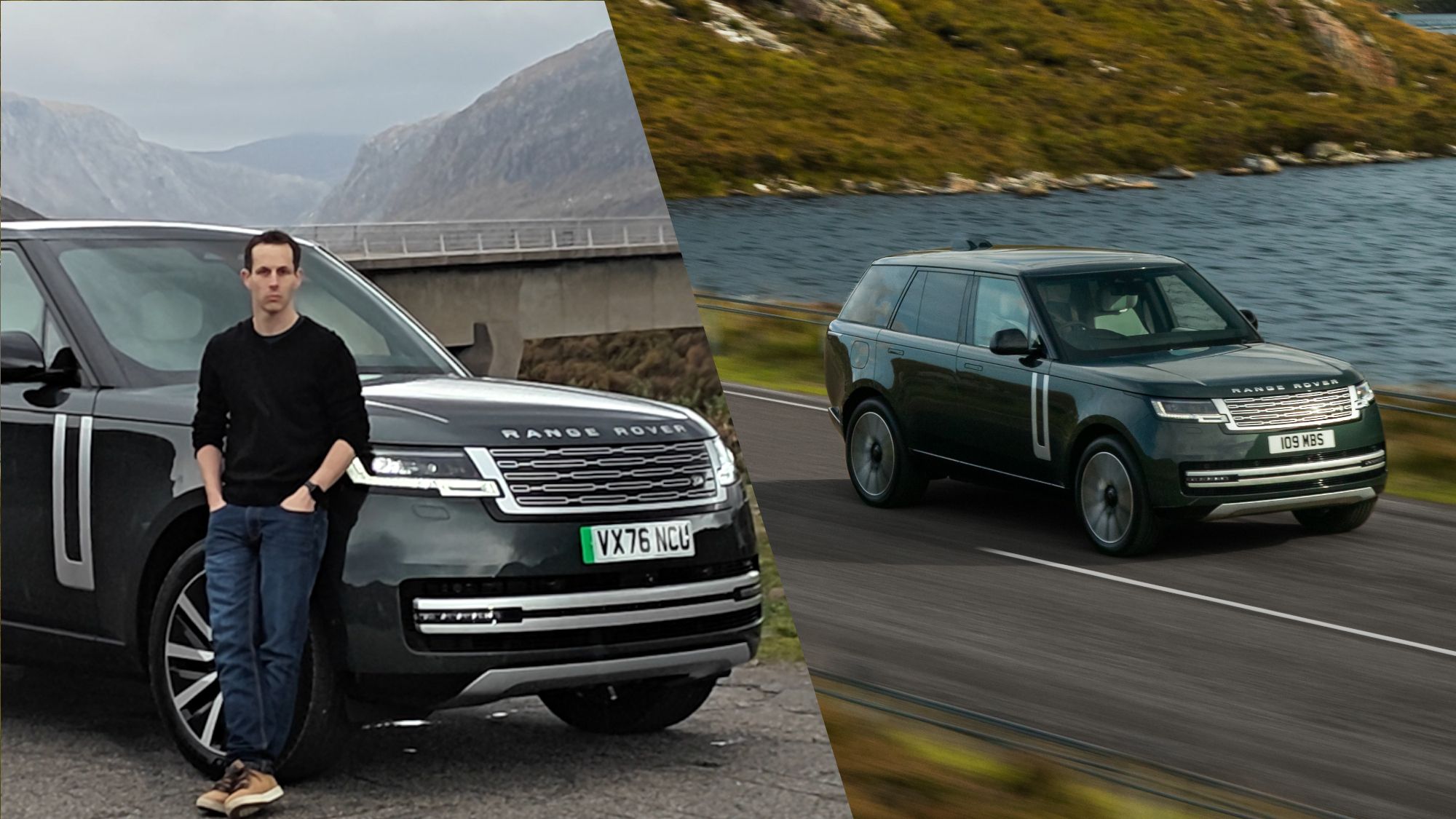
(Image credit: Tom's Guide / Range Rover) The first fully-electric Range Rover has been a long time coming. Five years after first announcing its EV ambitions, the luxury SUV brand’s entry into electrification is carrying the weight of expectation. Now it’s here, complete with insistence from Jaguar Land Rover (JLR) that it’s more responsive, with better acceleration and more torque than any of the four previous generations since the car was introduced back in 1970.In fact, the shift to electric pays some serious dividends when it comes to Range Rover’s luxury credentials. The cabin noise is quieter by 7 dB than the 2022 ICE V8 counterpart this car was benchmarked against. It’s also got V8-beating acceleration, 10% less body roll and a 60% quicker active damping system to intercept any infuriating road bumps. On top of that there's the traction management system I'll touch on later that responds 100 times faster than its combustion‑engine equivalent in the (unlikely) event the average Range Rover customer decides to take it off-road. Image 1 of 6 (Image credit: Range Rover) Speaking of Range Rover customers, this isn’t a vehicle to democratise EV adoption when pricing starts at £154k ($206k) for the standard wheelbase Autobiography trim. Even less so when it rises north of £225k ($301k) for the long wheelbase SV Black edition. But according to Rachel Hogg, Global Product Manager for Range Rover Electric, a lot of interested people are coming to the car for the first time.“We opened a global waiting list a couple of years ago and to date, 70% of the people on the waiting list are new to the Range Rover brand,” she told me following a day behind the wheel of the new car. "That's a pretty exciting opportunity for us, because these are people who aren't familiar with what Range Rover stands for. They're maybe not familiar with those experiences that you get from owning a Range Rover.“So I think this is an exciting opportunity to bring new people into the brand, and also to show our loyal customers that we haven't traded on what they know and love, and we have delivered something true to a Range Rover.”Range Rover first, EV second (Image credit: Range Rover)Over the course of a day and a half, I took the Range Rover Electric First Edition SWB (the mid-tier trim with a price around £157k ($210k)) on a 500-odd-mile round trip across Scotland, both on road and off. The constant refrain from the team at JLR was that the Electric was a Range Rover first and an EV second. As such, there’s almost no outward difference to speak of between this and the 2022 fifth-gen Range Rover. You’ll see a new grille, different wheels and, of course, the charging ports positioned on either side. But otherwise, it’s a dead ringer for its ICE siblings.The Range Rover Electric is built on an upgraded version of the Modular Longitudinal Architecture (MLA) platform used by its combustion-engined brother and electric stablemate, the Jaguar Type 01. I’m told this car is expected to be the most-patented in Range Rover’s history, with over 300 filed for just this model alone.Get instant access to breaking news, the hottest reviews, great deals and helpful tips.Among those patented components are twin 260kW permanent magnet electric motors forming the core component of the Electric Drive Units (EDU) mounted on the front and rear axels. Because the front EDU sits where the typical combustion engine would sit, there’s no ‘frunk’ to be found on this car. Another indicator that this machine isn’t trying to follow conventional EV flourishes. Swipe to scroll horizontally Range Rover Electric EV550 SWB: Specifications Propulsion 118.5kWh NMC battery pack, prismatic cells, 800v architecture Drivetrain Twin EDU, Intelligent All-wheel drive WLTP combined driving range (km / miles) 600 / 372 Power (PS / HP) 550 / 542 Torque (Nm / lb/ft) 850 / 627 0-60mph / 0-100kph 4.3 / 4.5 Top speed (mph/kph) 124 / 200 Max wade depth 900mm Max tow capacity 2,500kg Dimensions (L x W x H - mm) 5,052 x 2,209 x 1,867 Wheelbase (mm) 2,997 Unladen weight (EU kg) 2,810 Battery and range (Image credit: Range Rover)Those two motors are powered from a double‑stacked 118.5kWh battery with 800‑volt technology, giving the car a WLTP range of 372 miles. But the folks at Range Rover told me that, based on the extensive amount of virtual and real-world testing, you can expect around 333 miles before having to plug in. That’s roughly equivalent to the range you’d get from a full tank in a V8 ICE Range Rover — during my own drive, the readout was quoting around 300 miles until we started to tackle the off-road tracksThat range is good without being outstanding. BMW’s competing electric iX5 SUV delivers a claimed range of up to 435 miles. Charging via an 800‑volt compatible fast charger will take the Range Rover Electric from 10‑80% in 22 mins. Thankfully for Range Rover, high-powered 300-kilowatt chargers are becoming more prevalent — perhaps a silver lining to the fact we’ve waited a long time for this car.Range Rover’s team also told me they’ve worked hard to make sure the power levels are consistent for greater than 80% of the state of charge.“It's no good quoting, I don't know, 5,000 horsepower if you get it for 3 milliseconds when you're at 100% state of charge, and then by the time you get to 80% state of charge, you're down to 200 horsepower,” said Simon Fairbrother, Programme Chief, Range Rover Electric.“And we've got power by mode as well, so we tune the best power for the mode that you're in from a terrain response perspective.”"We tune the best power for the mode that you're in from a terrain response perspective.Simon Fairbrother, Programme Chief, Range Rover ElectricFairbrother also told me about the car’s thermal management system that juggles 300 different settings to keep the battery and the EDU at the optimal operating condition. For example, the system harvests waste heat from the vehicle to keep the cabin temperature or propulsion system warmer in cold conditions.Interior and technology (Image credit: Range Rover)This is, after all, a Range Rover and the cabin is spacious and oozing luxury from every pore of the faux leather upholstery. The central cluster is dominated by a 13.1-inch touchscreen running JLR’s Pivi Pro infotainment software.From that screen, you can control everything from cabin lighting, four-zone climate control and air purification through to individually heated (and massage-capable) seats. If you really want to dial up the opulence, you can trigger the “ambient fragrance diffuser” from the system and waft one of JLR’s curated ‘rejuvenate’, ‘peace’ or ‘restore’ scents through the cabin. (Image credit: Range Rover)Oh, and don’t forget the refrigerated compartment underneath the central armrest. That’s certainly a new one on me and probably speaks to the fact that a lot of these cars are used as chauffeur-driven transport vehicles.There’s full compatibility with Apple CarPlay and Android Auto and beneath the screen is an ample compartment for your phone(s) that includes a wireless charging shelf. Sound is provided courtesy of a custom-engineered speaker system from Meridian Audio that fills the near-silent cabin with ease. I appreciate the fact that Range Rover doesn’t use that sound system to deliver fake engine noise or any sci-fi-style whooshes or reverbs that you would easily find in any other EV with an identity crisis.Finally, the non-obtrusive HUD was extremely useful, with your current speed set against the road limit and navigation elements like your distance to destination called in when necessary.What’s it like to drive? (Image credit: Tom's Guide)All the usual adjectives can all be drafted in to describe the experience of driving the Range Rover Electric on the road: effortless, refined, sublime. Rinse and repeat. Driving this car is more akin to being transported down the road in a whisper-quiet armchair, and the few times I did floor it, the car demonstrated its 542bhp, 0-62-in-4.5-seconds prowess without so much as a stutter. There's a top speed of 124mph, and believe me when I say it barely registers when you start getting up towards it.The batteries actually lower the car’s center of gravity, so it improves the handling over gas-guzzling versions. I felt it was completely responsive, and turning was graceful without ever pulling uncomfortably to the side of my seat. The air suspension was on point, and tarmac driving meant every bump or pothole barely registered.And then we went off-road. (Image credit: Range Rover)Utilizing software and the dual motors to lock the differentials, the Range Rover Electric can adjust motor speed within 50 milliseconds and manage slip up to 100 times quicker than its ICE equivalent.The Range Rover Electric utilises a new Integrated Traction Management (ITM) system which Fairbrother told me was his proudest achievement when it came to the car. Utilizing software and the dual motors to lock the differentials, the Range Rover Electric can adjust motor speed within 50 milliseconds and manage slip up to 100 times quicker than its ICE equivalent.The ITM system works in conjunction with Terrain Response, which I duly engaged when faced with a twisted, muddy track leading up and over a headland next to a loch. The Electric Range Rover pretty much breezed through the process and I counted just a single time throughout the entire drive where I lost a bit of grip and felt a back wheel slide out.Once my muddy track had been conquered — with the aid of the front-mounted terrain camera guiding my all-wheel drive progress — it was time to experience the Range Rover Electric’s 900mm (35 inch) wading depth. We both forded a river and rolled our way through the aforementioned loch safely cocooned inside the cabin with just the sound of the water slapping against the bodywork. (Image credit: Range Rover)Once on the other side and crawling back along through mudded ruts with bracken and pine trees either side — on standard road tires the entire way — it occurred to me more than once that 95% of Range Rover’s typical suburban-based ownership will likely never put their own vehicle through anything like this kind of punishment. But just like a $5,000 dive watch that’ll never be worn beyond the shallows, they need to know that it can if it has to.Final thoughts (Image credit: Tom's Guide)Electrification fits the Range Rover brand like an understated tailored velvet glove. It’s more powerful, more responsive, but just as capable when it comes to range and terrain as its V8 brethren. But the extra solitude and acceleration granted by the electric power feel perfectly positioned with the understated luxury Range Rover aspires to provide.Perhaps part of the reason this car has taken so long to arrive is that it delivers so much whilst seemingly sacrificing very little. It’s taken its time to arrive, but now it’s here; well-heeled Range Rover fans will see it’s been worth the wait.Over to you — let me know your thoughts on the Range Rover Electric in the comments below, along with any other EVs you’d like us to test drive. Follow Tom's Guide on Google News and add us as a preferred source to get our up-to-date news, analysis, and reviews in your feeds. More from Tom's GuideYou're driving your electric car wrong — here's how to get the best efficiency out of itI drove the Kia Sorento and Hyundai Santa Fe for a week — here's the 3-row family SUV I recommendI drove over 10,000 miles this year and Google Maps needs to upgrade this feature ASAP — here's why Jeff is UK Editor-in-Chief for Tom’s Guide looking after the day-to-day output of the site’s British contingent.A tech journalist for over a decade, he’s travelled the world testing any gadget he can get his hands on. Jeff has a keen interest in fitness and wearables as well as the latest tablets and laptops. A lapsed gamer, he fondly remembers the days when technical problems were solved by taking out the cartridge and blowing out the dust.
I drove the new Range Rover Electric 500 miles on and off road — and it’s the luxury EV to beat
Full Article
Original Source
Read the full article at Tomsguide →KhanList aggregates and links to publicly available news content. We do not host full articles from third-party sources. Always verify important information with original sources.