
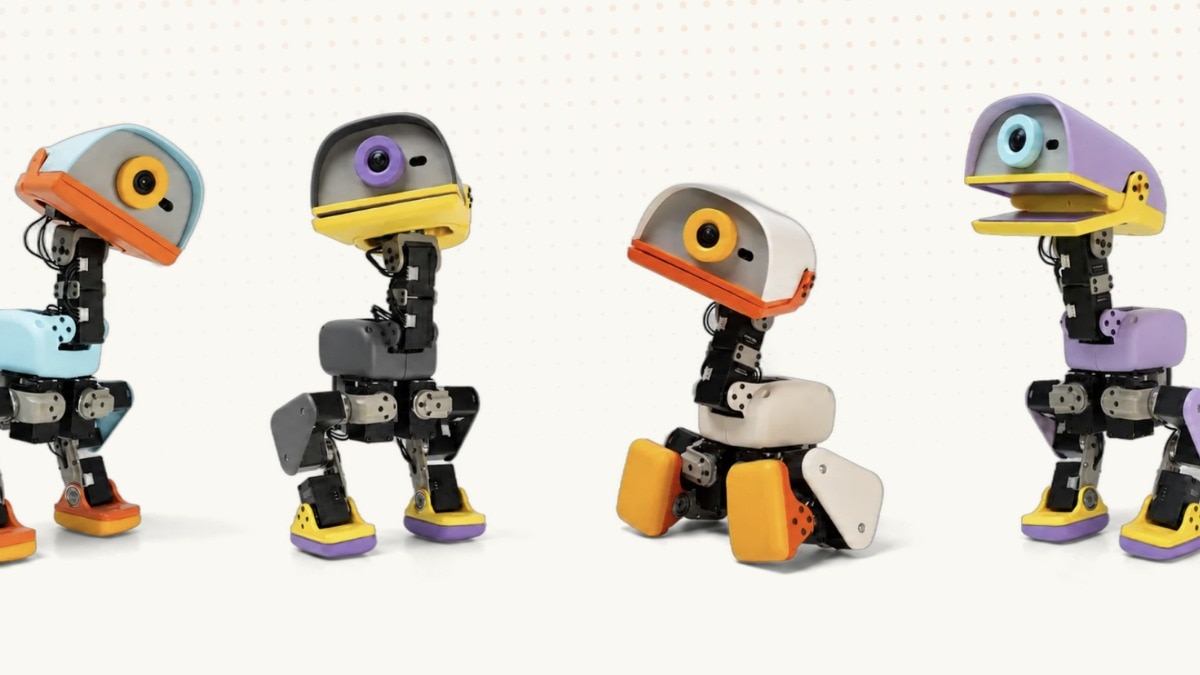
Hugging Face has unveiled a $399 robot duck that can waddle, pick things up with its beak and even learn new tricks from humans. It is packed with AI features and is open source, allowing developers and users to experiment with it.Can we call this month the Robo Month of 2026? Because why not? For the last few weeks, we have been seeing robots across the world helping with folding laundry, doing karate and, yes, even competing in the Robot Olympics in China, where we are seeing humanoid robots sprinting, sparring, clearing obstacles and even karate-kicking under stadium lights. And now, Hugging Face has also joined the party with its new and cute robot called Microduck.Just like its name, it is cute and duck-shaped — or rather, not quite. Personally, it reminds me a bit of Pingu. But coming back to the robot, Microduck is a duck-like biped robot priced at $399 that can waddle, pick up objects with its beak and learn new tricks from humans.At 25cm tall and weighing less than 800 grams, Microduck is tiny compared with the humanoid robots grabbing headlines. But that is part of the point. Rather than trying to build a robot that can do everything, Hugging Face wants Microduck to give developers, researchers and curious users an affordable way to experiment with physical AI.What can Microduck do?Clem Delangue, CEO of Hugging Face, describes Microduck as an open-source robot that people can teach new tricks using reinforcement learning. In simple terms, users can train the behaviour of Microduck in simulation, test it and then transfer it to the physical robot. The software development kit, simulation environment and reinforcement learning tools are being made available as open source. And despite its playful appearance, Microduck has some serious hardware packed into its small body. It has 15 motors, a camera, a small LiDAR sensor and two inertial measurement units to help it understand its movement and maintain balance. Its articulated beak also doubles as a gripper, allowing it to pick up objects weighing up to 800 grams.Out of the box, the robot comes with seven trained behaviours. It can walk with a waddle, sit and stand, crouch, kick a ball, pick up objects, roller-skate and recover from several common positions after falling over. It can also be controlled using a game controller and follow a laser pointer. Microduck does not communicate using words. Instead, it uses sounds through its built-in microphone and speaker, with each robot given its own audio identity. According to the company, the idea is to make it feel more like a small creature than an AI assistant.And then there is the open-source part. Hugging Face wants people to be able to see how the robot works, modify its software, retrain its behaviours and share what they build. That fits neatly with the company's wider focus on open AI models and tools, but takes the idea out of the computer and into the physical world.Meanwhile, Microduck is being developed by Pollen Robotics, the Bordeaux-based robotics team that joined Hugging Face in April 2025. It is the team's second consumer robot after Reachy Mini, but the two have different goals. Reachy Mini is primarily designed for interaction from a desk, while Microduck is built around movement and physical AI.How to buy Microduck?Pre-orders for Microduck opened on August 27 at an introductory price of $399, which is around Rs 33,000, before taxes and shipping. It is available in four colourways — Cream, Graphite, Lavender and Sky — with first deliveries targeted for before Christmas 2026 in North America, Europe and the UK. The box includes the robot, battery, USB-C cable and a game controller.- EndsPublished By: Divya BhatiPublished On: Aug 28, 2026 16:17 IST
Hugging Face launches $399 Microduck robot that can learn new tricks from humans
Full Article
Original Source
Read the full article at Indiatoday →KhanList aggregates and links to publicly available news content. We do not host full articles from third-party sources. Always verify important information with original sources.