
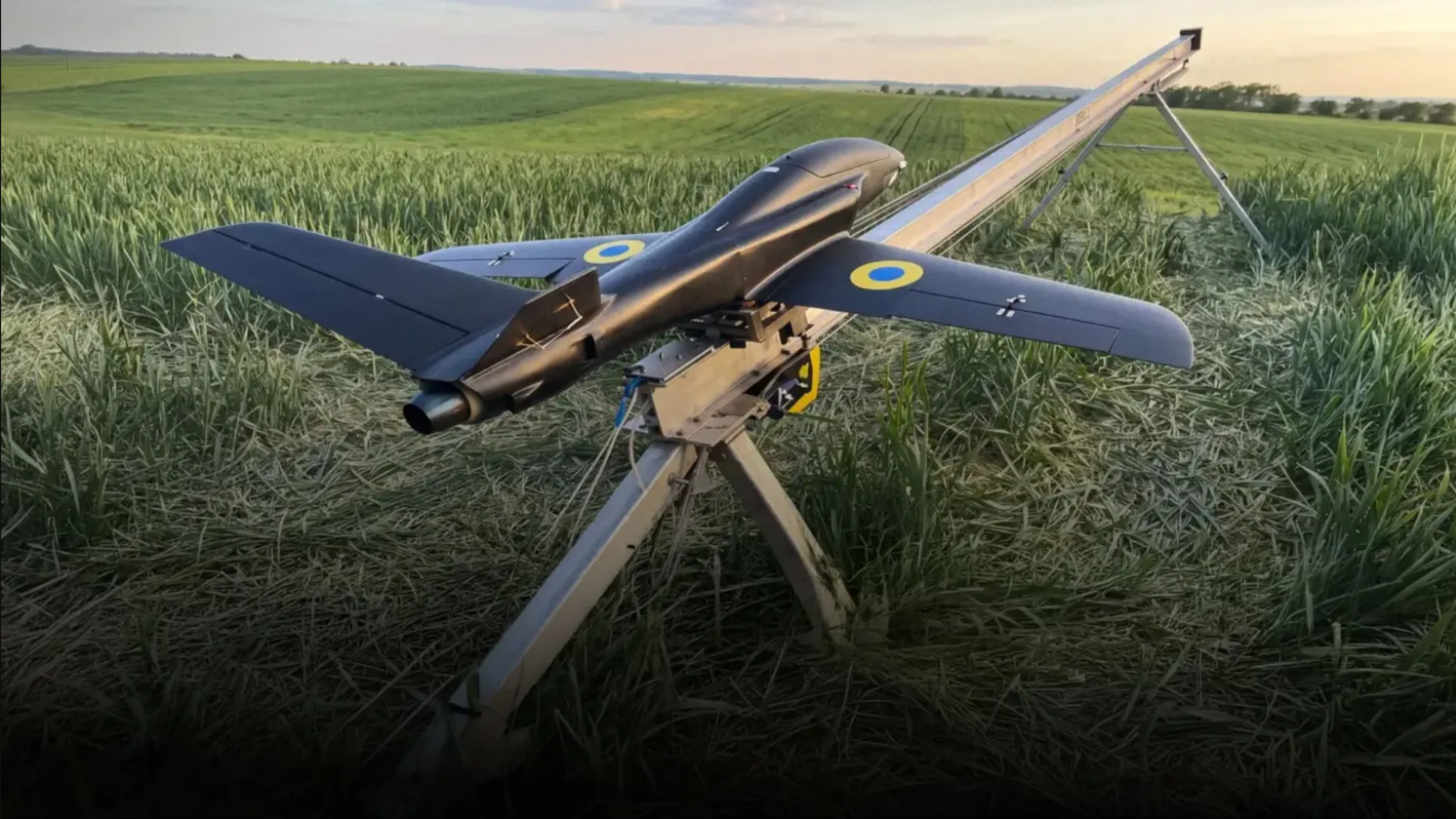
Ukraine has deployed a turbojet interceptor specifically designed to hunt Russian attack dronesThe compact aircraft can return home when an interception attempt failsMultiple warhead options allow the interceptor to tackle different aerial targetsUkraine's defense ministry has confirmed a new turbojet-powered aircraft built to shoot down Russian attack drones has now entered military service.Dubbed Alexa Spatium, the compact v-tail craft was engineered domestically to intercept small aerial and surface threats across the battlefield.It was built chiefly to engage Russia's Geran-3, Geran-4 and Geran-5 kamikaze drones, together with the frequently deployed Shahed-131 loitering munition.Built for speed and reuseThe aircraft measures 1.5 by 1.7 meters and is fired from a portable catapult stationed close to the front line.If it fails to strike anything on a given mission, the interceptor is designed to fly back toward its own launch point.It can be fitted with thermobaric, shaped-charge, fragmentation or high-explosive warheads, depending on the kind of threat it aims to destroy in the air.Guidance comes either from coordinates loaded before launch or through direct operator control once the aircraft is already flying toward its objective.Sign up to the TechRadar Pro newsletter to get all the top news, opinion, features and guidance your business needs to succeed!Detection relies on an electro-optical camera paired with an infrared sensor, allowing it to spot enemy aircraft even in low visibility conditions.As of the time of writing, Kyiv has not officially revealed the interceptor's top speed, and a statement from the Ukrainian Ministry of Defence left several performance figures undisclosed.A wider race against faster threatsUkraine is not the only country fielding this kind of weapon, since Britain introduced a comparable system earlier in the year.Known as Skyhammer and built by Cambridge Aerospace, it also runs on a turbojet engine and hunts down Shahed-style drones.It relies on a nose-mounted radar seeker and a fragmentation warhead built to disable rather than fully destroy its objective.Neither weapon, however, offers real protection from ballistic missiles, which travel far faster than any propeller or jet drone can manage.This gap matters a great deal for Ukraine, whose stock of American-supplied Patriot missiles has thinned after years of steady combat use.Ten European countries, Ukraine and the United Kingdom, formed an Anti-Ballistic Missile Coalition in July to help Ukraine close the gap.During a Kyiv visit marking Ukraine's independence anniversary, held every August 24th, the U.K.’s Prime Minister Andy Burnham confirmed its desire to help Ukraine.London cleared MBDA, the joint European missile maker, to hand over classified data on the Storm Shadow's internal components to Ukrainian engineers.The move should let Ukraine begin producing its own version of the joint British and French cruise missile domestically.Even so, none of these interceptors solve the core problem, since drones and missiles remain two very different categories of threat entirely.Whether new missile production can scale quickly enough to matter will likely depend more on politics than on engineering alone.That question, more than any single weapon unveiled this month, may ultimately decide how well Ukraine's skies are defended through the coming winter months.Via The Register Follow TechRadar on Google News and add us as a preferred source to get our expert news, reviews, and opinion in your feeds.
Ukraine has built its own jet-powered drone interceptor — and it'll easily fit in the back of a pickup truck
Full Article
Original Source
Read the full article at Techradar →KhanList aggregates and links to publicly available news content. We do not host full articles from third-party sources. Always verify important information with original sources.