
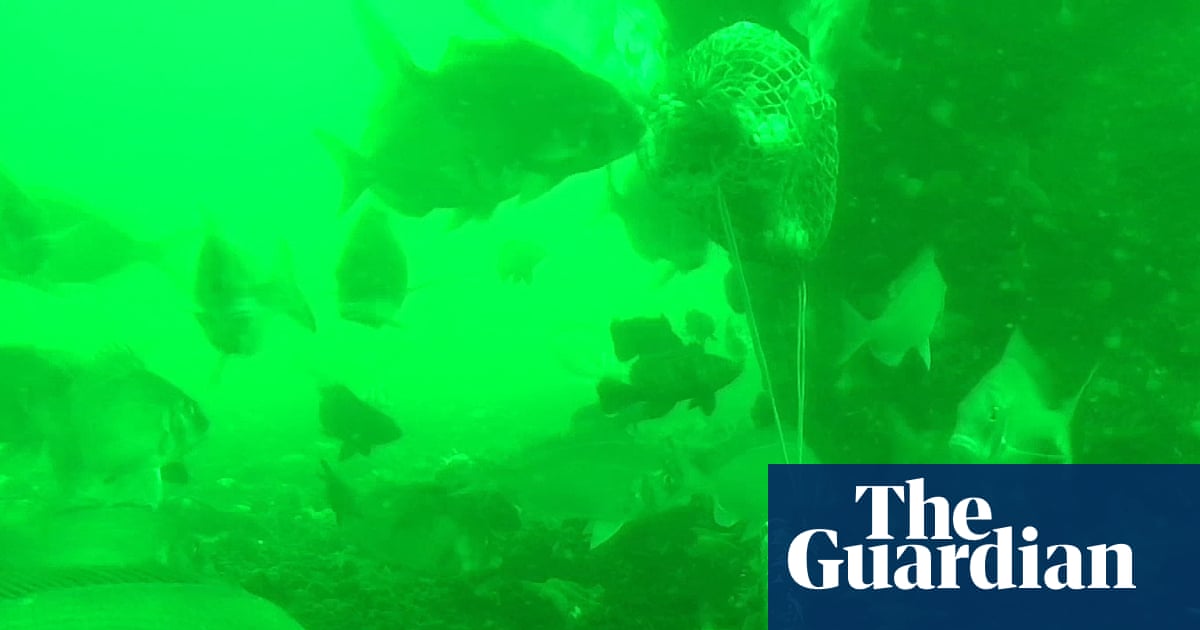
A few years ago, Tony DiLernia, a New York-based charter boat captain, heard rumors of prime fishing near the Block Island windfarm, off the tip of Long Island. So he went with his family to see for himself. Almost immediately after motoring up to one of the project’s five turbines, black sea bass and summer flounder started nibbling at his rod and reel.DiLernia, who has fished for 50 years, wasn’t surprised: he knew about the reef effect, where certain species cluster around structures like the turbines. “It’s what we call ‘stupid fishing’,” he joked. “You’ve got this thousand-foot [sign post] sticking up out of the water saying: ‘Fish here.’”In recent years, researchers and fishers have discovered that offshore wind turbines are turning stretches of seafloor into reef habitat. Now, they’re studying what that means for sea life and the fishing industry.The artificial reef effect starts when structures such as the turbines attract bivalves and algae, which in turn attract creatures including crab and small fish seeking food and shelter. Eventually, these “reefs” and the creatures living on them attract larger species, such as black sea bass.A 2022 study found the number of black sea bass increased tenfold near the windfarm compared with reference areas. Pictured: Researchers working near the Block Island windfarm. Photograph: Chris Rillahan“As soon as [the turbines] are in, they’re starting to attract settlement, and you’re starting to get mussels growing on them,” said Kevin Stokesbury, dean of the University of Massachusetts, Dartmouth’s School for Marine Science & Technology (Smast). “It’s fairly quick,” he said. “In six months, you would start to have reef effects.”The effect has been measurable at the Block Island windfarm, the United States’ oldest offshore windfarm, completed in 2016. A 2022 developer-funded study found that the number of black sea bass had increased tenfold near the windfarm compared with reference areas with similar habitat. The reef effect has been previously observed in underwater structures such as shipwrecks and oil rigs, as well as at European windfarms built decades ago. In 2012, researchers found cod were attracted to rocky turbine foundations in the North Sea near the Netherlands; a separate 2014 study found mammals, including harbour seals, appeared to be using the turbines as hunting grounds.The United States has five offshore windfarms operating off its east coast, with three more expected to come online in 2027. Altogether these farms are expected to generate 6GW, enough to power more than 4.5m homes. In addition to helping wean the US off fossil fuels, scientists are also discovering they are also serving as new habitats for reef-oriented species.‘Attraction v production’“The big argument that everybody talks about is attraction versus production,” said Chris Rillahan, an assistant research professor at Smast. Researchers want to know whether turbines are attracting and concentrating fish or creating a habitat that increases overall populations.His colleague Andie Painten, a PhD student at Smast, said so far she has not found black sea bass larvae but rather a “transient presence” of juveniles and adults. “That could answer this really big question of the artificial reef effect – if they’re just attracted to the turbines, or actually if they’re reproducing,” she said, adding that it will take years of sampling before she can conclude which it is.Rillahan recently submitted a report to the federal Bureau of Ocean Energy Management based on two years of survey data that found black sea bass stuck close to the Block Island wind turbines while they were in the area, but then continued their usual migration patterns.The Block Island windfarm off of Rhode Island. Photograph: Chris RillahanThat clustering near the turbines has implications for the regional fishing industry. “If those fish all hunker down at the turbines, and they’re not in the traditional fishing grounds, that would preclude the use of some of the mobile fishing gear that fishermen rely on,” Rillahan said. That could favor smaller operations that use rods and reels, or traps over trawlers, he said. It could also make it more difficult for federal and state agencies to survey fish populations, which could result in more conservative fishing quotas even if the true population remains unchanged, according to a 2023 report.Smast researchers are working with commercial fishers, who in the US are allowed to fish in wind lease zones, to study how species are responding to new turbines and how fishers can adapt. It will be one of the first US studies on how commercial fishers behave within a commercial-scale American windfarm.‘A huge experiment in biogeography’Researchers predict that continuing to build wind turbines along North America’s Atlantic continental shelf could bring the largest changes to the ocean floor since the last ice age ended.Stokesbury said that the transformation of the ocean floor from an open sandy-bottom area to a grid pattern of hundreds of artificial reefs, will probably affect which species thrive in the region. “It’s a huge experiment in biogeography,” he said. “Animals that have evolved to be in a wide open space – similar to the Great Plains, for example – now that’s broken up by these reefs,” Stokesbury said. “[That attracts] different species from what evolved there originally, and that will affect all the different types of fisheries that you do around it.”Researchers are examining whether building wind turbines ultimately help or hurt the surrounding fishing industry. ‘I think the truth is somewhere in the middle,’ said Chris Rillahan, pictured near the Block Island windfarm. Photograph: Chris RillahanThat could mean more reef fish, including black sea bass, and fewer fish that are used to big, uninterrupted spaces, such as mackerel and herring, Stokesbury said. It could also give certain invasive species a competitive advantage: researchers have found a tunicate sometimes called sea vomit at the Block Island windfarm. The sea vomit, or Didemnum vexillum, spreads like a carpet, smothering shellfish including scallops.Stokesbury and his colleagues’ research is adding nuance to their understanding of offshore wind’s immediate environmental impacts, with turbines posing a localized threat to some birds and sea life, while potentially benefitting others. Their research will also help determine whether building wind turbines will ultimately help or hurt the fishing industry. “I think the truth is somewhere in the middle,” said Rillahan.Noise during windfarm construction can kill or injure fish, although strategies such as bubble curtains can reduce noise. Seabirds can also be harmed by offshore wind projects if the risks are not properly planned for and mitigated. Opponents of offshore wind, including Donald Trump, have cited concerns about wildlife when attacking the projects. However, scientists, including researchers with the National Audubon Society, a conservation group, say that the climate crisis poses a far greater threat to wildlife than wind turbines, and that offshore wind is an important part of moving away from planet-warming fossil fuels.While scientists continue to gather data, fishermen including DiLernia are enjoying their bounty. Construction is nearly complete on the Empire Wind project south of Long Island, and DiLernia is targeting its newly built turbines on a future trip. “I’ll definitely get sea bass,” he said.
‘Huge experiment in biogeography’: US offshore windfarms are creating artificial reefs
Full Article
Original Source
Read the full article at Theguardian →KhanList aggregates and links to publicly available news content. We do not host full articles from third-party sources. Always verify important information with original sources.