
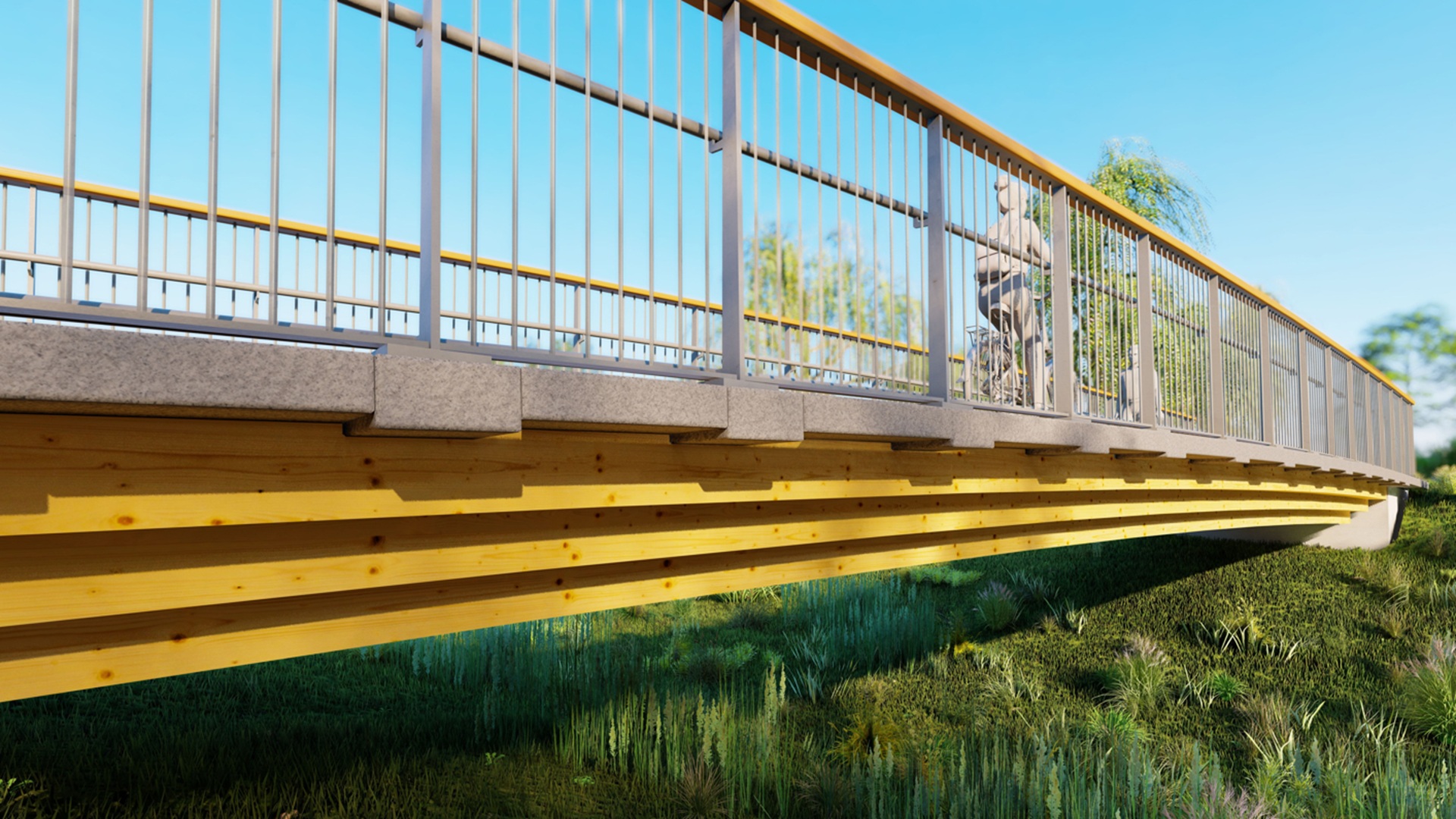
German engineers have developed a concrete-free bridge made from wood and granite that could last up to five times longer than conventional wooden bridges and significantly reduce carbon dioxide (CO2) emissions. The bridge created by researchers at the Technical University of Berlin (TU Berlin) in collaboration with engineering firm Miebach is reportedly the first in the world to combine these two building materials. The team carried out numerous stress tests to ensure its stability and safety. The structure uses large granite slabs instead of concrete to protect the wooden structure from harsh weather conditions. Miebach now intends to construct two such bridges for pedestrians and cyclists in Berlin’s Spandau district. Each will measure about 49 feet (15 meters) long and replace an old, deteriorating wooden bridge. The team believes the material combination could also support heavier loads and make bridges easier to dismantle and recycle. Stronger wooden bridges The approach, backed by around USD 153,000 (EUR 140,000) in funding from the German Federal Environmental Foundation (DBU), addresses a major weakness of wooden bridges. Exposure to rain and harsh weather conditions can significantly shorten their lifespan. “Composite bridges made of wood and concrete already exist,” Volker Schmid, PhD, a researcher at TU Berlin and head of the research group, said. “However, we use large granite slabs instead of concrete, thus reducing the resulting emissions.” Schmid added that the biggest weakness of unprotected wooden bridges is their relatively short lifespan. “At the same time, the lifespan and load-bearing capacity increase compared with a wooden bridge,” he continued. “This means the wood-granite bridge can be built with a slimmer and more elegant design.” The structure underwent numerous stress tests at TU Berlin. Credit: Technische Universität Berlin He highlighted that the construction method is a world first. However, connecting the two materials was challenging because of their properties. To address this, the engineers used granite slabs of different thicknesses that interlock with the wooden beams underneath. Additional screws keep the slabs in place, and a high-strength epoxy adhesive connects the slabs and creates a watertight seal. “Granite slabs form the surface on which people can walk or cycle,” Schmid noted. This prevents rainwater from reaching the wooden beams underneath. The beams also become narrower toward the bottom, which keeps them dry during heavy rain. As a result, the new bridges could last three to five times longer than regular ones. Lower emissions, reusable materials Another advantage of the design is that almost all the materials can be reused if the bridge needs to be renovated or dismantled. This practice is known as circular construction. In addition, using wood and granite rather than concrete could slash CO2 emissions during bridge construction. “These emissions are largely avoided when granite is used,” Schmid pointed out. “Unlike concrete slabs, the individual granite slabs can also be easily removed after loosening the screws and reused, just like the wooden support beam.” Miebach will now carry out the planning and structural calculations for the two bridges in Berlin-Spandau. The researchers believe the design could eventually serve as a model for other pedestrian and bicycle bridges across Germany. Alexander Bonde, DBU’s Secretary General, said many bridges across the country are in need of repairs. “Conventional reinforced concrete bridges generate large amounts of climate-damaging emissions, such as carbon dioxide (CO2),” he said in a press release. “We now have many solutions that are often more sustainable and require less energy and fewer resources.”Get the latest in engineering, tech, space & science - delivered daily to your inbox.Based in Skopje, North Macedonia. Her work has appeared in Daily Mail, Mirror, Daily Star, Yahoo, NationalWorld, Newsweek, Press Gazette and others. She covers stories on batteries, wind energy, sustainable shipping and new discoveries. When she's not chasing the next big science story, she's traveling, exploring new cultures, or enjoying good food with even better wine.
World’s first wood and granite bridges could last 5 times longer, slash CO2 emissions
Full Article
Original Source
Read the full article at Interestingengineering →KhanList aggregates and links to publicly available news content. We do not host full articles from third-party sources. Always verify important information with original sources.