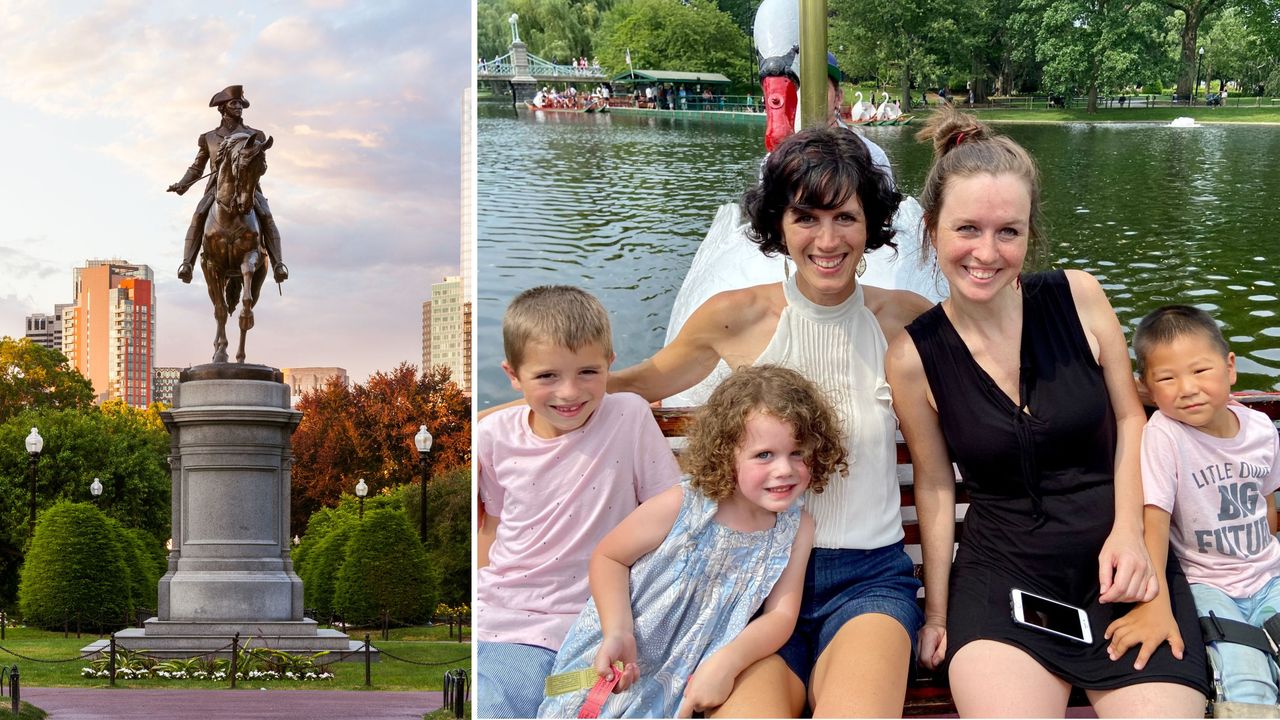
From history and gardens to accommodating restaurants, one family found the Massachusetts capital excitingly accessible.For Jenn Allen, the writer behind a travel blog for families with disabilities—Wonders Within Reach—a family trip to Boston was a no-brainer. The city has a reputation for accessible transit systems and smartly designed central streets which would make it easier for her younger son, Jaden who uses a wheelchair, to explore. The family had recently visited Nashville where Jenn partnered with Old Town Trolley and the experience had been exceptional due to their accessible trolleys which had been smooth for five-year-old Jaden to use. Old Town Trolley also exists in Boston, plus Jaden and his olkder brother Wesley love US history.So Jenn packed up her three children (Nella, 4, Jaden, 5, and Wesley 8), along with her sister, and drove the minivan into the city. She had a trolley booked, a hotel reserved, and a plan for the Boston Tea Party Ships. Everything else, she decided, they would find as they went. That looseness turned out to be its own kind of gift.Jaden, Nella, and Wesley outside the Boston Tea Party Ships & Museum The Boston Public Garden’s iconic George Washington statue Why Boston works for families with a wheelchairThe practical case for Boston starts with its reputation. The city has a genuine culture of accessibility built into its major public spaces, from the central playground and the Freedom Trail to the museums. The playground is poured rubber, instead of mulch, which is an accessibility upgrade, and also built so that the upper level can be accessed by a ramp allowing kids with mobility needs to access both areas of the playground. The Freedom Trail has areas that are less accessible to some, but this is clearly communicated online so that people can plan accordingly.“Accessibility information online is, unfortunately, a rare treat,” said Jenn. For a family that has learned to read a city's welcome before committing to it, that matters.But Jenn's approach to travel has always started with a single anchor. “We built our trip around the one thing we knew we could do—the accessible trolley —and one thing we hoped we could do, based on what we read online: the tea party ships.” From those two fixed points, she let the rest of the trip take shape around them.Driving as a safety netWhile not everyone can drive to Boston, Jenn's choice to drive from her home in Lancaster, Pennsylvania was not merely convenient. Jaden's wheelchair, which carries medical supplies and comfort items, complicates flying logistics. Having their own vehicle meant they always had everything they needed.It also gave them an unexpected advantage in Boston: free parking. In Massachusetts, any metered space is free with a handicap placard, which made driving into the city far more practical than it might have been. They found accessible parking near most destinations, and when they couldn't, the placard covered a standard metered space at no cost. "We opted to drive in and park," Jenn says. It simplified nearly every outing.The Old Town Trolley's hop-on-hop-off trolley is an ideal way to orient yourself in Boston. GettyStart with the trolley tourOn their first day, the Old Town Trolley served as both transportation and orientation. It reaches nearly everywhere a first-time visitor would want to go, and the hop-on, hop-off format accommodates wheelchair users without advance negotiation."It was like catching a bus that included a knowledgeable and entertaining guide," Jenn says. For Wesley, whose passion for American history made Boston a sort of pilgrimage, the narration was a dream come true.The trolley also did something practical: it gave them a map of the city before they needed one. By the time they stepped off, they had a feel for the neighborhoods, the distances, and the places they wanted to return to on foot.Call the hotel aheadThe trip's first real challenge happened before they unpacked. Jenn had booked the Fairfield Inn Boston Dedham online, a common choice made under common assumptions. She couldn't confirm an accessible room through the website, but she hoped for the best. "I hate making phone calls," she admits. "I just assumed we could make it work."The room was too small to close the bathroom door with the wheelchair inside. Navigating the room itself required crawling over the bed. Jaden can walk short distances with his leg braces, but the room made even that difficult. They switched hotels after a single night.Their second hotel, The Four Points by Sheraton Norwood, just down the road, was the difference between enduring a trip and enjoying one. "The rooms were spacious, the staff was accommodating, the facilities were beautiful, and the pool was just what we needed to unwind at the end of the day," Jenn says.The lesson she carries forward: a website's accessibility checkbox is not a room description. Ask specifically whether a wheelchair fits through the bathroom door, whether the family can navigate the room, and whether the accessible room has more than one bed. Don't assume.The Tea Party Ships and Museum lets kids throw faux tea parcels overboard in the middle of Boston Harbor. Planning as they went: Tea Party Ships, the Freedom Trail, and a playground worth traveling forThe family moved through the city with no fixed agenda beyond accessibility. They found an all-abilities playground using the GoWhee App, which Jenn had downloaded before the trip. The playground was designed for children of all abilities to play together without separate entrances or adapted equipment bolted awkwardly to the side.At the Boston Tea Party Ships, all three children got to hurl crates of tea overboard into the harbor. Wesley felt like he was sharing something he loved with his younger siblings. Jaden and Nella had a blast simply throwing things in the water.They waddled behind ducks at the Public Garden. They floated on swan boats. They ate, repeatedly and happily, at places that hadn't required extensive research to find.A moment that stopped her at the Children’s MuseumInside the Children's Museum, there was a pulley. The kind designed for children to test whether they can lift their own body weight using arm strength alone.For Jaden (who has limited leg muscle tone and uses his arms to wheel himself everywhere), stepping up to the pulley and lifting himself was effortless. He had been training for exactly this task his entire life without knowing it."He used his arms to wheel himself all around the city, so lifting his own weight on a pulley was nothing," Jenn says. "I loved seeing his joy and pride at being able to do something really well while playing with other kids."What made it matter was not the feat itself but the audience: children of all ages and abilities, none of whom had any reason to see it as unusual. Jaden was simply the kid who was very good at the pulley. That was all.The Paul Revere House is a must-visit Freedom Trail stop in the centrally located North End. The North End restaurant to visitOf all the places Jenn will describe when she talks about Boston, none comes before Ristorante Saraceno.They arrived tired, and the children were hungry past the point of patience. They hadn't researched the restaurant and simply rolled up."When we enter a restaurant, it's often clear that we weren't planned for and sometimes they're not sure what to do with us," Jenn says. "I feel like a burden from the moment we stroll in until I can get us back out of their hair."At Ristorante Saraceno, she felt none of that. "I felt not only seen and welcomed, but like they'd been waiting for us and were excited that we'd finally arrived."The restrooms had narrow doors, a detail Jenn notes honestly, because honesty about accessibility is valuable. But the restaurant itself was accessible, and they were genuinely hospitable."To be so thoroughly welcomed reminded me that we belong here," she says. "No gap in infrastructure, no lack of education, gets to decide that."The Public Garden's Make Way for Ducklings statues nod to Robert McCloskey's classic children's book set around the bird sanctuary in the park's lagoon. Most-underrated (accessible) stopJaden's favorite part of the trip was the Public Garden. At the Public Garden, accessible paths wound through the grounds and down to the water's edge. He found a spot on the wall, picked up some sticks, and spent a long time in the sun watching ducks drift past."It may seem that ducks in a park are hardly worth traveling for," Jenn says. "But I beg to differ. An accessible and welcoming space for a family to unwind and enjoy together without barriers is a rare treat."She means this literally; spaces that do not require constant management, where she does not have to scout for ramps or negotiate with steps or explain her son's chair to well-meaning strangers, are not the default. When a place works, the absence of friction is its own pleasure.What to know before you goStart small, Jenn says. Boston is a reasonable first city for families traveling with a wheelchair user precisely because it has made genuine efforts at inclusion and because the issues that arise there tend to be recoverable. The only way to find out what your family is capable of is to go somewhere and find out.Download the GoWhee App before you land. It locates accessible playgrounds and spaces that would be nearly impossible to find through a standard search. Filter your Google Maps routes for accessibility before you confirm them. Call hotels directly and ask specific questions: not whether a room is accessible, but whether a wheelchair fits through the bathroom door, whether a family can navigate the room, and whether the accessible option has more than a king bed.Book the Old Town Trolley for at least one full day. It covers the city, accommodates wheelchair users without advance logistics, and provides a narrated tour that does significant orientation work that would otherwise take days to piece together on your own. For a family with a child who loves history, it's rare to find an activity that's worth the time.And leave room in the schedule for the thing you didn't plan. The pulley at the Children's Museum was not on anyone's itinerary. Neither were the ducks. Neither was the restaurant that turned out to be so memorable."Everything feels overwhelming when it's the first time," she says. “The only way to know what you're capable of is to try.”The bottom lineGroup size: Five (2 adults and 3 kids)Days on the road: Four—driving from Pennsylvania with only two full days in the city.Transport cost: $90 in gas, $14 in tollsCost of hotels: We stayed on Marriott Bonvoy pointsCost of food and activities: $400. The Boston Children's Museum is part of Museums4All, offering $3 admission to families with a disability ACCESS card (for the card holder and three guests).Jordi Lippe-McGraw is a contributing writer for Condé Nast Traveler. As a lifestyle reporter/editor for almost a decade, she's written for various outlets including the New York Post, Travel+ Leisure, and Ocean Drive, and appeared on TODAY, MSNBC, and E! for her expertise. In addition to being a travel writer, ... Read More
How We Spent Our Family Vacation in Boston: One Wheelchair, Three Kids, and Four Days
Full Article
Original Source
Read the full article at Cntraveler →KhanList aggregates and links to publicly available news content. We do not host full articles from third-party sources. Always verify important information with original sources.