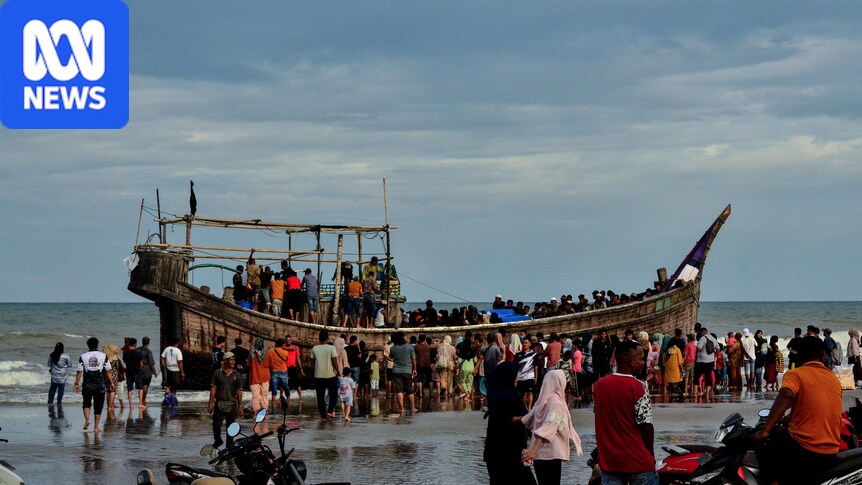
Two boats carrying more than 500 Rohingya asylum seekers have disappeared almost without a trace off the coast of Myanmar in recent weeks.The tragedy brings the number of people reported lost at sea in the region this year to more than 800 — nearly reaching last year's record total of about 900.One in seven Rohingya who attempted the sea journey in search of safety and a better life last year were reported missing or dead – the highest mortality rate worldwide of any major refugee and migrant maritime route, according to the United Nations High Commissioner for Refugees (UNHCR). So why are so many increasingly risking their lives taking such a dangerous journey?Who are the Rohingya?The Rohingya are a Muslim ethnic minority from the north-west of Myanmar's Rakhine State who have long endured persecution and violence. They are not recognised as a distinct ethnic group in majority-Buddhist Myanmar and are instead accused of being foreigners who migrated illegally from over the border in Bangladesh.However, historians say there is evidence their presence in the area goes back centuries.The Rohingya people have faced persecution in Myanmar for generations. (Reuters: Jorge Silva)Denied citizenship rights, the Rohingya are the world's largest stateless population, according to the UNHCR.In 2017, a co-ordinated program of killings and arson by the Myanmar military, as documented by international bodies, forced more than 750,000 to flee across the border to Cox's Bazar in Bangladesh.A case is underway in the UN World Court with the Myanmar military accused of genocide.The military has insisted its deadly campaign was a legitimate counter-terrorism operation. Smoke rises from a burned house in Myanmar's Rakhine state in 2017. (AP)Since 2017, tens of thousands more Rohingya have swollen the refugee camps in Cox's Bazar to an estimated 1.2 million living in a "labyrinthine tent city" covering about 24 square kilometres. About three-quarters are women and children.At the same time, thousands seeking a better life have attempted to make their way to other South-East Asian countries, especially Malaysia, via land and the deadly maritime route. What happened to the boats?According to the UNHCR, the two vessels departed from Rakhine State in late June carrying mostly Rohingya passengers, reportedly including some who had travelled from the refugee camps in Cox’s Bazar.One boat, believed to have been carrying around 250 people, lost contact shortly after departure. A second boat, reportedly carrying some 280 people, is believed to have sunk off Myanmar’s Ayeyarwady coast on July 8.The boats set off during the monsoon season, which starts in April, when torrential rain, large swells and high winds make the journey even more hazardous.Local media reported at least five bodies later washed up on the coast although it was unclear if they were passengers on the boats.Chris Lewa, the founder and director of the Arakan Project, said there was a misperception that the people on the boat were so desperate they decided to leave outside the sailing season between October and April.Ms Lewa said they had actually gathered to leave in April but had been held by the people smugglers for two-and-a-half months in Thameehla village in Northern Rakhine.It was unclear why the smugglers waited so long before deciding to leave when they did, she said."These people, they were not planning to leave in the monsoon season, but they were forced to by the smuggling network," she said. Ms Lewa said an overcrowded fishing boat could capsize in seconds if hit by a strong wave during monsoon conditions and the first boat sunk at night."We have no info about the second boat, but fishermen reportedly spotted dead bodies floating at sea," she said.Cox's Bazar is in Bangladesh across the border from Rakhine State. (Reuters: Mohammad Ponir Hossain)Why are the Rohingya so desperate to leave?Since the beginning of the civil war sparked by the military coup in February 2021, the rebel ethnic Arakan Army has seized control of most of Rakhine State, pushing out the Myanmar military that orchestrated the deadly massacres in 2017.Ms Lewa said conditions remained difficult there due to continuing fighting and air strikes along with a blockade by the junta which caused food and energy shortages, and disrupted telecommunications.Both Rakhine people and Rohingya were subject to conscription into the Arakan Army and forced to join work gangs, she said.However, while the Arakan leadership publicly espouses a philosophy of equal treatment, Ms Lewa said the Rohingya continued to be marginalised and discriminated against.She said they faced travel restrictions, arbitrary detention and confiscation of their land.The Arakan Army has denied the Rohingya are being discriminated against."It's complex," Ms Lewa said. "It's difficult for everyone, especially the Rohingya, but not only the Rohingya."The Arakan Army has also faced accusations that it has intentionally targeted Rohingya during their operations against the Myanmar military, which it has denied.Ms Lewa said the Rohingya also faced forced conscription and persecution in the areas controlled by the junta."So, depending on the region, you see Rohingya fleeing conscription by the military or by the Arakan Army," she said. More than a million of Myanmar's persecuted Rohingya minority live in the camps at Cox's Bazar in Bangladesh. (AP: Mahmud Hossain Opu)Situation desperate in Cox's BazarAcross the border, the conditions in the Cox's Bazar camps are overcrowded and increasingly desperate.Ms Lewa said they were plagued by violent criminal gangs involved in drug trafficking, kidnapping and extortion."They don't have any political ideology, but they have been fighting for control," she said. The camps were also exposed to natural disasters such as the recent floods and landslides that killed at least 17 people.She said the people were fleeing mainly because they felt they had no future and wanted to work to support their families, get married and have children. "They feel helpless in the camps in Bangladesh, not being able to work, not being able to do anything, and now affected by aid cuts," she said. At least 17 people were killed in a landslip at Cox's Bazar earlier this month. (AP: Shamimul Islam Faisal)Hafsar Tameesuddin, a New Zealand-based Rohingya refugee and human rights activist, saw first-hand the desperate conditions there during a visit last month.Ms Tameesuddin, co-secretary general of the Asia Pacific Refugee Rights Network, said drains filled with waste flowed among the shelters and there might be as many as 30 families sharing a single infrequently emptied toilet.Malnutrition is rife and, amid US aid cuts, the monthly ration for refugees in the camp has been reduced to between $US7 ($10) and $US12 per month. "It's nothing," she said. "People can barely buy rice and chillies."She said children who had been living in the camps since 2017 were not receiving an education, had no hope for the future and were susceptible to being lured into the gangs and armed groups.While she was there a five-year-old boy went missing. His family paid a ransom but his body was found a week later."It happens all the time," she said, adding that women and girls were sometimes sold into brothels. About three-quarters of the residents of the camps at Cox's Bazar are women and children. (AP: Shamimul Islam Faisal)Ms Tameesuddin said she was not surprised people were getting into boats in the hope of finding something better — even if there was a high chance of dying on the way.She said she had heard stories of women preparing for their journey by buying contraceptive pills knowing they would be raped by the smugglers."That broke my heart," she said. "Any women, any girl, regardless of what your nationality is knowing perfectly well that you will get raped on the boat but you're still choosing to [go] — that is the explanation of how terrible and deteriorating the situation is in Cox's Bazar."Hopes to return homeIn the wake of the tragedies, the UNHCR and the UN International Organization for Migration issued a joint statement calling for stronger regional and international efforts to prevent further loss of life along the deadly maritime route.They included enhanced search and rescue efforts, access to asylum and protection, and actions against smuggling and trafficking networks.UNHCR spokesperson Mariko Hall said most Rohingya say that they want to return home to Myanmar if they can "sustainably, and in safety and dignity". "Desperation and fear for their lives are driving more and more people to attempt these dangerous sea journeys," she said.Ms Tameesuddin said Australia had a regional leadership role to play providing the Rohingya in the camps with humanitarian and development aid, particularly to community-led organisations.She said Australia in the longer term should also take a leadership role engaging with the Myanmar government to ensure a "safe and dignified repatriation can take place for the Rohingya population".Australia's Department of Foreign Affairs was contacted for comment.
How two boats with 500 people disappeared almost without trace
Full Article
Original Source
Read the full article at Abc →KhanList aggregates and links to publicly available news content. We do not host full articles from third-party sources. Always verify important information with original sources.