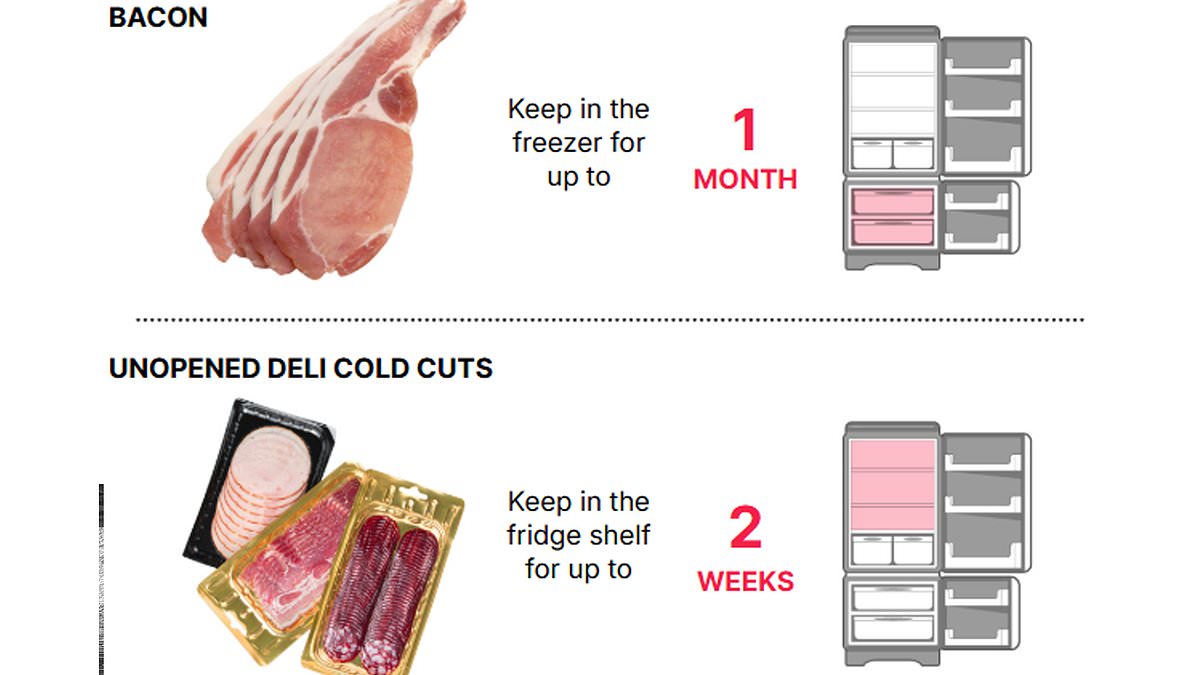
If you've noticed that perfectly ripe bananas are turning black faster or that groceries are spoiling long before their 'use by' date, you're not alone. As the UK grapples with a fourth heatwave this year, food wastage has increased, with a recent YouGov survey revealing 22 per cent of adults were forced to toss spoiled or rotten items. New research commissioned by home appliance brand Hotpoint suggests that British households are throwing away fresh fruits and vegetables worth over £138 million each week.'It can be really disappointing when you've just done a fresh food shop, to discover your fruit and veg have gone off before you've had a chance to use them,' said James Cooper, senior product manager for refrigeration at Hotpoint. However, you can make your groceries last much longer - despite the 30C temperatures - with a few simple tweaks. Food safety experts have shared common mistakes you're making and best practices for storing items like fish and poultry, cheese, and 'delicate' produce such as strawberries, stone fruit, and spinach during a heatwave. Food storage mistakes you don't know you're making 'As a doctor, my first bit of advice is to stop treating food storage as a small kitchen detail,' said Dr Waqqas Jalil. 'In hot weather, the small habits matter because bacteria grow faster when food is kept too warm or cooled too slowly.'He explained that poorly stored meals and ingredients can cause food poisoning, which can become serious for children, older adults, pregnant women and people with weaker immune systems. 'One of the most important things is to keep your fridge between 3C and 5C, as this temperature helps slow bacterial growth while preserving freshness, texture, and quality of food,' according to Nick Fletcher, marketing manager at ASKO appliances. Rather than trusting the temperature setting on the dial, Dr Jalil advises buying a fridge thermometer, which costs between £3 and £15, as research suggests the average UK fridge is set to 2C too warm. 'During a heatwave, fridges can struggle, especially if the door is opened often. The safe fridge temperature is about 4C. If the fridge is warmer than that, meat, dairy, eggs, seafood and leftovers become much riskier to eat,' he said. Another common mistake most people make is relying on smell to check if something has gone off. 'Food can smell normal and still be unsafe. With meat, fish, dairy, eggs, cooked rice, pasta and leftovers, time and temperature matter more than your nose,' he added. Neglecting proper fridge organisation after a big shop can also impact how long your food stays fresh, added Mr Cooper. Raw meat, fish and seafood should be stored tightly wrapped or in sealed containers to prevent juices from dropping onto other food, while dairy products, cooked meat, eggs and leftovers go on the middle shelves. Ready-to-eat foods, deli meats and cooked items can be stored on the top shelf, while condiments, sauces, and juices are better suited to the fridge door Fruit and vegetables should be stored in crisper drawers, but kept separate where possible. 'Certain foods produce ethylene gas as they ripen, including apples, pears and avocados,' Mr Cooper said. 'When those are kept alongside other vegetables in a confined drawer, the gas speeds up deterioration across everything in there. If your fridge has a humidity control, set it high for vegetables and low for fruit.' However, the refrigeration expert warned that overfilling or overstocking is one of the most common and costly mistakes people make, adding: 'A well-stocked fridge is not the same as an overstuffed one.' 'Avoid packing your fridge so tightly that food on one shelf is touching the shelf above,' he said. 'This prevents cool air from circulating properly, which pushes up the temperature in parts of the fridge and causes food to deteriorate faster.How to store your groceries in a heatwave Vegetables Experts say that ingredients like mushrooms should be stored in a paper bag instead of plastic to keep them fresh for longer. Plastic traps moisture, and mushrooms become slimy very quickly in heat.The same is true for onions and garlic, which Dr Jallil suggests storing in mesh, baskets or open paper bags rather than plastic. Put kitchen roll or a clean cloth in bags of salad leaves to absorb trapped moisture, which ultimately slows down wilting and sliminess. Do not wash the whole bag unless you are about to use it. Lining fridge drawers with paper towels will enhance their effectiveness during a heatwave, said AO.com's refrigeration expert Sarah Heaps. By keeping the compartments dry, you will reduce the risk of mould and sogginess in 'delicate' fruits and vegetables like strawberries and spinach. Keep apples and tomatoes away from potatoes. Potatoes are often stored badly during summer, and nearby fruit can make the problem worse. Potatoes should be stored in a dark, cool place and not with apples or tomatoes.Tomatoes don’t have to be stored in the fridge either, and you can usually leave them on the kitchen counter after removing all their packaging. You can also put them in a vented container where they will keep for five days.Asparagus should have their stems placed in water with their tops lightly covered in plastic (a Ziploc bag rather than clingfilm) and stood upright on the fridge shelf where they can keep for four days.Beets and bell peppers (capsicum) can both be stored in plastic bags on the fridge shelf. The former will stay fresh for two weeks, whilst the latter will last for seven days.Wrap in clingfilm and keep it in the fridge drawer to make it last for five days. Do the same with cabbage, and you’ll be able to stretch a head for two weeks.Carrots can be stored in a plastic bag where they will keep for three weeks in the fridge drawer. Do the same with cauliflower to make it last five days.Celery, on the other hand, should never be stored in plastic. Instead, wrap it in foil and pop it in the drawer rather than the shelf, where it will keep for two weeks.Keep the clingfilm on your cucumbers and pop them in the drawer for one week’s worth of eating.Dark, leafy greens can be stored in a plastic bag but remember to pop in a dry sheet of kitchen roll to absorb all the moisture and they will stay fresh for a week.Avocados can be stored in the fridge where they will keep for four days. However, if your avocado is halved, you need to wrap it in clingfilm and store it in the fridge. Squeezing some lemon juice on it will stop the fruit from going brown. Fruit Apples can be kept unwrapped in the fridge drawer for three weeks, whilst citrus fruits such as oranges, lemons and limes are best stored unwrapped on the fridge shelf where they will keep for two weeks. Halved citrus fruits will have to be wrapped in cling film to make them last for up to five days. Bananas are best stored on countertops when they are uncut, but if you have half a banana that you don't want to waste, wrap it in tin foil and put it in the fridge shelf where it will keep for up to two days.Soft stone fruits such as peaches and plums can stay on the countertop to ripen, but should be transferred to the fridge once ripe. Unwrapped, these fruits can keep for up to five days. Decant your berries so they are uncovered, or put them in a vented container and place them inside the fridge drawer where they will keep for three to five days.Enjoy grapes for up to two weeks from purchase by keeping them in the fridge, in a perforated plastic bag.Cooked meats such as burgers, sausages and chicken should be cooled and refrigerated within two hours, ideally in airtight containers rather than loosely wrapped in foil or cling film, added Matthew Glynn, senior product manager at Hisense UK. Salads, fruits, cheeses and dips are best stored separately in sealed containers to help maintain freshness and prevent odours from transferring between foods. Dr Jallil recommends freezing small portions of milk, chopped herbs, grated cheese or sliced bread before they are close to spoiling. You can also freeze things like eggs (without their shells) and mashed avocado to increase their shelf life. 'People often freeze food too late, when the quality has already dropped. In a heatwave, freeze early. Bread should be sliced first so you can take out only what you need,' Dr Jallil said. Meat, poultry, fish, and eggs Unopened packs of bacon should be sealed in a bag with no air and stored in your fridge’s meat drawer, where it will keep for two weeks. Open packs can be stored in the same way for one week.But if you want your bacon to last for more than two weeks, then you can always freeze it for up to a month.Opened cold cuts from the deli will keep for one week if you store them in a sealed bag and on the fridge shelf, and will stay fresh for two weeks if it's unopened.Pre-packaged cuts should be left in their packaging and kept on the shelf where they will stay fresh for two weeks if unopened or five days if opened.Live shellfish should be kept in a shallow tray in a single layer on the fridge shelf and covered with a damp sheet of kitchen roll – but do not store them like this for any longer than a day.The same goes for raw fish and shellfish such as scallops and shrimp. Keep them in their packaging, and store them in the meat drawer, but covering them in kitchen roll is not required.To store them in the freezer, remove all packaging and place them in a Ziploc bag where they will stay for three to six months.Eggs can be kept on the fridge shelf for up to two weeks or until the expiration date, but don’t take them out of the carton.Smoked fish such as salmon can stay on the fridge shelf for two weeks if unopened or five days if opened. In a freezer, it will keep for six months, but remember to place the fish in a sealed bag with no air in both instances. Herbs When it comes to herbs, basil, coriander and parsley will all keep for a week if you put their stems in water and cover the tops loosely with a Ziploc bag. Coriander will need to be refrigerated but basil can be left on the countertop.Rosemary and thyme can be wrapped in clingfilm and stored on the fridge shelf, where they will keep for two weeks.Delicate chives have to be swathed in damp kitchen roll before being clingfilmed and kept on the fridge shelf, where you will be able to use them for the next five days.
How to store food properly during a heatwave: Experts reveal the mistakes that lead to gone-off groceries - and why you should keep eggs in the FREEZER
Full Article
Original Source
Read the full article at Dailymail →KhanList aggregates and links to publicly available news content. We do not host full articles from third-party sources. Always verify important information with original sources.