
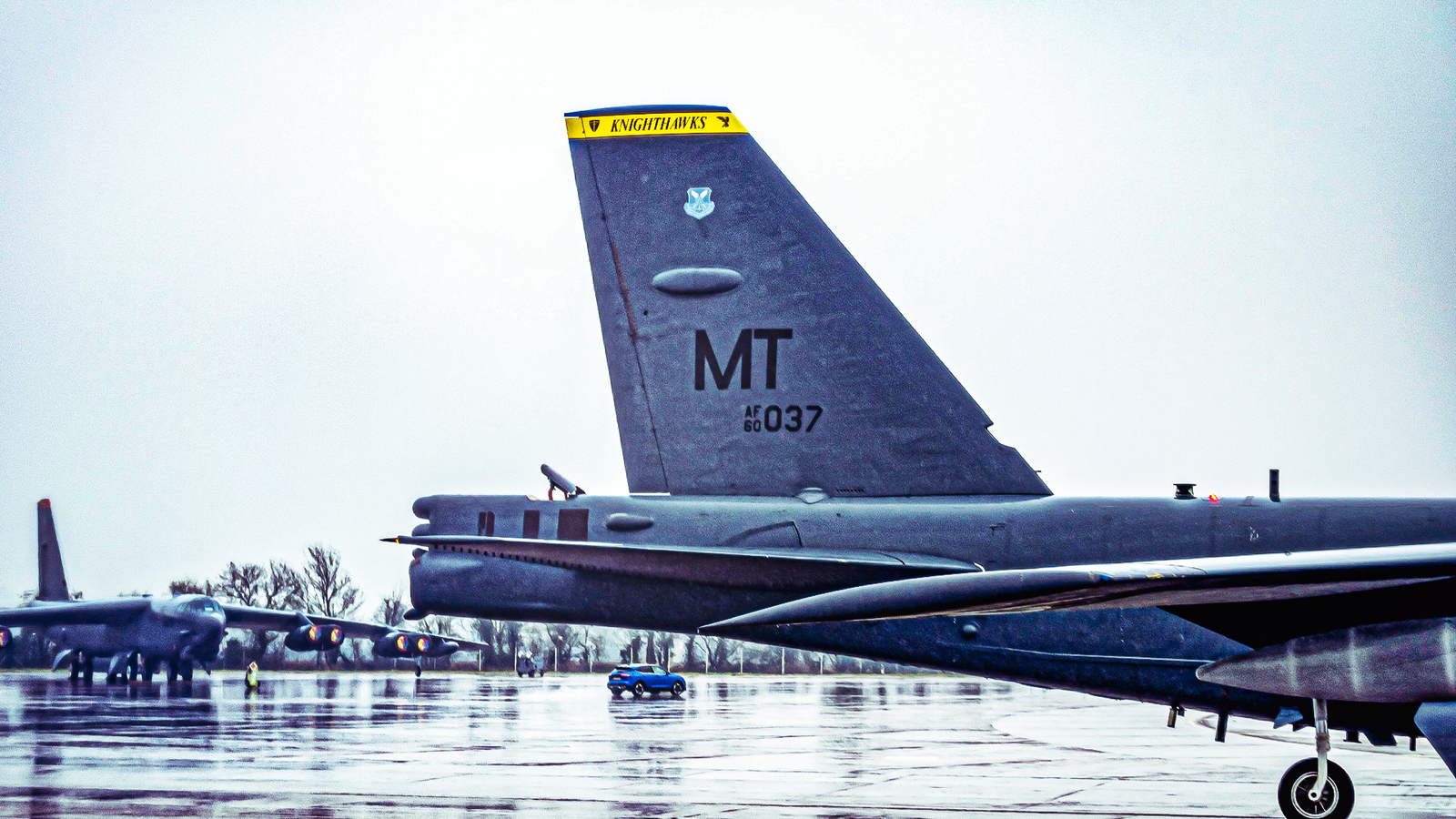
Published Oct 31, 2026, 8:00 AM EDT Passionate about promoting aviation, the beauty of flight and the science behind it, Antonio is an avid reader of aviation magazines and books, and he loves visiting airshows all over the world, taking photos and writing about airplanes and helicopters as well. He is currently based in Palermo, Sicily. Sign in to your Simple Flying account On October 1, 1991, the only enlisted airman aboard America’s most enduring bomber stopped flying with it, and he has never come back. He wasn’t a pilot or a navigator. He sat alone, facing backward, with a radar scope and a trigger, and he is the reason a 1950s jet bomber once shot MiG fighters out of the night sky. Then, within months, the United States Air Force (USAF)erased his job. So why did the Boeing B-52 Stratofortress give up its guns and, with them, its sixth crew member? The easy answer is a budget line. The fuller story, pieced together from Air & Space Forces Magazine and other sources, involves a Cold War that ended almost overnight, missiles that outranged every machine gun, and a friendly-fire shot over the Gulf that sheared off the back end of a bomber. To understand how it ended, you first have to meet the man in the tail. The B-52's Sixth Crew Member: The Tail Gunner The man sitting at the back of the B-52 had a job that set him apart from the rest of the crew. The original crew comprised two pilots, a navigator, a radar navigator, an electronic warfare officer (EWO), and a gunner, as explained by This Day in Aviation. As Air & Space Forces Magazine reports, everyone else was an officer, making the gunner the only enlisted airman on board. The B-52 entered service in 1955, and the defensive gun position came with it. This Day in Aviation adds that the last of 744 Stratofortresses, a B-52H, was delivered on Oct. 26, 1962, and that airframe is still in service. The hardware depended on the model. Air & Space Forces Magazine notes that the A through G models carried four .50-caliber (12.7 mm) machine guns in the tail, while the B-52H, the only version still flying, uses an M61 Vulcan, a 0.79-inch (20 mm) six-barrel rotary cannon. In early models, the gunner sat under a transparent canopy at the very back and reached his seat by climbing over its reclined backrest. Airmen compared the space to a coffin. Turbulence made the ride even worse: for every foot (0.3 meters) the cockpit moved vertically, the tail could bounce six feet (1.8 meters). From the G model onward, the same reporting explains, the gunner moved into the main cabin and fired the turret by remote control. Isolated or not, he earned his seat. His search radar reached up to 12 miles (19 km), letting him guide trailing bombers and act as the pilot’s eyes to the rear. But a defensive gun is only worth a crew member if someone fires it in anger. Did a B-52 gunner ever actually manage to shoot down an enemy fighter? When B-52 Tail Gunners Shot Down MiG Fighters Credit: Bao Minh 36 | Shutterstock Working alone at the back of the aircraft did not make the gunner a passive observer. His search radar could detect targets up to 12 miles (19 km) away, helping him monitor the space behind the bomber formation and alert the crew to approaching aircraft. The B-52's tail guns did score two confirmed kills, both during Operation Linebacker II over North Vietnam in December 1972. The encounters were unusual achievements for a bomber crew operating under intense attack. As detailed by We Are The Mighty, 129 B-52s launched toward Hanoi on Dec. 18, 1972, from Thailand and Guam, and on the way home Mikoyan Gurevich MiG-21 "Fishbed" rose to intercept. Staff Sgt. Samuel Turner, gunner on the B-52D “Brown III,” spotted one climbing from below and behind while a second hung back to watch. Air & Space Forces Magazine reports that Turner fired a six-second burst of about 700 rounds, and the fighter disappeared in a fireball. We Are The Mighty adds that it was the first kill by a bomber crew since the Korean War. Six days later came the encore. On Christmas Eve, 18-year-old Airman 1st Class Albert Moore, aboard “Diamond Lil,” saw a blip eight miles (13 km) behind him. In the combat report quoted by Aviation Wings, Moore described the target closing until it stabilized at 4,000 yards (3,658 meters). He called for evasive action, chaff, and flares, opened fire at 2,000 yards (1,829 meters), and watched the return vanish at about 1,200 yards (1,097 meters). Another gunner on a nearby bomber saw the MiG burn and fall away. Per Air & Space Forces Magazine, it was the last confirmed kill of an enemy fighter by a bomber gunner. Moore later wrote that he didn't know whether to feel happy or sad, because a pilot in that MiG wanted to get home as badly as he did, but his life and his crew’s were against the other man’s. Diamond Lil survived the war and now sits just inside the main gate of the US Air Force Academy in Colorado. The two victories gave B-52 gunners a remarkable place in aviation history, but they did not change the balance of the air war. Five MiG kills were claimed by gunners during Linebacker II, yet only two were confirmed. Meanwhile, North Vietnamese surface-to-air missiles brought down 15 B-52s during the campaign. The guns proved they could kill a fighter, but that wasn't the same as protecting the bomber from the weapons it faced most often. Why B-52 Tail Guns Could Not Stop Soviet-Built Missiles The combat record tells a different story from the two gunner victories. According to Air & Space Forces Magazine, all 15 B-52s lost during Linebacker II were brought down by North Vietnamese surface-to-air missiles. We Are The Mighty counts 31 B-52s lost during the Vietnam War, including 18 to missiles or ground fire and 13 to non-combat causes, with no bomber credited with a confirmed loss to an enemy aircraft in US tallies. The tail guns proved their value in a rare encounter, but they couldn't address the threat behind the bombers' combat losses. Technology had also moved on. Aviation Wings relays the view of a former B-52 gunner that cost and missile progress drove the end. The gun fire-control system was the only system on the bomber still relying on vacuum tubes, so a failed part might have to be built from scratch. Meanwhile, missiles let fighters engage from beyond visual range, which meant guns mattered only if an enemy pilot came close enough to use his own. So the weapon was aging, expensive, and aimed at the wrong threat. Still, it survived until 1991. What finally tipped the decision, and why do several accounts point to one bizarre night over the Persian Gulf? The B-52 Friendly-Fire Incident During Desert Storm Credit: The National Archives Catalog The incident that put the B-52's tail radar in the spotlight occurred during Operation Desert Storm, which began on Jan. 16, 1991. We Are The Mighty reports that B-52s flew more than 1,740 sorties in the war and dropped about a third of the ordnance. During one mission, however, the bomber's own defensive equipment helped trigger an attack from an American aircraft. As described by The Aviation Geek Club, a B-52 turned on its defensive fire control system (DFCS) radar at the exact moment a nearby American McDonnell Douglas F-4G Wild Weasel fired an AGM-88 HARM missile, designed to home in on radar emissions. The missile blew off the aft six to eight feet (1.8 to 2.4 meters) of the fuselage, but the bomber managed to land near Jeddah, Saudi Arabia, then moved on to Diego Garcia and finally Andersen Air Force Base on Guam, the only base able to saw off a B-52 tail and weld on another. It sat out the rest of the war, but it earned a name, “In HARM’s Way,” and fresh nose art. Accounts disagree on how much weight the incident deserves. We Are The Mighty says it caused the decision, with savings a side effect, while the former gunner quoted by Aviation Wings stresses cost and missiles. Either way, the timing was striking: the radar behind a friendly-fire shot was the very system the Air Force no longer wanted. What happened when the announcement came? Why The US Air Force Removed B-52 Tail Gunners In 1991 Credit: Antonio Di Trapani | Simple Flying On Sept. 16, 1991, Strategic Air Command chief Gen. George L. Butler announced that the gunner position would be eliminated. In a letter to gunners reproduced by The Aviation Geek Club, he said the decision “stemmed from the collapse of the Soviet threat” and came amid very sharp budget cuts. The change cut 525 positions, per Air & Space Forces Magazine, and ended a career field in which about 5,000 airmen had earned gunner’s wings since the 1950s. Starting Oct. 1, 1991, B-52s flew without a gunner. The human story ended with a splash. John Stallings, who flew 130 combat hours as a gunner in the Gulf War, was the last gunner to fly out of Loring Air Force Base in Maine. When he landed in late September 1991, fellow gunners waited with a portable water tank, and he recalled the water was far from warm. The hardware left more quietly: the guns were non-functional by 1992, according to Aviation Geek Club, and the turrets were physically removed between 1991 and 1994. From Last Class To Last Gunner Date Milestone Jan. 16, 1991 Operation Desert Storm begins Sept. 16, 1991 Gen. Butler announces the end of the gunner position Late Sept. 1991 Last gunner class graduates; Stallings flies out of Loring. Oct. 1, 1991 B-52s fly without a gunner 1991–1994 Turrets physically removed from the fleet May 12, 2017 Chief Master Sgt. Rob Wellbaum, one of the last gunners, retires A recent Simple Flying article explains that the official crew is five: two pilots, two navigators, and an electronic warfare officer, and that the service wants fewer airmen. The same article also cites Defense News on a $48.6 billion overhaul meant to keep the bomber flying until about 2060 alongside the Northrop Grumman B-21 Raider. The B-52's Future: Another Crew Reduction? Credit: US Air Force In a Simple Flying piece, the upgraded B-52J is described as a stand-off missile truck that will never be survivable in a modern integrated air defense, carrying 70,000 pounds (31,751 kg) against roughly 30,000 pounds (13,600 kg) for the B-21. As explained by Simple Flying, continued investment could allow the aircraft to approach 100 years of service from its first flight in 1952, an extraordinary milestone for a jet bomber. That extended service life will depend on more than keeping the airframe in the air. New engines, upgraded systems, and a changing weapons load will reshape how the B-52 operates, potentially giving it missions that its original designers never envisaged. The question is whether those changes will also alter what the Air Force expects from the people aboard. The sharpest signal arrived days ago. As reported by Air & Space Forces Magazine on Oct. 23, 2026, the Air Force told Congress its future strategy could include arming bombers with air-to-air strike capabilities as fighter procurement faces constraints. A bomber that gave up its guns in 1991 may be asked to fight fighters again, this time with missiles. For the wider story, MiGFlug’s Stratofortress profile collects history, specs, and stories. Whether that future needs a sixth set of eyes, or fewer, is the question to watch.
How The B-52 Lost Its Tail Guns & Its 6th Crew Member
Full Article
Original Source
Read the full article at Simpleflying →KhanList aggregates and links to publicly available news content. We do not host full articles from third-party sources. Always verify important information with original sources.