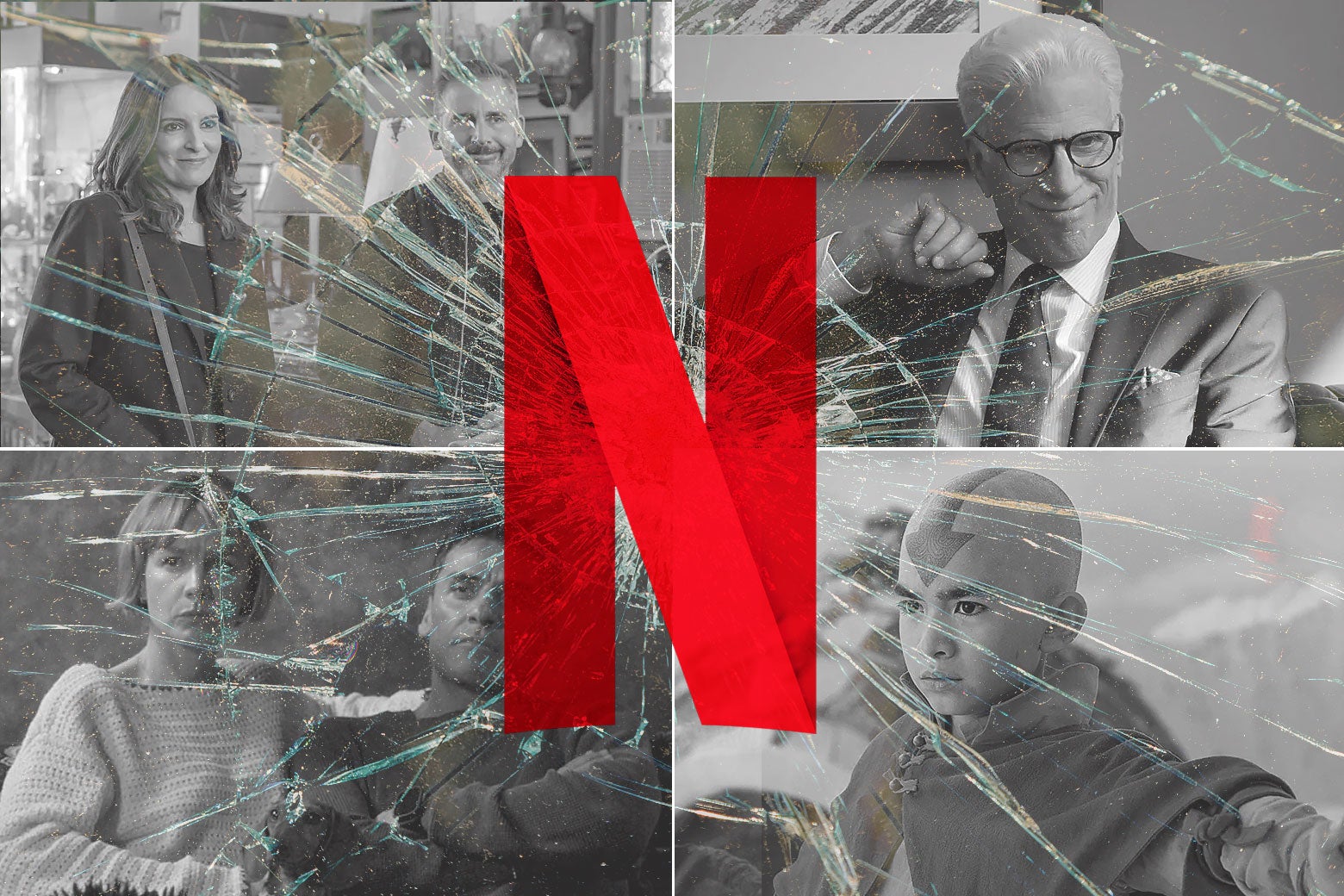
Television Something disturbing is happening to the streaming giant’s ratings. It has only itself to blame. By Enter your email to receive alerts for this author. Sign in or create an account to better manage your email preferences. Unsubscribe from email alerts Are you sure you want to unsubscribe from email alerts for Sam Adams? July 23, 20265:40 AM Photo illustration by Slate. Photos via Netflix. Sign up for the Slatest to get the most insightful analysis, criticism, and advice out there, delivered to your inbox daily. In the movie Galaxy Quest, aliens kidnap the star of a sci-fi TV show because they don’t understand the difference between truth and fiction. For them, the long-canceled drama is a historical document, proof that the actor who played a starship captain onscreen is the key to defeating their intergalactic enemy. But they’re not the only ones who get their boundaries blurred. In order to secure a human fan’s help without explaining the whole story, the actor (played by Tim Allen) simply tells the fan that everything that happened on the show was real. “Oh my God,” he screams back, “I knew it!” The idea that TV fans think what they’re watching is real is one of the movie’s favorite jokes, an affectionate but condescending way of sending up the relationship between a lower art form and its unsophisticated audience. But the joke lands, not because movie viewers think that TV viewers are simpleminded rubes (many people, of course, are both), but because they recognize the underlying truth that there is something unique about the bond between a TV show and the people who stay devoted to it. Or there was, anyway, until Netflix broke TV. The reason TV characters felt real was because we spent real time with them—a standing date, week in and week out. They were in our homes more often than anyone but our immediate family, and they, usually, aged as we did, whether or not the show acknowledged it. Buffy started sophomore year one season and junior year the next; John Carter went from raw med student to seasoned chief resident. We knew on some level that the barflies from Cheers weren’t really our drinking buddies, but they served the same function—a group of lively, funny, unpredictable oddballs you always knew where to find. They were, in the words of another classic sitcom, there for you. Streaming shows, by contrast, turn up when they feel like it—dropping by months or years later, sometimes without even the courtesy of an advance announcement. Rather than a steady, manageable commitment, they take up hours at a clip, like an old college buddy who’s in town only for the night. The sustained engagement can be exhilarating, but then it’s over, and who knows when they’ll be back. Netflix’s binge-drop model disrupted the stodgy rhythms of old-school TV. No longer would you have to wait a week to get more of what you wanted. It was all there to be consumed at your own pace. Network TV, operating on an industrial model that produced 22 episodes on a more or less annual schedule, had been on the wane for years, but now it didn’t just feel cheaper than the competition; it was slower. So we left our old pals, reliable but a little boring, for the new kids in town, and for a time that worked out great. The streaming shows were prettier and more exciting, and the gold rush meant throwing money at ideas—like, say, a cartoon about a self-loathing ex–TV star who is also a horse—that the old model would never have come close to embracing. But as the bubble began to burst, the shows got less adventurous, less diverse, less distinctive. (Can you imagine Amazon greenlighting a show about a Jewish family’s trans matriarch now?) And once that happened, the trade no longer felt like such a fair one. Of late, Netflix’s investors have been shocked to find that viewers aren’t returning for the second seasons of even some of its biggest hits. The Four Seasons, A Man on the Inside, and Beef drew less than half the audience of their inaugural seasons. The live-action Avatar: The Last Airbender went from more than 21 million viewers to less than 9 million over a comparable period. And A Good Girl’s Guide to Murder saw the biggest decrease of all, with more than three-quarters of its initial audience failing to return. There are lots of potential reasons for the slump, among them that the second seasons might simply not be as good as the first (though the reviewers don’t necessarily agree) or that Netflix puts most of its promotional muscle behind new shows. But that doesn’t explain why HBO, for one, isn’t seeing similar drop-offs. House of the Dragon’s season premieres have fallen only slightly in the ratings, and The Pitt finished its second season with its most watched episode ever. The Pitt, which began life as a spinoff of ER, is a deliberate throwback to the glory days of network TV, right down to the fact that its episodes, each of which covers an hour in real time, actually run closer to the 40-odd minutes of a broadcast show. It’s even hewing to an annual schedule, with a third season slated to debut in January, just like the two before. No wonder it seems to have forged a similar connection with its fans, or at least scratched an itch: When people talk about the show, they don’t talk about the medical oddity of the week, but whether Santos is being too hard on Langdon, or what’s up with the simmering flirtation between Javadi and Mateo. They’re invested in the kinds of incidental details you pick up only if you watch week to week, scrutinizing each passing interaction while you’re waiting for more. Netflix’s competitors have been turning away from the binge-drop model in favor of more or less weekly schedules, because they’ve realized—or relearned—that the time when a show’s not on the air is as important to building its audience as the time when viewers are actually watching. The all-at-once approach didn’t just take away our weekly date with our TV friends; it made it more complicated to share the experience with our friends in real life, because there’s always someone who failed to power through the entire season in a single day and is nervous about spoilers. We lost the virtual third spaces of Cheers and Central Perk, and we lost the watercooler too. Not every network show was Friends, of course. Not every relationship worked out, and sometimes our TV pals just got canceled and ghosted us. Being a fan of a popular network show was great, but sometimes a cult favorite would get yanked off the air without notice, the remaining episodes burned off in the summer months or simply shelved for good. But the promise was there, that if you stayed faithful and chose well, the relationship could be a long and fruitful one. Recent experience has taught us to be disloyal viewers, clicking away if a show doesn’t grab us in the first few minutes, as if we’re looking for someone more interesting to talk to, or abandoning ones that end a season on too satisfying a note because we don’t feel compelled to know where the story goes. But if Netflix wants more enduring relationships, it needs to prove it’s interested in rewarding them, bringing our favorite fictional companions back year after year rather than whenever it pleases or, worse, snatching them away because they didn’t fulfill some opaque metric. If it’s a better friend, maybe we will be too. Get the best of culture Get the best of movies, TV, books, music, and more. Comedy Netflix TV Avatar: The Last Airbender
How Netflix Broke TV’s Most Important Promise
Full Article
Original Source
Read the full article at Slate →KhanList aggregates and links to publicly available news content. We do not host full articles from third-party sources. Always verify important information with original sources.