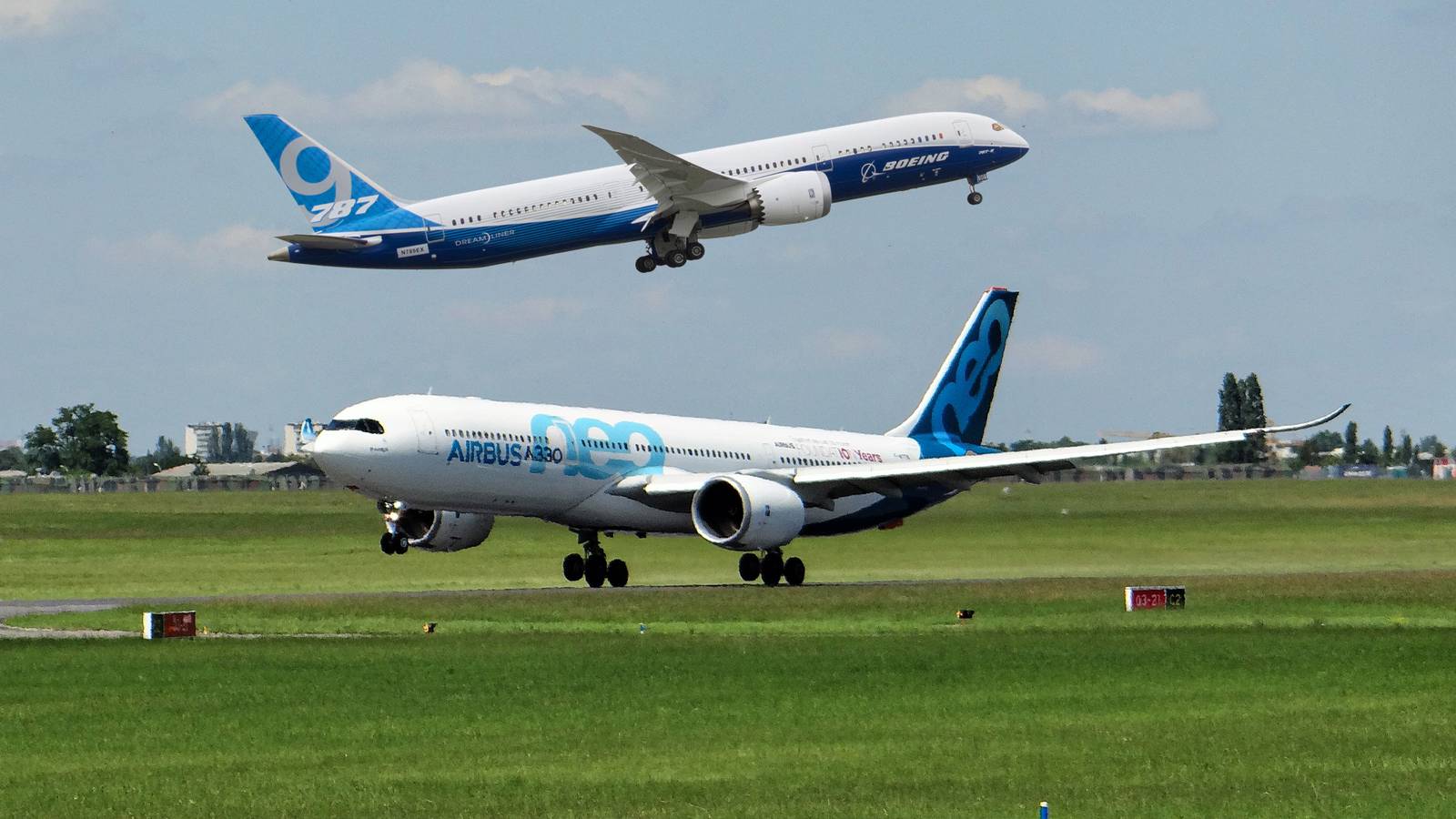
Published Jul 23, 2026, 3:00 PM EDT Brandon's passion for aviation started at a young age. Growing up, he was involved in the flight simulator and VATSIM communities, and he went on to earn his private pilot license while in college. Brandon holds a BSE in computer science and currently works as a software engineer. Outside of work, he continues to build flight hours and explore new airports around the country. The Boeing 787 Dreamliner and the Airbus A330-900neo compete directly for the same long-haul routes at dozens of airlines worldwide. The 787 is a clean-sheet composite aircraft with a no-bleed electrical architecture. The A330neo is a re-engined derivative of an aluminum airframe that first flew in 1992. On paper, the 787 should be the more fuel-efficient aircraft, and in total fuel burn it is. Per passenger, the answer is less clear. The A330-900neo's longer cabin allows airlines to configure it with a comparable or slightly higher seat count than the 787-9, which means its slightly higher total fuel burn can be divided across a similar or greater number of passengers depending on the layout. How each airline configures the interior, how many seats it installs, and how long the route is all affect which aircraft produces the better per-passenger number. Here is how much fuel each one burns, what the per-passenger figures look like across different configurations, and why the aircraft with the lower total fuel burn does not always win the efficiency comparison. How Much Fuel Each Aircraft Burns Per Hour The Boeing 787-9 burns approximately 1,400-1,500 gallons (5,300-5,700 liters) of fuel per hour in cruise, powered by two GE GEnx-1B or Rolls-Royce Trent 1000 engines. The Airbus A330-900neo burns approximately 1,450-1,530 gallons (5,500-5,800 liters) per hour, powered by two Rolls-Royce Trent 7000 engines. The difference in total fuel burn is modest, roughly 50-80 gallons per hour or 3-5% in the 787's favor depending on mission length, payload, and atmospheric conditions. The 787 achieves its lower total burn through a combination of factors that the A330neo does not share. The 787's airframe is approximately 50% composite by weight, which reduces structural mass compared to the A330neo's primarily aluminum fuselage. The 787 uses a no-bleed electrical architecture that eliminates the engine bleed air systems found on conventional aircraft including the A330neo, allowing its engines to dedicate more energy to thrust rather than powering pneumatic systems. Its wing has a higher aspect ratio than the A330neo's, producing less induced drag at cruise. Each of these advantages is individually small, but they compound over a long-haul sector. The A330neo counters with a lower acquisition cost and newer engines on a proven airframe. The Trent 7000 is a derivative of the Trent 1000 and Trent XWB, designed specifically for the A330neo and delivering a 25% fuel burn improvement over previous-generation competitors including the A330ceo. The A330neo's total fuel burn is higher than the 787's, but not by enough to make the comparison straightforward once passenger count, seat configuration, and capital cost enter the calculation. What The Numbers Look Like Per Passenger Credit: Simple Flying Dividing each aircraft's fuel burn by its passenger count is where the comparison shifts. The 787-9 in a typical three-class configuration carries approximately 260-290 passengers depending on the airline. The A330-900neo in a comparable three-class layout carries approximately 260-300 passengers. Using published data from the i6 group, the 787 family consumes between 0.6 and 0.7 gallons per passenger per 62 miles (100 km) depending on variant and configuration. The A330-900neo consumes approximately 0.65 gallons per passenger over the same distance in a typical 300-seat multi-class layout. Condor, which operates its A330-900neos in a high-density 310-seat three-class configuration, publishes a figure of approximately 0.5 gallons per passenger per 160 miles (2.1 liters per 100 km). At 90% load factor, a 787-9 achieves approximately 76 passenger-miles per gallon. The A330neo achieves approximately 85-95 passenger-miles per gallon in higher-density configurations. The per-passenger numbers are close enough that configuration decisions matter more than the aircraft's inherent efficiency advantage. A 787-9 configured with 240 seats in a premium-heavy layout and an A330-900neo configured with 310 seats in a high-density layout are burning similar total fuel but dividing it across very different passenger counts. The 2-4-2 vs 3-3-3 Trade-Off Credit: Delta The most visible difference between the A330neo and 787 cabins is the economy seat layout. The A330neo's standard 2-4-2 configuration means no passenger is ever more than one seat from the aisle. Every window passenger has only one neighbor to pass. The 787's 3-3-3 layout places the middle seat of each three-seat block two positions from the aisle, a configuration that most passengers consider less desirable and that airlines frequently discount to fill. The A330neo's 2-4-2 layout is one of the most commonly cited reasons passengers prefer it over the 787 on routes where both aircraft are available. Airlines including Delta, which operates both types, report higher passenger satisfaction scores on the A330neo in economy despite the 787 being the newer and more technologically advanced aircraft. The seat width difference of approximately 0.5-1 inch (1.3-2.5 cm) per passenger is noticeable on flights exceeding five or six hours, and the absence of a true middle seat in the two-seat window blocks is a product advantage the 787 cannot replicate at nine abreast. That passenger preference feeds back into the efficiency comparison indirectly. An airline that can charge marginally higher fares or achieve higher load factors because passengers prefer the A330neo's cabin layout generates more revenue per departure, which offsets the 787's lower fuel cost. The per-passenger fuel burn number matters, but it is not the only number that determines which aircraft produces more profit on a given route. An aircraft that passengers actively prefer to book may generate better financial returns even if it burns slightly more fuel per seat mile. Where Route Length And Mission Profile Affect The Comparison Credit: Shutterstock The 787's efficiency advantage over the A330neo grows as the route gets longer. On a five-hour medium-haul sector, the difference in total fuel burn between the two aircraft is modest and the A330neo's lower acquisition cost and higher seat count can offset it. On a 12-hour ultra-long-haul sector, the 787's composite construction, lower structural weight, and no-bleed architecture compound over a longer cruise phase, and the fuel cost gap widens in the 787's favor. The 787 was designed for long, thin point-to-point routes where fuel efficiency over extended distances is the primary economic driver. Its range of approximately 7,530 nautical miles (13,950 km) for the 787-9 exceeds the A330-900neo's approximately 7,200 nautical miles (13,334 km), and the difference becomes operationally relevant on the longest transpacific and Asia-Europe sectors where the A330neo may require payload restrictions to reach the destination. The 787's structural weight advantage also means it can carry a full passenger load over longer distances without trading cargo revenue for fuel, which matters on routes where belly cargo contributes meaningfully to the economics. The A330neo is strongest on medium-haul routes of 4,000-6,000 nautical miles (7,400-11,100 km), where its range is not a limitation and its lower capital cost produces better returns per departure. Several carriers, including Delta, Condor, and ITA Airways, deploy the A330-900neo on transatlantic routes where the sector length sits comfortably within the aircraft's range and the economics favor a lower-cost widebody over the 787. The route determines which aircraft makes more financial sense, and neither wins across every mission profile. How Both Compare To The Aircraft They Replace Credit: Shutterstock The 787 replaced the Boeing 767-300ER on most of the routes it now serves. The efficiency improvement is approximately 20-25% per seat, depending on configuration and mission length. The 767-300ER entered service in 1988 with two Pratt & Whitney PW4000 or GE CF6 engines, an aluminum airframe, and a conventional pneumatic architecture. Every major system on the 787 represents a generational improvement over the 767, from the composite fuselage to the no-bleed electrical system to the GEnx or Trent 1000 engines. Airlines that transitioned 767-300ER routes to the 787 saw immediate fuel cost reductions on the same city pairs, which is why the 767 has been steadily retiring from passenger service since the 787 entered the fleet in 2011. The A330-900neo replaced the A330-200 and A330-300ceo, aircraft that entered service in 1994 and 1993 respectively. The improvement is approximately 14-15% per seat, a smaller gain than the 787 achieved over the 767 because the baseline aircraft was newer and more efficient to begin with. The A330ceo was already a competitive widebody when the neo variant arrived, and the improvement comes primarily from the Trent 7000 engines and aerodynamic refinements rather than a fundamental change in airframe construction. For airlines already operating the A330ceo, the neo offers a meaningful upgrade with minimal retraining and infrastructure cost because the two variants share a common type rating. Both aircraft have also displaced the Airbus A340, a four-engine widebody that was efficient for its era but cannot compete with twin-engine fuel burn on any route a twin can serve. The Boeing 777-200ER, which entered service in 1997, is being replaced by both the 787 on thinner routes and the A330neo on medium-haul sectors where its capacity is not needed. The generation of aircraft the 787 and A330neo are replacing burned 20-25% more fuel per seat and carried higher maintenance costs. The efficiency gap between old and new is large enough that even marginal differences between the 787 and A330neo are small compared to the improvement both offer over the aircraft they are retiring.
How Many Miles Per Gallon Does A Boeing 787 Get Per Passenger Compared To An Airbus A330-900neo?
Full Article
Original Source
Read the full article at Simpleflying →KhanList aggregates and links to publicly available news content. We do not host full articles from third-party sources. Always verify important information with original sources.