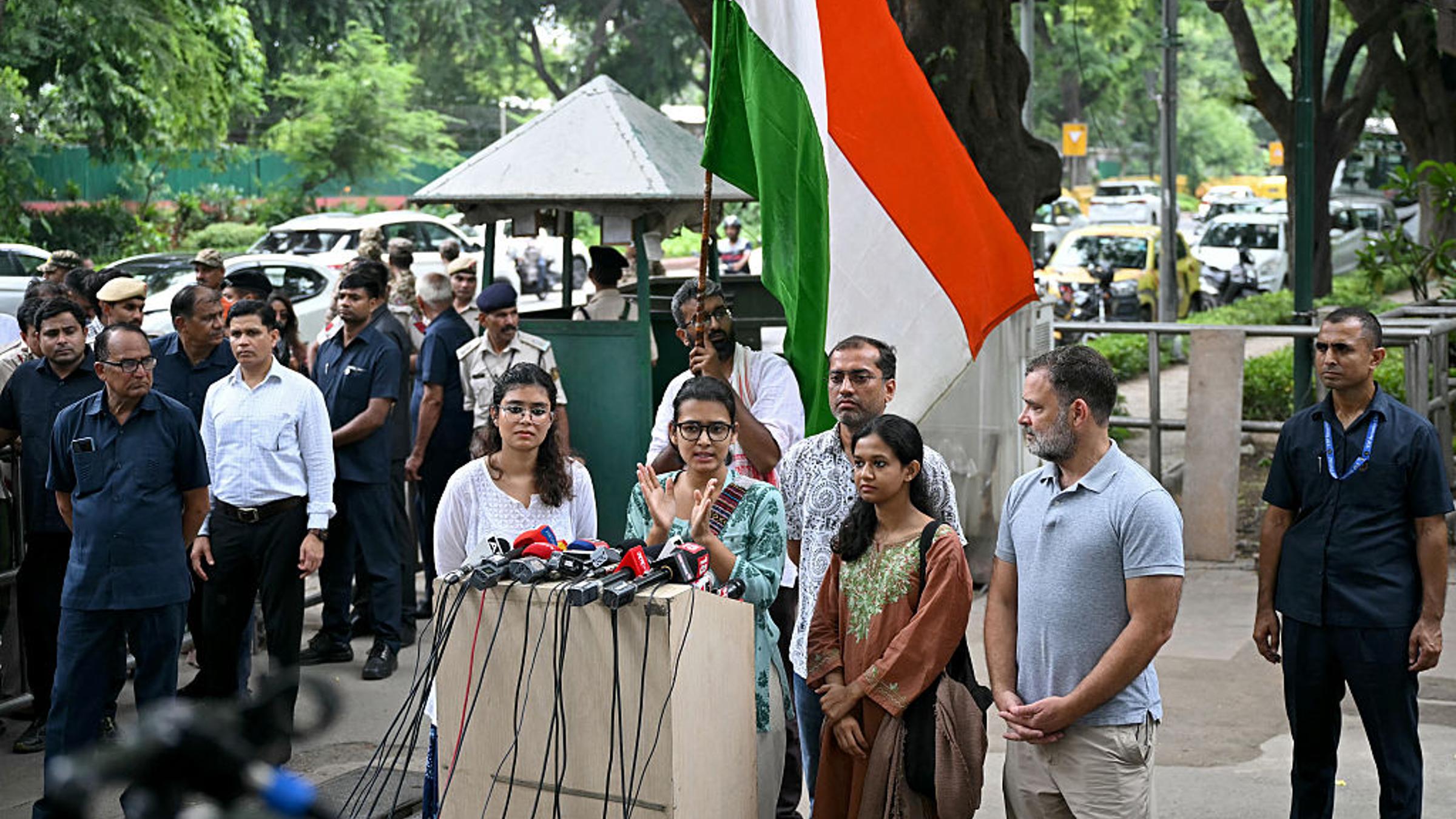
A botched medical entrance exam, a judge’s slur, and a young Indian student in Boston turning to satire converged to produce something India has not witnessed in over a decade: a youth movement that punctured the hegemony of Prime Minister Narendra Modi’s government and forced his education minister to resign. The sparks that ignited the protests came in May. More than two million students took a punishing examination for admission in medical colleges. Not for the first time, papers were leaked, the examination was scrapped, and the government ordered the students to take the test again. Frustrations mounted.On May 15, India’s chief justice, Surya Kant, disparaged the unemployed youth of India as "cockroaches" who complain about the system on social media. Abhijeet Dipke, an Indian student in Boston, embraced the slur and created the satirical Cockroach Janta Party (CJP), on Instagram, deploying it to forge a new political vocabulary that spoke to India’s youth in a grammar they understood. The CJP page briskly gathered 20 million followers.What began as an Instagram phenomenon, soon found its voice on the streets. In late June, a prominent educator and activist Sonam Wangchuk, along with student leaders led by Neha Bora, a graduate student, began a hunger strike in support of the CJP and its primary demand: the resignation of the education minister. As the days wore on, the crowds swelled, reaching a crescendo on July 20, after the Modi government forcibly removed Wanghuck from the protest site on the 21st day of his hunger strike.The government deployed its all-too-familiar playbook to quell dissent: batons, tear gas, pellet guns, internet shutdowns. But the students kept coming. Five days later, the education minister resigned, forcing an imperious government, that had never dismissed a minister under public pressure to be accountable to the people’s demands and reducing the prime minister, a man accustomed to controlling the narrative, to posting uncurated midnight Instagram videos to reach out and connect with the protesting youth.A rising power without jobsThe examination scandals at the heart of the protests are symptomatic of a deeper structural malaise. India’s economic growth has failed to generate jobs and prosperity for the bulk of the country's young: 40% of India’s university graduates under the age of 25 are unemployed. India’s education system is broken and the quality of education it offers is poor. Half of the country’s grade five students can barely read a grade two textbook.The narrow path of opportunity that the Indian education system offers toward a place in the formal economy and a potentially hopeful future runs through a set of competitive examinations for admission to medical, engineering, and law schools. Students prepare desperately for years to compete in these grueling exams. But even they face bleak prospects.Between 2004 and 2023, five million Indians graduated from colleges annually, but a mere 1.7 million found salaried work. That awareness increases the stakes in admission examinations for vocational schools such as medicine. These examinations also lend a veneer of meritocracy to a broken education system and an unequal economy.Rather than question the broken system, Indian families buy into the myth of meritocracy, investing everything into private coaching—which for many begins at the kindergarten level—to give their children a chance. It is when the state fails to do its part and ensure fair examinations that the myth breaks down. This is what fueled the anger of millions of young Indians and their families.Modi’s elusive good daysIn 2014, Modi rode to power promising a New India of “acche din” (good days). His slogans of “maximum governance, minimum government” and “Make in India” captured the aspirations of the moment. For nearly a decade many Indians willingly accepted a Faustian bargain: tolerating an increasingly authoritarian politics in exchange for the promise of that new India. Hindu majoritarianism provided the ideological glue. It enabled Modi’s Bharatiya Janata Party (BJP) to dismiss student protests in the past, casting demonstrators as “Soros-funded,” “anti-nationals” hostile to the Hindu nationalist zeitgeist in the eyes of the majority.This time was different. Modi has run India for thirteen years. The failures of “maximum governance” were visible to all, and the students—many of them part of the BJP’s core vote base—were now questioning the terms of the bargain. They did so with a creativity and irreverence that left this middle-aged protestor feeling a little less worried about her children’s screen addictions.The posters, memes, and Instagram videos told the story. India’s youth are done with the “dickatatorship,” as one poster put it. Their demand: a government that is responsive and accountable. “So silent,” read another. “Even I wasn’t as silent during my viva as this government is.” The most powerful slogans at the protest site in New Delhi challenged the dominant discourse of Hindu nationalism: “Whenever Modi gets scared, he turns to Hindu-Muslim” and “When Hindus and Muslims stand together, what can the fascist do?”Such slogans appeared in earlier protests, particularly those against the Citizenship Amendment Act in 2019, which sought to make religion a basis for offering citizenship granting preferential access to citizenship to non-Muslim migrants India’s neighboring countries. Those protests insisting on secular citizenship were led by Muslim community organizations and students and supported by secular Indians. The difference now was that these slogans came from a broader base of largely Hindu students, many of whom had until then been comfortable with the bargain Indians made with Modi. Against this, the government’s usual playbook failed.In those heady moments, at the protest site, scrolling through social media, it felt as if India was breathing again, as if the fear had lifted and young India was ready to reclaim its constitutional promise. But the dark shadows never quite disappeared. The mood was spirited and free, yet anxious. Every few hours, the threat of more police action and greater repression surfaced. In the aftermath, despite promises to the contrary, a crackdown on protesters across the country has begun. It is these shadows that make any assessment of what comes next a grim exercise.The battles ahead for IndiaStill, some democratic space has opened. Never in these 13 years has Modi’s governance been so actively delegitimized. The young are searching for a new political grammar rooted in democracy and accountability. Education reform is the rallying cry. The failures of education are not entirely this government’s making, but it drove in the final nail by placing the education system in service of the Hindu nationalist project: rewriting school curricula, making political appointments, overcentralizing and defunding higher education.The government’s response to the protests—setting up fast track courts and a committee led by a tech czar—holds little promise. It neither addresses the core issues nor breaks the ideological yoke that burdens India’s education system today. India’s political opposition has an opportunity to rise to the occasion. But its task is complicated by another phenomenon the protests made visible. The formal sites of democratic legitimacy—political parties, elections, the Parliament—are no longer seen as credible venues for demanding accountability. This is due in part to the BJPs ability to achieve total electoral dominance through means both legitimate and illegitimate: institutional capture, financial control and the manipulation of electoral rolls.It is instructive, however, that the Indian National Congress, the country’s main opposition party, which started protesting the paper leaks weeks before the CJP was formed, could not rouse popular sentiment the way an avowedly non-partisan formation did. The other two great protests of the decade in India—against the citizenship law and the farm reforms—likewise steered clear of formal partisan affiliation.What happens to a democracy when its formal sites of accountability are delegitimized? The future of Indian democracy rests on its ability to navigate this complex terrain. In the interim, India’s democratic backsliding will continue to be punctuated by moments when its people can breathe, followed by brutal state repression.Cockroaches, after all, are hard to exterminate.
How India’s Young Faced Down Modi
Full Article
Original Source
Read the full article at Time →KhanList aggregates and links to publicly available news content. We do not host full articles from third-party sources. Always verify important information with original sources.