
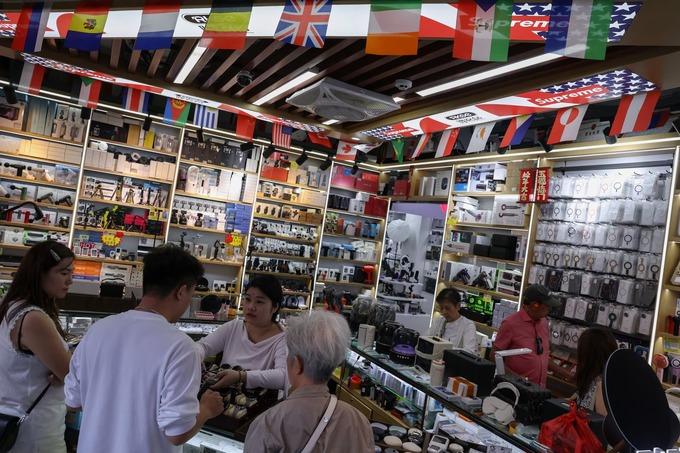
Merchants tracing their roots to a single region of eastern Guangdong Province account for an estimated 70% to 80% of the traders at Huaqiangbei, the world's largest electronics market in Shenzhen. Huaqiangbei covers 1.45 sq.km in Shenzhen's Futian District and holds 35 specialized markets and more than 115,000 businesses, People's Daily reported. They supply over 1 million types of components and finished electronics, from smartphones, drones, robots to the capacitors and resistors used to build them.Both Sixth Tone and the South China Morning Post describe it as the world's largest electronics market, a ranking based on vendor numbers and floor area.The traders behind the counters speak neither Mandarin nor Cantonese but Teochew, the dialect of an area centered on the Guangdong cities of Chaozhou, Shantou and Jieyang. The three cities form Chaoshan region.Hong Kong tycoon Li Ka-shing was born in Chaozhou. Tencent co-founder Ma Huateng was born in Chaoyang, Shantou, as was Huang Guangyu, who founded GOME and built it into China's dominant electronics retailer before a 2010 conviction for insider trading and bribery.Huaqiangbei dates to September 1979, when Guangdong relocated three military-industrial factories to Shenzhen and merged them into Huaqiang Electronic Industry Company, using the city's proximity to Hong Kong and the "three supplies and one compensation" model, which paired foreign equipment, materials and components with local assembly.The industrial zone north of the plant took the name Huaqiangbei, or Huaqiang North.E-commerce and traffic congestion thinned the crowds for years. Huaqiangbei drew 850,000 visitors a day over the Labor Day holiday, including 8,000 foreign buyers daily, according to official figures cited by the South China Morning Post.The paper reported in May that the district is repositioning itself as a showroom for artificial intelligence hardware, helped by China's visa-free entry rules and expanded tax refunds. Customers shop for electronic products at a mall of Huaqiangbei electronics market in Shenzhen, Guangdong Province, China, Oct. 30, 2025. Photo by Reuters Shenzhen became a special economic zone in 1980, when it held only a few tens of thousands of people against roughly 18 million today, and designated the area a hub for electronics.Construction boomed, and the first wave of Chaoshan migrants arrived on those sites, drawn by a tradition in which a relative has usually arranged housing and work before a newcomer sets out.Shenzhen had merged more than 100 electronics enterprises into what became SEG Group by the mid-1980s, but imports still required government approval and foreign currency quotas that could take months to clear, killing orders before they shipped.SEG proposed China's first specialized components market at Huaqiangbei in 1986, modeled on Tokyo's Akihabara, where goods could be sold without purchase permits.Chaoshan traders used family networks to import advanced components through Hong Kong's free port, sometimes in legal gray areas, and resell them to mainland factories.They had a second supply line at Guiyu, a town in Shantou's Chaoyang that became the world's largest electronic waste processing site, where CNN reported in 2013, citing a U.N. study, that workshops recovered metals by burning circuit boards and washing them in acid, contaminating workers and the surrounding environment.Refurbished chips, resistors and capacitors from Guiyu kept small factories running when official channels seized up, Sixth Tone reported. Traders at Huaqiangbei still distinguish between boxed components in original packaging and cheaper loose parts pulled from recycled or surplus stock.Authorities ordered Guiyu's informal workshops into the 1.5 billion yuan Guiyu Circular Economy Industrial Park from Dec. 1, 2015, CGTN reported, with all incoming scrap screened at a central receiving point to keep foreign e-waste out. The Basel Action Network, the U.S. environmental group that first documented the town's trade in 2001, said after visiting that month that hand-cooking of circuit boards continued inside the park, though fumes were now drawn into scrubbed chimneys.Clan-based credit, informal arbitration and hometown associations came with the migrants, according to Sixth Tone. Urgent deals close on a spoken promise, and traders short of cash borrow from wealthy relatives without collateral.Price movements, inventory being dumped and the names of unreliable sellers circulate over tea and in chat groups, the outlet reported, an advantage that takes an outsider years to build.Urban villages such as Futian and Chiwei have become Chaoshan enclaves where restaurants serve dishes traceable to individual villages, Sixth Tone reported. Young Teochew still rely on relatives who went ahead of them, but the destination is now Shenzhen rather than Bangkok or Singapore.Merchants who left the physical stalls have moved into cross-border e-commerce, opening storefronts on platforms including Amazon and branching into imported cosmetics and food, the outlet reported.
How Guangdong migrants set up world's largest electronics market in China
Full Article
Original Source
Read the full article at E →KhanList aggregates and links to publicly available news content. We do not host full articles from third-party sources. Always verify important information with original sources.