
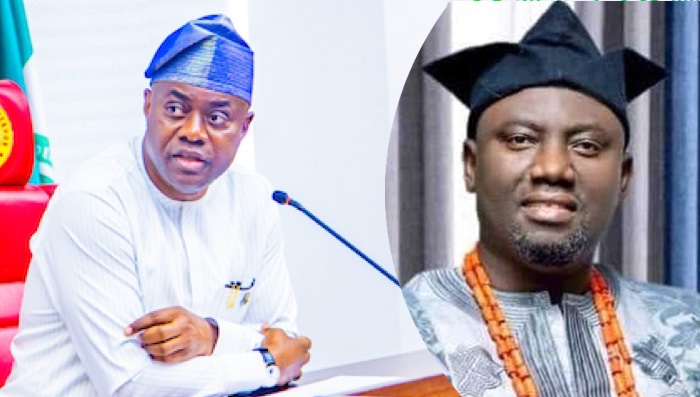
There was a time when the chemistry between Governor Seyi Makinde and the Alaafin of Oyo, Oba Akeem Owoade, appeared almost picture-perfect. The governor had played a prominent role in the process that produced the new monarch, and, after the controversies surrounding the Alaafin stool, the two men appeared to have found common ground. Palace visits, warm exchanges and public courtesies suggested that the royal-political relationship had settled nicely. Today, the warmth appears considerably more measured, while questions about the relationship between Government House and the palace continue to attract attention. The dispute, as gathered by Society Watch, gathered momentum when Makinde announced a rotational chairmanship among the Alaafin, the Olubadan of Ibadanland and the Soun of Ogbomosoland, with Oba Rashidi Ladoja emerging as the pioneer chairman. The governor said he had consulted the three monarchs and obtained their agreement. But Alaafin’s palace swiftly disputed that account. According to the palace, the monarch neither met with Makinde nor endorsed the rotational arrangement. More strikingly, Oba Owoade was absent when the council was inaugurated last January. For palace watchers, that absence spoke volumes. It was certainly a far cry from the earlier days when the governor and the monarch appeared to share a cordial public relationship. Then came another delicate issue: the elevation of several Baales and high chiefs to crown-wearing Obas by the Makinde administration. That, according to sources, disrupted the hierarchy and the changing architecture of traditional authority in Oyo. With the growing tension, one wonders whether the palace and government house can rediscover the harmony that once appeared so effortlessly. The Audacious Gamble of Nigeria’s Oil Czar, Uju Ifejika When a global oil giant walks away from an asset, the conventional wisdom is usually simple: there must be a reason. But Catherine Uju Ifejika has never been one to be intimidated by conventional wisdom. Instead, the billionaire businesswoman saw an opportunity where one of the world’s biggest oil companies saw limited commercial attraction, and placed a staggering $400 million bet on it. Today, that audacious gamble is beginning to tell the story of a woman who has spent decades rewriting the rules in Nigeria’s notoriously male-dominated oil and gas industry. Chairman of Brittania-U Nigeria Limited, Ifejika has carved an enviable niche for herself across exploration, production and trading, earning recognition as one of Africa’s most prominent female figures in the petroleum industry. At various times, she has been honoured with the African Businesswoman Award and listed among the 100 outstanding female executives in African oil and gas. But beyond the awards and glittering recognition lies a career built on resilience, technical knowledge and an unusually strong risk appetite. Brittania-U was incorporated in 1995 and became operational in 2003, initially as an oil trading company. When Ifejika joined as chief executive in 2007, she began steering the business beyond trading into the more capital-intensive world of exploration and production. Her defining wager came with the acquisition of 100 per cent equity in the Ajapa marginal field, offshore Forcados in Delta State, from Chevron. What the oil major considered a marginal or difficult-to-develop asset became, in Ifejika’s hands, a long-term opportunity. Brittania-U has since invested more than $400 million in developing the field, including additional wells and a floating production, storage and offloading vessel. The field’s reserves have been estimated at $4.3 billion, underscoring the scale of the opportunity she chose to pursue. With an oil block, jetty, crude export terminal and vessels supporting her operations, Ifejika has transformed Brittania-U from a trading venture into a vertically integrated indigenous energy company. She has demonstrated that in the oil business, sometimes the biggest opportunities are hidden inside the assets others have chosen to leave behind. And that, perhaps, is the most fascinating chapter of the billionaire’s story: she did not merely buy an oil field Chevron walked away from; she bought into the possibility that everyone else had underestimated.
How Alaafin-Makinde Warmth Turned Cold
Full Article
Original Source
Read the full article at Thisdaylive →KhanList aggregates and links to publicly available news content. We do not host full articles from third-party sources. Always verify important information with original sources.