
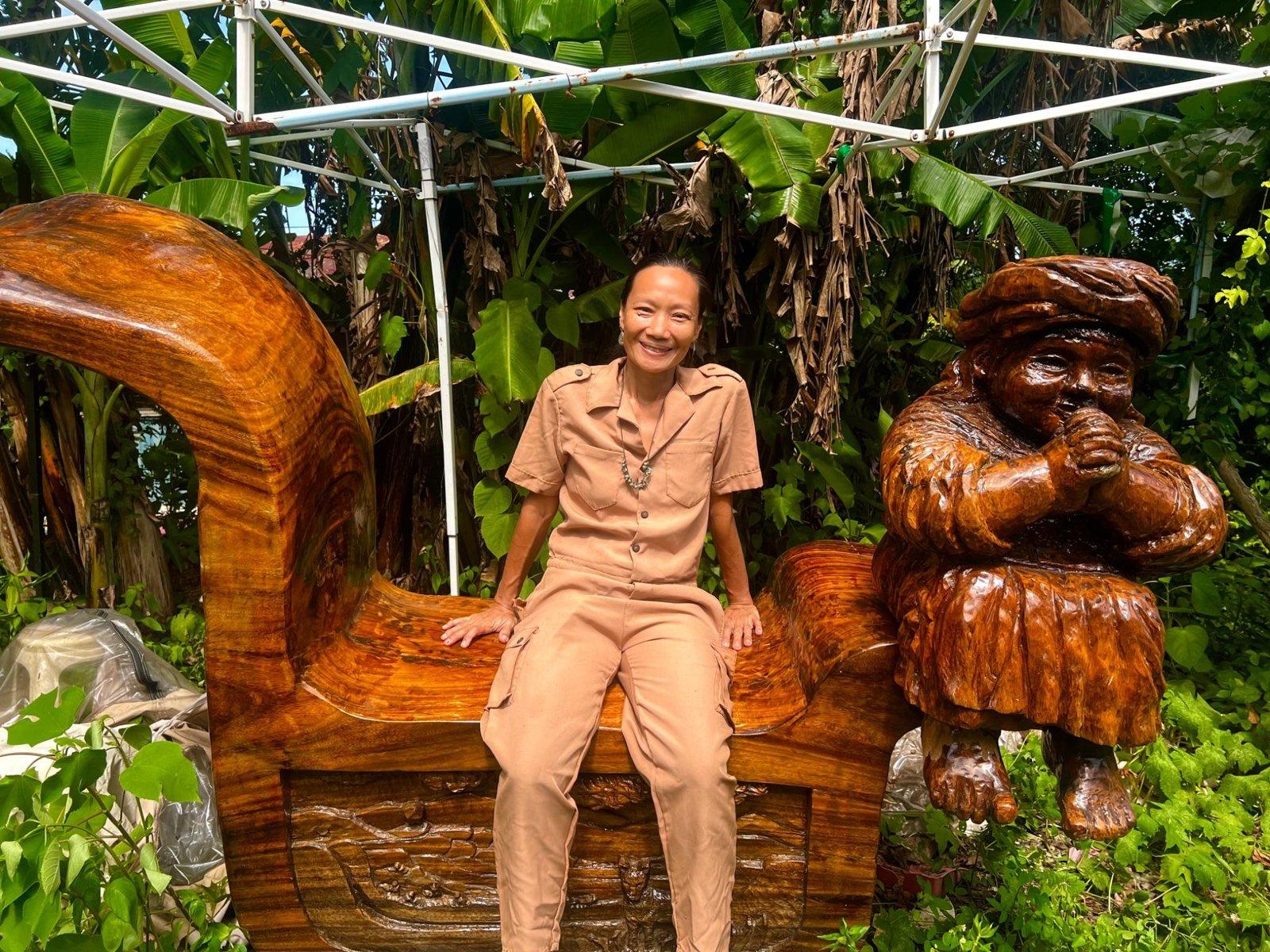
Walang pera sa art (There’s no money in art). It is a line Filipino artists often hear, and Yvette Beatrice Co understands where it comes from. For Co, money is only part of an artist’s purpose. It is a belief she has carried for over a decade as the founder of Ginhawa Craft Studio in Los Baños, Laguna, where she makes and teaches art. How Ginhawa began Co, an interior design graduate of University of the Philippines Diliman, had joined group exhibits in Manila for over a decade before she moved to Los Baños around 2010. Wherever she had settled, she said, she would have started making art, since being an artist was already part of her identity. She named it Ginhawa Farm Arts and Crafts around 2011. The studio ran from 2012, with paintings and woodwork as its early focus, and was registered with the Department of Trade and Industry in 2015. For the woodwork, she brought in two carvers from Paete, the carving capital of the Philippines. Wood carving had yet to reach University of the Philippines Los Baños (UPLB), and she wanted people to see it up close. Los Baños also had the material. In Paete, cutting trees was banned and wood was expensive. In UPLB, typhoons brought down trees that no one was putting to use. A German friend from the ASEAN Centre for Biodiversity, who knew woodworkers in Germany, suggested she ask the dean for the fallen wood and offer an artwork in return. “Give us this trunk, and we’ll give you an eagle sculpture,” Co recalled. A fallen narra in the forestry area was carved on site, drawing students who stopped to take photos. It later became an exhibit, and the eagle is now with the university administration. More woodwork followed. “Dala ng bagyo, tsaka ng suggestion ng foreigner (It was brought by the typhoon, and by a foreigner’s suggestion),” she said. That habit of using what is around her lives on in her art today. Much of it is mixed media with texture and relief, and even leftover glue gun plastic finds its way into her pieces. Her work has since reached well beyond the campus, including a 34-foot whale shark she made for an international conference on migratory species at the PICC in 2017 and a five-meter ark of wooden wildlife sculptures at the entrance of the UP Laguna Quezon Land Grant in 2022. The café years and losing the space For a time, Ginhawa operated from a commercial space at the UPLB Alumni Plaza, where it ran an art café and held lessons. People could schedule their own exhibits there every month, giving other artists a place to show their work. Keeping it running took a lot of juggling. The overhead was high, and staffing was hard to get right. On busy days, they were short on hands, so they hired more people. On slow days, there were more staff than customers. “Mas marami kang binabalance, ‘di ba? (You have more things to balance, right?)” Co said. GINHAWA CAFÉ. The former space of Ginhawa Craft Studio, which housed its café and gave artists a place to hold monthly exhibits. Photo courtesy of Ginhawa Craft Studio Production had its own hurdles. At times, the right help was not available, which slowed the work down. Some projects ran out of resources before they were finished, while daily expenses kept coming. The space was also up for bidding every two years. When their term ended and it went up for bid again, Ginhawa lost, and the café closed. Still, Co sees room for Ginhawa to grow. “Marami pa naman room mag-grow (There’s still a lot of room to grow),” she said. She admits she has yet to promote the studio all out. Today, she works from her house, with sculptures and works in progress upstairs. A friend has suggested turning it into a display area where people can hold exhibits again, much like in the café days, and Co is open to the idea once the house is fixed up. She still makes coffee there too, using an espresso machine she got from a friend who was giving her things away. For now, the work continues, and so do the lessons. The lessons kept going Through all of it, the art lessons never stopped. Ginhawa has never run out of enrollees, Co said. Sometimes there are only a few, yet classes run all year round. “Laging merong current student (There’s always a current student),” she said. Over the years, her students have spanned generations. Most start at around eight years old, though she has taught kids as young as four and learners all the way up to seniors. Today, her most frequent students are teens, pre-teens, and younger kids who can already follow instructions. WORKSHOP. Participants, many of them first-time painters, create their own expressionist paintings at a Ginhawa Craft Studio workshop during the ASEAN Centre for Biodiversity’s 20th anniversary Biodiversity Marketplace. Photo courtesy of Ginhawa Craft Studio Aside from painting, Ginhawa offers classes in basic art, handbuilt pottery, woodworking, and resin. Lessons cover the basics of sketching, shading, color theory, and perspective. From there, the studio’s teaching philosophy leaves much of the choosing to the students, from the colors they use to the style they eventually make their own. What has changed most is why they come. Art lessons used to feel like an extension of schoolwork. Now, Co sees more students who genuinely want to learn, and families who find ways to fit the lessons into their budget. “They really try to squeeze it in their budget,” she said. For a studio that has dealt with high overhead and the loss of its café, that steady stream of learners says a lot. People in Los Baños still find art worth making room for, and in her classes, more of them get to feel the same joy Co finds at her own work table. Why artists matter At 50, Co finds herself thinking about art the way many parents do. She understands the question they often ask children who want to pursue it. “Are you going to make money through your art? Ito kasi ‘yung tanong, eh (That’s really the question),” she said. For Co, the answer goes beyond income. “Pag artist ka, hindi lang ‘yun ang purpose mo (When you’re an artist, that isn’t your only purpose),” she said. “Being an artist itself is essential. Essential, ‘di ba (right)? For a society.” Artists, she explained, are the ones who feed people’s emotional health. They are also the ones who come up with new ideas, since their minds are free to roam. “Ikaw kasi malikot ‘yung isip. Mas wala kang restrictions (Your mind is restless. You have fewer restrictions),” she said. She sees artists as community catalysts. They take what they find in nature, turn it into inspiration, and share it with the public. Much of the change in society, she added, begins with them. WORKSPACE. Brushes, a paint palette, and dabbed strokes fill Yvette Co’s workspace at home in Los Baños. Photo by Arabella Grace Sta Ana/Rappler She also understands why many artists lose heart. The world today expects people to push hard and keep up, while artists tend to feel deeply, which makes that pace harder to follow. “Progressive means aggressive,” she said. “Tapos ‘yung artist naman, very empath (And artists, on the other hand, are very empathetic).” These are reflections that have come to her lately, especially as she thinks about how her generation should talk to the young. Her answer is a question for parents. “If you are a parent and you thought of that, wouldn’t you want a daughter to be an artist?” The meaning of Ginhawa Even the studio’s logo carries the name’s meaning. The green stroke in the middle of its “H” is the Baybayin character for “ha,” which Co said stands for the breath of life. Over a decade since Ginhawa began, Co says she can see her purpose as an artist more clearly. “Nakikita rin namin ‘yung purpose namin na lumalabas, being artists (We can also see our purpose coming through as artists),” she said. She sees it in the kids and teens who keep showing up for lessons, in the families who make room for them, and in the sculptures and paintings still taking shape in her home. Ginhawa has changed form over the years, from a carving site on campus to a café to a home studio. Through each change, it has kept making room for anyone who wants to learn. If the past decade is any sign, it still has plenty left to create. – Rappler.com Arabella Grace Sta. Ana is a Rappler intern studying BA Philosophy at UP Los Baños.
How a Los Baños artist shares ‘ginhawa’ through art for over a decade
Full Article
Original Source
Read the full article at Rappler →KhanList aggregates and links to publicly available news content. We do not host full articles from third-party sources. Always verify important information with original sources.