
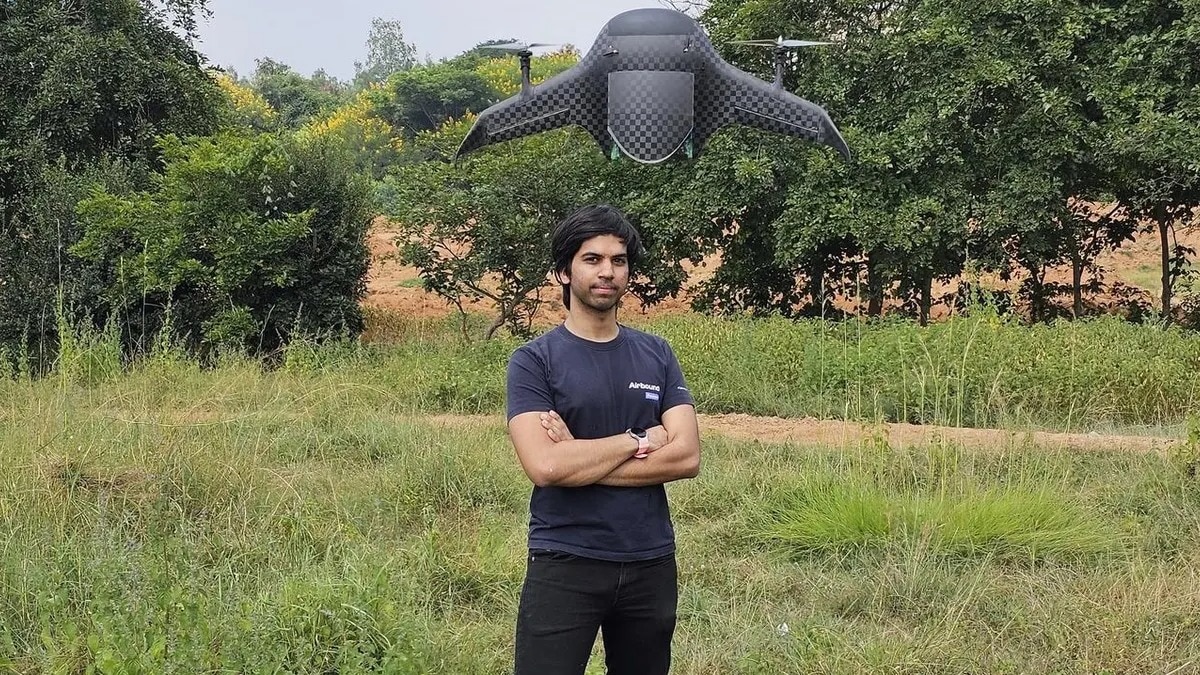
Airbound has raised $37 million in a Series A led by Greenoaks as founder Naman Pushp expands drone logistics. The journey that started with lockdown when a young boy, out of boredom, chose to build a drone is now making headlines.In 2020, at the peak of the pandemic, when schools had shut and a 15-year-old, Naman Pushp, was confined to his home, he turned to something he had been doing since childhood: building robots. His interest in drone-making began out of boredom during the lockdown.There was no grand business plan behind it. Pushp, who had grown up partly in Malaysia, was looking for something to build during the lockdown. He called the project Open Drone and took it to a hackathon. It won him $500. He put the prize money back into the project and used it to build his first serious prototype.That drone still hangs on the wall of Airbound’s office.Six years later, Pushp, now 21, is the founder and CEO of Bengaluru-based aerospace startup Airbound, which has raised $37 million in a Series A led by Greenoaks, taking the company’s total funding to nearly $50 million. The journey between the first drone and the latest funding round is also a story of a young founder learning to turn an engineering problem into a business.FROM MALAYSIA TO MUMBAIBorn in Mumbai, Naman Pushp spent parts of his childhood in Hyderabad and Malaysia before returning to India, where he completed his schooling at Dhirubhai Ambani International School in Mumbai. His interest in building things began early; while in Malaysia, he started making simple robots in Classes 5 and 6 and later took part in robotics competitions and engineering projects. By the time he reached senior school, Pushp was increasingly drawn to learning by building rather than through conventional classrooms.His LinkedIn profile says he completed Class 12 and was admitted to Carnegie Mellon University, but chose not to attend, deciding instead to pursue his own projects and eventually build Airbound.Pushp was still in school when he received his first venture cheque from GradCapital at 16. There was an unusual complication: because he was a minor, investors had to speak to his father before making the investment. He later secured admission to Carnegie Mellon University but chose not to go.Instead, he stayed with the problem he had encountered while building drones.Conventional aircraft, he realised, spend much of their energy carrying their own weight. The payload, the thing being transported, becomes secondary. That makes drone delivery difficult to compete with road transportation on cost.Airbound’s approach is to reverse that equation.Its current TRT aircraft weighs about 1.5 kg and can carry around 1 kg of cargo. It takes off vertically before transitioning to horizontal flight. The company is developing a model capable of carrying a 5 kg payload and plans to expand manufacturing.“We want to build towards a world where everything has cost parity with trucking,” Pushp has said in a post he shared on LinkedIn.The idea is no longer confined to prototypes.Airbound has completed more than 13,000 autonomous flights across Bengaluru and Guntur, including more than 1,000 flights for Narayana Health. The company now transports blood samples between a clinic and a hospital, replacing ground transport on that route.The scale of that experiment is striking. Narayana Health’s new Banashankari hospital in Bengaluru was designed without a diagnostic laboratory, relying on Airbound’s drones to move medical samples between facilities.The service currently handles as many as 20 flights a day on one clinic-to-hospital route.Pushp’s ambition is larger still. In Andhra Pradesh, Airbound plans to connect Amaravati, Vijayawada and Guntur, with a long-term target of 10,000 flights a day.The state government is helping create a network of ground observers so that private operators can use the infrastructure while keeping flights within visual line of sight.For Pushp, the next challenge is manufacturing. Airbound is betting on lightweight carbon-fibre aircraft that can be produced at scale.“100 aircraft a day will start to feel very small,” he said.It is an ambition that captures the arc of his journey: a schoolboy building a drone during lockdown, a teenager raising his first cheque, a university admission he chose to decline, and, at 21, a company trying to make drone delivery part of everyday logistics.- EndsPublished By: Rishab ChauhanPublished On: Aug 30, 2026 15:27 IST
How a Bengaluru teen turned a lockdown drone project into a $37 million startup
Full Article
Original Source
Read the full article at Indiatoday →KhanList aggregates and links to publicly available news content. We do not host full articles from third-party sources. Always verify important information with original sources.