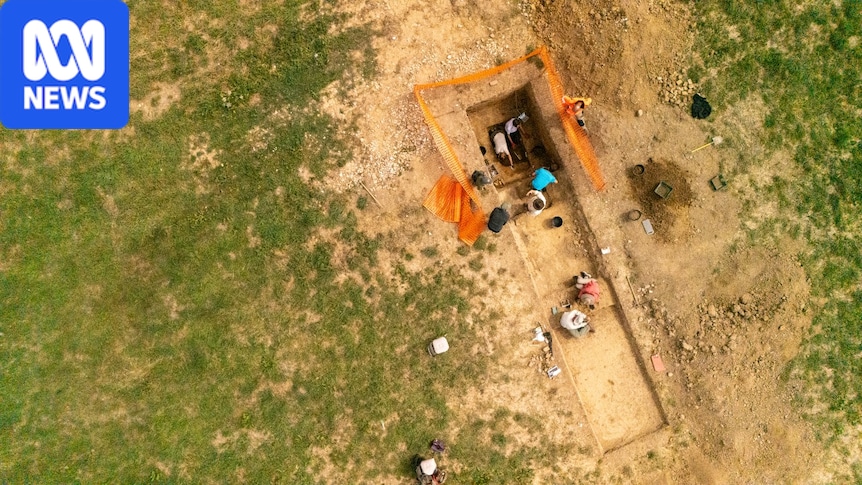
On the edge of a tiny village in northern France, a team of archaeologists is digging through ground that was fought for, and won, by the sacrifice of Australian soldiers.Warning: This story contains details some readers may find distressing.To the untrained eye, this site might look like any other paddock. But buried under the surface is evidence of a German gun battery and trench system from World War I.This is the first time it has ever been excavated. Dubbed Project Pozières, and led by a team from Flinders University, it is a rare archaeological excavation of the Somme battlefield, 110 years on.Since work began on July 12, the team has uncovered hundreds of artefacts which were buried for more than a century.Andrew Wilkinson and Leon Kelly work at the site in Pozières this week. (ABC News: Daniel Pannett)The butt of a rifle. Duckboard that formed the floor of a trench. A single button. Each find is a clue that will help these experts piece together what happened on the battlefield."That's our job as archaeologists, it's not just about counting some artefacts and telling you 'well, there were 10 shovels here, or you know, 300 shrapnel balls'. We need to make a story about who the people were," said Flinders University archaeologist and Australian armed services veteran, Dr Daryl Wesley.Many members of the 20-person international team have served themselves, including the dig's scientific director, Andrew Wilkinson."What we're finding here with the shrapnel is potentially that direct connection to what these people felt and experienced at that time," Mr Wilkinson said.It was an experience described by some as hell.Dr Daryl Wesley is a Flinders University archaeologist and Australian veteran. (ABC News: Daniel Pannett)Australia's official World War I historian Charles Bean famously wrote that Pozières ridge "is more densely sown with Australian sacrifice than any other place on Earth".In less than seven weeks of fighting, the Australian troops sustained 23,000 casualties. Of those, 6,800 men were killed.The town was obliterated, but the Australians managed to regain ground under relentless German attack."It was a slaughter. Most of the veterans didn't want to talk about it or describe it as a horror," Project Pozières historian Leon Kelly told the ABC.Leon Kelly takes part in the dig this week. (ABC News: Daniel Pannett)Journalist-turned-soldier John Alexander Raws described the conditions in a letter he wrote in August 1916, just weeks before he was killed in action."We are lousy, stinking, ragged, unshaven, sleepless. Even when we're back a bit we can't sleep for our own guns. I have one puttee, a dead man's helmet, another dead man's gas protector, a dead man's bayonet. My tunic is rotten with other men's blood and partly splattered with a comrade's brains," Mr Raws wrote.During research in the lead up to the dig, Mr Wilkinson was amazed to discover he went to the same school as Raws, one of many personal connections between the archaeologists and the men whose stories they're working to uncover.Hopes for more excavations in futureThis kind of foreign-led excavation is extremely rare in France, but Pozières locals like Yves Potard have gone out of their way to facilitate it.As the President of the historical group Franco-Australian Digger-cote 160 Association, Mr Potard has spent decades finding ways to commemorate the troops who died here."It is important that these excavations are carried out, because it will be a way to bring the diggers back to life in the memory," Mr Potard told the ABC.Pozières local Yves Potard was excited about what might be found. (ABC News: Daniel Pannett)Ever since their town was rebuilt post-WWI, the people of Pozières have prioritised remembrance — something that was on full display on the 110th anniversary of the battle's beginning.Organised by Mr Potard, dozens of residents, local dignitaries and Australian visitors gathered near the town hall as the clock ticked towards midnight, on July 23.The group made their way to the Australian first division memorial on the edge of town for a formal service, which included a speech from Michael Lee.Mr Lee's uncle Leonard was one of the diggers who died on the first day of battle. Like so many others, Leonard's body never made it home. Mr Lee has returned to Pozieres for the battle's anniversary every year, since 2016."There's a feeling that, yes, I've got to go. I've got to be there every year and remember my uncle," Mr Lee told the ABC.Archaeologists uncovered shrapnel from the dig in Pozières this week. (ABC News: Daniel Pannett)Mr Lee also expressed doubts about the need for an archaeological project in Pozières.While he understood the project's intent was to uncover artefacts, he was worried the dig might disturb the bodies of soldiers who died there."One-hundred-and-ten years these guys have been under the ground here. And I think they should just let them rest," Mr Lee said.Project Pozières archaeologist Andrew Wilkinson has been looking forawrd to the dig. (ABC News: Daniel Pannett)Dr Wesley told the ABC it was important to acknowledge that perspective."It's one of our jobs as archaeologists to understand the sensitivities of people," Dr Wesley said."We're not here to be trying to recover Australians, that's the job for the Commonwealth War Graves Commission … we're not trying to disturb where these soldiers lie."It's about understanding that battle and bringing a new dimension to that time."The dig is due to finish on July 31, but the team hopes this project opens the door to future excavations.There is a significant Australian connection to the area around Pozières, France. (ABC News: Daniel Pannett)
Hopes excavations in northern France can shed light on diggers' sacrifice
Full Article
Original Source
Read the full article at Abc →KhanList aggregates and links to publicly available news content. We do not host full articles from third-party sources. Always verify important information with original sources.