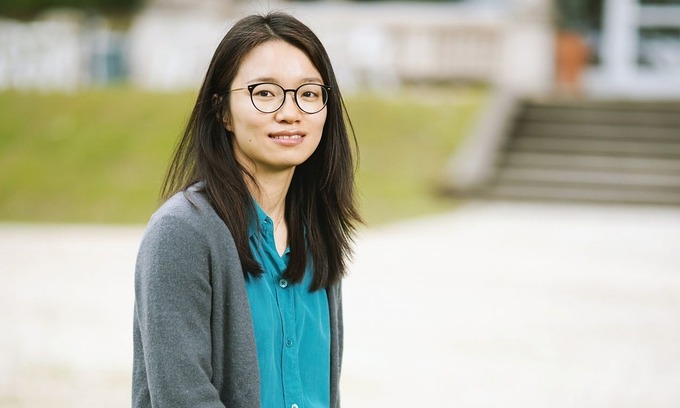
Hong Wang, who abandoned mathematics for a semester of architecture in Paris after deciding she was not good enough for research, has become the third woman to win the Fields Medal. Hiraku Nakajima, president of the International Mathematical Union and chair of the Fields Medal selection committee, presented the four medals at the Pennsylvania Convention Center in Philadelphia on July 23. The other recipients were Yu Deng of the University of Chicago, John Pardon of Stony Brook University and Jacob Tsimerman of the University of Toronto.The union cited Wang's work in harmonic analysis and geometric measure theory, including the local smoothing conjecture for the planar wave equation, Fourier restriction, Falconer distance sets, Furstenberg sets in the plane and the Kakeya problem in three dimensions.Wang is Silver Professor of Mathematics at New York University's Courant Institute and, since September 2025, a permanent professor at France's Institut des Hautes Études Scientifiques. She is the first NYU faculty member to win the Fields Medal, the university said.The medal has gone to a woman three times since it was first awarded in 1936. Maryam Mirzakhani, an Iranian mathematician at Stanford University, broke a run of 52 consecutive male recipients when she won in 2014 at 37, cited for her work on the dynamics and geometry of Riemann surfaces and their moduli spaces. She died of breast cancer in 2017, aged 40.Maryna Viazovska, a Kyiv-born number theorist at the École polytechnique fédérale de Lausanne, won in 2022, also at 37, for proving that the E8 lattice gives the densest possible packing of spheres in eight dimensions, a question open for more than 400 years.Wang and Deng are the first Chinese nationals to take the award, the South China Morning Post reported. Shing-Tung Yau and Terence Tao, who won in 1982 and 2006, are ethnic Chinese but held other citizenships at the time. Chinese mathematician Hong Wang. Photo courtesy of the Institut des Hautes Études Scientifiques (IHES) Wang was born in 1991 in Pingle County, near Guilin in Guangxi, to parents who both taught at a local secondary school, and cruised through her early academic years with comfort.She read Greek myths and Harry Potter, played table tennis and badminton, and worked through the exercises in each new textbook before term began because she wanted to, Quanta Magazine reported. She skipped two grades.She entered the School of Earth and Space Sciences, at 16, on a college entrance exam score of 653. A geophysics professor pointed out how much mathematics underpins the science, including the seismic wave analysis used to map the Earth's interior, and she was eventually allowed to transfer to the School of Mathematical Sciences.She graduated in 2011 and moved to France through a postbaccalaureate program at École Polytechnique. Her courses went well, but she did not believe she was capable of original research.So she left, switched to architecture and took an internship at a Paris firm, where the pressure of mathematics lifted and her sense of purpose went with it. She returned within the semester, having decided to stop asking whether she would be good enough.A research internship at MIT in 2013 put her in a seminar given by the analyst Larry Guth, whose explanation of his own recent proof she found clear enough to follow in part. She earned a master's degree at Université Paris-Sud in 2014, entered MIT's doctoral program the same year with Guth as her adviser and finished in 2019, then held a postdoctoral position at the Institute for Advanced Study, joined the UCLA faculty in 2021 and moved to NYU in 2023.The problem she is best known for dates to 1917, when the Japanese mathematician Soichi Kakeya asked how little area a needle needs in order to turn and point in every direction. Abram Besicovitch showed by 1928 that the area can be made arbitrarily close to zero.The modern conjecture concerns dimension rather than area, and Roy Davies proved the two-dimensional case in 1971. The three-dimensional version resisted every serious attempt for the next half century, defeating Jean Bourgain and Guth among others.Wang and Joshua Zahl, then at the University of British Columbia, posted a 127-page proof of that case in February 2025. A Kakeya set in three-dimensional space can occupy zero volume, they showed, and still have dimension exactly three."If you change it to three-dimensional complex space, the statement we proved is false," Wang told the Centre de Recerca Matemàtica, adding that most familiar tools cannot distinguish real numbers from complex ones. The proof drew on Bourgain's discretized sum-product theorem, which rules out fractal sets of real numbers approximately closed under both addition and multiplication. Hong Wang lectures on Kakeya. Photo by IHES Wang had read a 2014 blog post by Tao setting out a strategy he and Nets Katz devised but never pursued, and contacted Zahl to attempt it, Quanta reported. The work took four years.Katz has called the solution a once-in-a-century achievement in which Wang played the central role. Guth, her former adviser, has since posted two expository papers on the arXiv preprint server walking other mathematicians through the argument."The Kakeya conjecture was the first major obstacle to solving many other problems," Tao wrote in an IHES newsletter, adding that its resolution opens the restriction, Bochner-Riesz and arithmetic Kakeya conjectures.NYU mathematician Guido De Philippis said the result opens developments in harmonic analysis, number theory, computer science and cryptography, because information in those fields breaks into wave packets concentrated along thin tubes. The South China Morning Post has reported possible implications for imaging, data processing and wireless communication.The proof brought the Salem Prize, the Ostrowski Prize and the International Congress of Chinese Mathematicians Gold Medal in 2025.The Clay Mathematics Institute named Wang among four recipients of a Clay Research Award on April 14 this year, and the Breakthrough Prize Foundation announced her $100,000 New Horizons in Mathematics Prize four days later. She also won the Maryam Mirzakhani New Frontiers Prize in 2022, named for the first woman to win the medal she has now been given.The restriction and local smoothing conjectures remain open in three dimensions, as does Kakeya in four dimensions and above.
Hong Wang, third woman in 90 years to win math's highest honor, once left the field for architecture
Full Article
Original Source
Read the full article at E →KhanList aggregates and links to publicly available news content. We do not host full articles from third-party sources. Always verify important information with original sources.