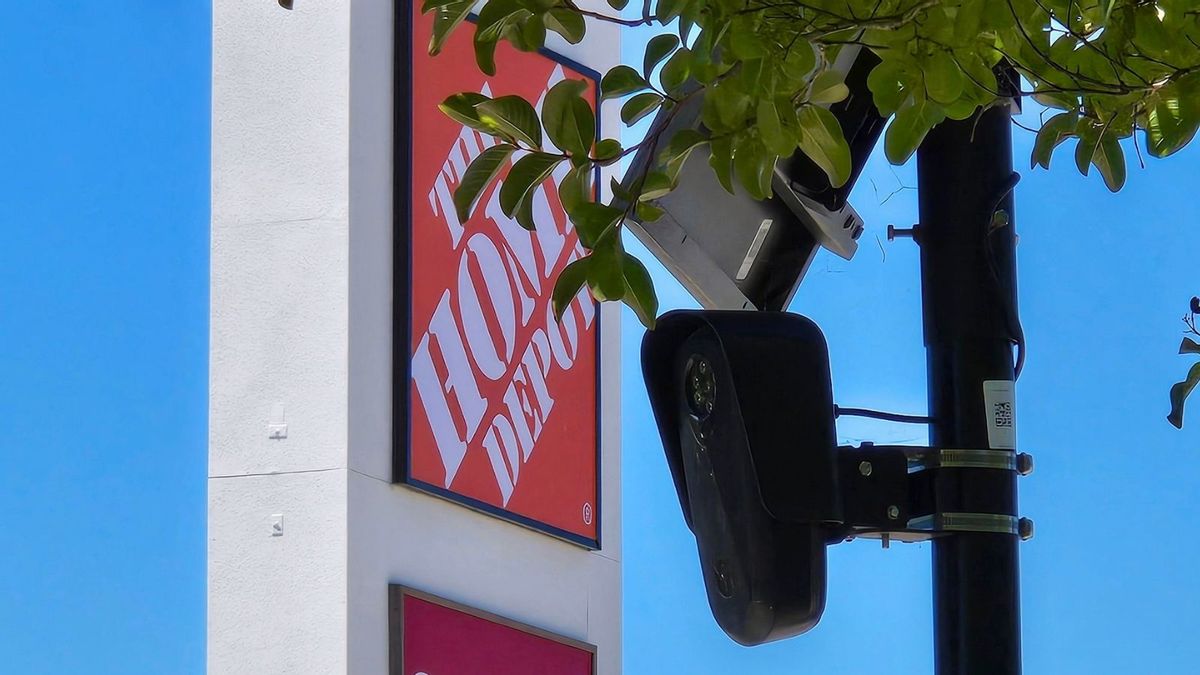
The company allegedly surveilled customers using Flock cameras and stored the information in a database accessible by law enforcement. Published July 24, 2026 Claim: An authentic class action lawsuit alleges Home Depot illegally and secretly surveilled California customers' vehicles and faces with Flock camera technology and stored that information in a database accessible by law enforcement, and argues plaintiffs and class members should receive up to $2,500 each. What's TrueA class action complaint document confirms the lawsuit is real. In April 2026, a group of California plaintiffs alleged Home Depot illegally and secretly surveilled customers' vehicles with Flock camera technology and stored that information in a database accessible by law enforcement. However ... What's False... users falsely claimed the complaint mentions the tracking of customers' faces. Flock spokesperson Paris Lewbel told Snopes by email, "Flock's products do not have facial recognition, and we have no facial recognition technology in development." Also, users inaccurately said the complaint argues for individual payments of up to $2,500. In reality, the lawsuit cites a California privacy law about people receiving a minimum — not a maximum — of $2,500. In July 2026, people claimed a class action lawsuit alleges retail chain Home Depot illegally and secretly surveilled California customers' vehicles and faces with Flock camera technology and stored that information in a database accessible by law enforcement, and argues plaintiffs and class members should receive a maximum payment of $2,500 per person. Snopes received reader mail and searches asking about the authenticity of the purported case. Flock, a U.S.-based technology company, offers products including motion-activated license plate readers that feature a surveillance camera and solar panel affixed near the top of a pole. Flock's website describes the business as "a public safety technology company that builds connected camera, audio and investigative systems to help communities respond to and investigate safety incidents using objective evidence." A view of a Flock automated license plate reader surveillance camera and solar panel. (Jordan Liles for Snopes.com) For example, on July 14, a Facebook user posted a video (archived) alleging a lawsuit claimed Home Depot customers could receive up to $2,500 after the company installed parking lot cameras to capture data such as images of customers' faces and vehicles — including automated license plate readers, or ALPRs — for sharing with law enforcement databases. In the video, the user claims in part: Home Depot is being sued and you need to hear this if you've ever shopped at Home Depot. They could owe you up to $2,500. They allegedly used technology to scan your face and your license plate anytime you went in and out of a Home Depot store. And the lawsuit claims that they collected your license plate number, your vehicle make and model. Even the color and the exact time you parked. I'm sorry but why does Home Depot need this information? So, according to this lawsuit, they was apparently sharing this information with law enforcement databases. This was of course without any of our knowledge or consent. So if you've ever shopped at Home Depot, I would stay up to date on this one if I were you. Other users shared the rumor on Facebook (archived), Instagram (archived) and TikTok (archived). One particular Instagram video (archived) received over 1 million views. Most of the popular posts ended with promotional pitches for mobile apps or websites purportedly for the tracking of potential class action settlements. In short, this rumor mixed truth with falsehoods. A class action complaint document confirmed the case truly exists. The lawsuit mentions Flock surveillance cameras tracking vehicles and license plates, and alleges that that information ended up in a database searchable by law enforcement. Contrary to social media users' claims, however, the filing says nothing about the tracking of faces. Flock spokesperson Paris Lewbel told Snopes by email, "Flock's products do not have facial recognition, and we have no facial recognition technology in development." Users also wrongly said the lawsuit mentioned maximum payments of up to $2,500. A reading of the complaint shows the plaintiffs cited a California privacy law that specifically mentions a minimum — not a maximum — of $2,500 for individuals. The ongoing nature of the case means we don't yet know the outcome of the lawsuit, including what may or may not happen in terms of potential payments. We emailed Home Depot and the plaintiffs' attorneys mentioned in the complaint to request further information about the lawsuit. We will update this article if we receive more information. The people sharing this rumor potentially confused this lawsuit with a completely separate case from 2025 alleging Home Depot used facial recognition technology in customer checkout lanes. The plaintiff in that previous filing has since dropped the case, leading to its dismissal. A Flock surveillance camera at a Home Depot store in California. (Jordan Liles for Snopes.com) Home Depot lawsuit, explained In April 2026, a group of California plaintiffs initially filed a class action complaint against Home Depot alleging the company engaged in "illegal, secretive, invasive and negligent" practices when installing Flock ALPR cameras in parking lots: America's largest home improvement retailer is running a covert surveillance operation in its parking lots. Home Depot U.S.A., Inc. and The Home Depot, Inc. operate 233 retail stores across California, more than in any other state, and have installed, primarily through their ALPR vendor Flock Group, Inc., d/b/a Flock Safety ("Flock"), at the entrances and exits of their parking lots of their California stores. These cameras capture the license plate, make, model, color and distinguishing features of every vehicle entering Home Depot's properties, log that data with precise timestamps and location information, and feed it into a centralized, searchable database accessible to law enforcement agencies across the country. The complaint cites news media outlets' reports as evidence of law enforcement accessing Flock camera data captured in Home Depot parking lots, arguing the technology "makes every shopper's vehicle data available to hundreds of law enforcement agencies simultaneously, in real time." The lawsuit mentions that in August 2025, 404 Media reported a Texas sheriff's office retained the ability to "tap into Flock license plate reading cameras at 173 different Lowe's locations around the U.S. and that it can tap into cameras and gunshot-detecting microphones at dozens of Home Depot stores in Texas." The filing also notes San Diego's KPBS publishing in November 2025 that Home Depot and Lowe's, as well as other San Diego-based establishments, reportedly provided police access to license plate reader data. The complaint highlights what plaintiffs believe is a violation of California privacy laws, including California Civil Code Section 1798.90.5, which spells out state ALPR laws over the course of six pages. For example, Section 1798.90.54 specifically mentions damages "not less than" $2,500 per individual, along with other applicable sanctions, penalties, remedies, fees or costs. That minimum $2,500 figure aligns with the amount plaintiffs argued for on a per-individual basis in their complaint. In another part of the lawsuit, plaintiffs cite concerns over the allegedly lucrative nature of the information Flock cameras capture in Home Depot parking lots, specifically mentioning data brokers, advertisers and other services. The Home Depot website's privacy policy features an ALPR section that specifically lays out information about the potential sale, sharing or transfer of Flock camera data, as well as defines the people authorized to access that information. According to CourtListener.com — a website database storing millions of legal decisions — a court clerk working the Home Depot case has scheduled an initial, public-facing case management video conference on a Zoom webinar for Aug. 10, 2026. For further reading, we previously investigated other matters involving surveillance technology. For example, one rumor claimed U.S. Immigration and Customs Enforcement agents could access Ring doorbell camera videos through the company's partnership with Flock. Sources Bagdonas, Tracy. "Class Action Lawsuit Alleges Home Depot Parking Lot Cameras Secretly Transmit Driver Data to Law Enforcement." ClassAction.org, 14 May 2026, https://www.classaction.org/news/class-action-lawsuit-alleges-home-depot-parking-lot-cameras-secretly-transmit-driver-data-to-law-enforcement."California Code, Civil Code - CIV § 1798.90.5." FindLaw.com, https://codes.findlaw.com/ca/civil-code/civ-sect-1798-90-5/."California Code, Civil Code - CIV § 1798.90.54." FindLaw.com, https://codes.findlaw.com/ca/civil-code/civ-sect-1798-90-54/.Frankel, Jillian. "Home Depot Hit with Lawsuit Over Allegations About Using Facial Recognition Technology." People.com, 22 Aug. 2025, https://people.com/the-home-depot-hit-with-lawsuit-over-allegations-facial-recognition-technology-11795671."Immigration Activity in Our Parking Lots." The Home Depot, https://corporate.homedepot.com/page/immigration-activity-our-parking-lots.Koebler, Jason. "Home Depot and Lowe's Share Data From Hundreds of AI Cameras With Cops." 404 Media, 6 Aug. 2025, https://www.404media.co/home-depot-and-lowes-share-data-from-hundreds-of-ai-cameras-with-cops/."Privacy and Security Statement." The Home Depot, https://www.homedepot.com/privacy/privacy-and-security-statement#ALPR.Rattigan, Kathryn M. "Seventh Circuit Dismisses Home Depot Facial Scan Lawsuit." National Law Review, 6 Nov. 2025, https://natlawreview.com/article/home-depot-facial-scan-lawsuit-voluntarily-dismissed-whats-next-biometric-privacy.Richards, Brandon. "Class Action Alleges Home Depot Illegally Shared California License Plate Data with Federal Agencies." Claim Depot, 9 Apr. 2026, https://www.claimdepot.com/cases/home-depot-class-action-alleges-secret-license-plate-surveillance-at-california-stores.Rodd, Scott, and Gustavo Solis. "San Diego County Police Agencies Access Many Private License Plate Readers with Minimal Oversight." KPBS Public Media, 20 Nov. 2025, https://www.kpbs.org/news/public-safety/2025/11/20/san-diego-county-police-agencies-access-many-private-license-plate-readers-with-minimal-oversight."Schmierer v. Home Depot U.S.A., Inc., 3:26-Cv-03967." Court Listener, https://www.courtlistener.com/docket/73287899/schmierer-v-home-depot-usa-inc/."Solar Powered Surveillance." Flock, https://www.flocksafety.com/blog/solar-powered-surveillance."What Is Flock? Public Safety Technology." Flock, https://www.flocksafety.com/what-is-flock."Why Was My Class Action Settlement Payout Smaller Than Expected?" Top Class Actions, 17 Nov. 2016, https://topclassactions.com/faqs/class-action-settlement-payout-smaller-expected/. By Jordan Liles Jordan Liles is a Senior Reporter who has been with Snopes since 2016. Article Tags
Home Depot parking lot surveillance class action lawsuit: What posts get right, wrong
Full Article
Original Source
Read the full article at Snopes →KhanList aggregates and links to publicly available news content. We do not host full articles from third-party sources. Always verify important information with original sources.